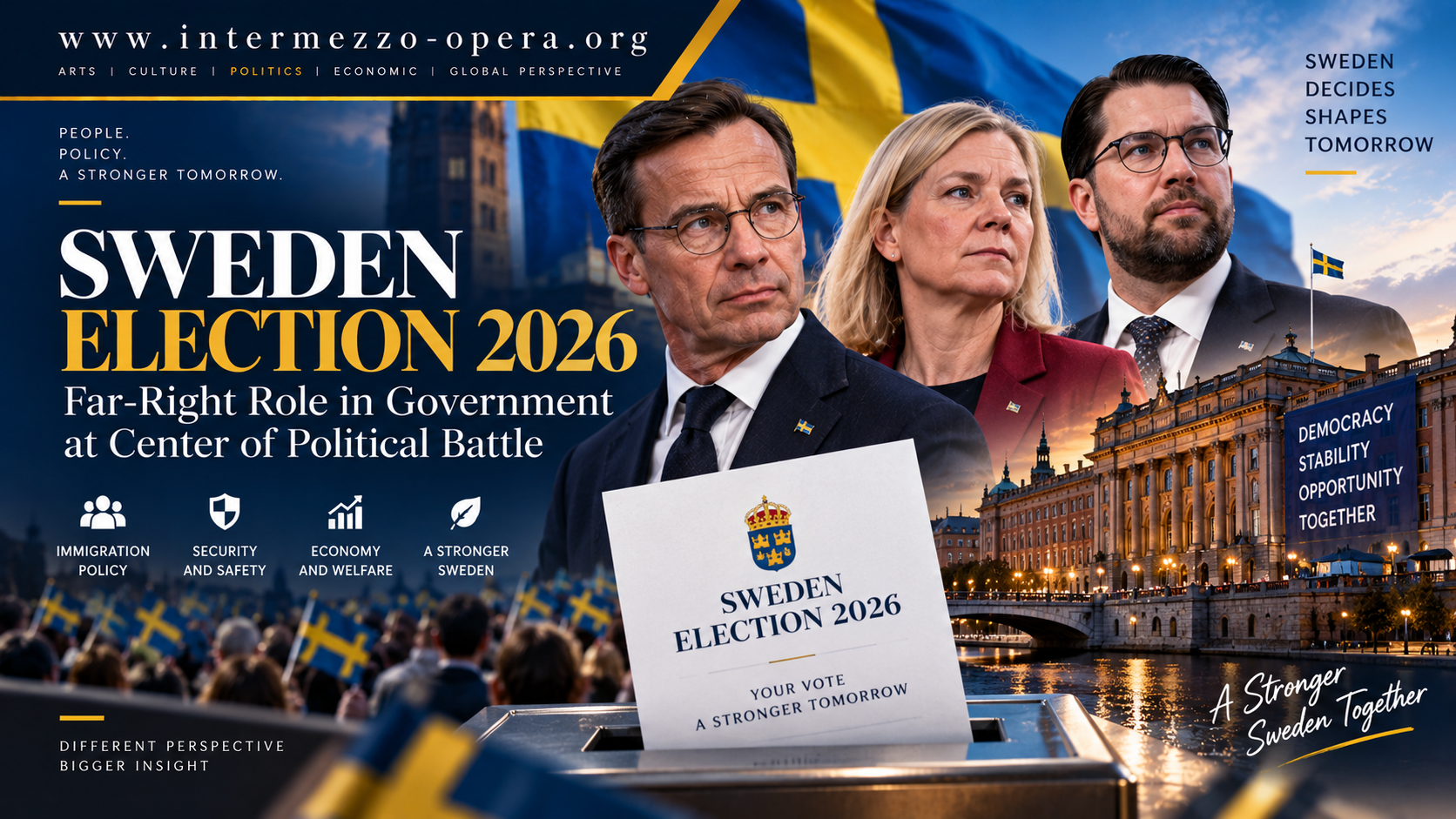
Sweden Election 2026 Puts Far-Right Role in Government at Center of Political Battle
 0
0
 0
0
Read Time:4 Minute, 7 Second
The Sweden election 2026 has become one of Europe’s most closely watched political contests as voters prepare to cast their ballots on September 13. At the center of the campaign is a question that could reshape Swedish politics: whether the Sweden Democrats should formally enter the national government for the first time.
Prime Minister Ulf Kristersson’s center-right coalition is seeking a second term. His bloc has worked closely with the Sweden Democrats since 2022, but the party has remained outside the cabinet. Kristersson now says the parties intend to build a common majority government if they secure enough parliamentary support.
Sweden Election 2026 Could Reshape the Government
The Sweden Democrats are polling at around 19%, making them an important force in the contest. The party has already influenced government policy through its parliamentary cooperation with Kristersson.
However, receiving cabinet positions would represent a significant political shift.
The Sweden Democrats emerged from Sweden’s far-right fringe and have spent years trying to distance themselves from their extremist past. In 2025, the party apologized for historical neo-Nazi and antisemitic views. Nevertheless, its possible entry into government continues to generate intense debate.
For Kristersson, closer cooperation could provide the parliamentary majority needed to govern more effectively. For critics, however, the change could move Sweden further away from its traditionally liberal political identity.
Immigration Remains a Major Political Issue
Immigration and integration have played major roles in the Sweden election 2026.
During the past four years, Sweden has tightened several immigration policies. The government abolished permanent residency for refugees, strengthened welfare requirements, increased expulsions for people without the right to remain, and introduced tougher border policies.
Asylum applications have consequently fallen to their lowest level in roughly 40 years.
Kristersson argues that the government should now put greater attention on integration. Meanwhile, the Sweden Democrats want additional measures and continue to campaign strongly around national identity, language and Swedish cultural norms.
Therefore, the election is about more than choosing a prime minister. It could determine how far Sweden continues along its new political direction.
Magdalena Andersson Leads the Center-Left Challenge
Former Prime Minister Magdalena Andersson leads the Social Democrats and hopes to return to government.
Polling cited by Reuters showed the center-left opposition maintaining a small but narrowing advantage ahead of the vote. However, winning more seats than Kristersson’s bloc would not automatically guarantee Andersson a stable government.
The Social Democrats, Greens, Left Party and Centre Party broadly support stronger welfare services and higher public investment. However, disagreements remain.
They differ over wealth taxation, nuclear energy and other economic policies. The Centre Party also refuses to participate in a government with the Left Party.
As a result, coalition negotiations could become difficult even if the opposition performs well.
Cost of Living and Security Also Matter
Immigration may dominate international attention, but Swedish voters face several other concerns.
Both major political blocs have promised stronger welfare services. They also broadly support continued assistance for Ukraine and additional defense investment.
Meanwhile, household finances remain important. Sweden has experienced pressure from food prices, energy costs and broader cost-of-living concerns.
Gang violence has also shaped the political debate. Kristersson argues that cooperation with the Sweden Democrats helped his government reduce shootings and strengthen measures against organized crime.
These issues make the election more complicated than a simple left-versus-right contest.
Sweden Reflects a Wider European Political Shift
The Sweden election 2026 is also attracting attention because similar political changes are taking place elsewhere in Europe.
Far-right and nationalist parties have gained influence in countries including Italy, Finland, Croatia and the Czech Republic. Germany has experienced another major shift after the Alternative for Germany, or AfD, achieved a historic victory in Saxony-Anhalt earlier this month.
However, the trend is not uniform across Europe. Some nationalist parties have suffered setbacks, while others have struggled after entering government.
Sweden could therefore provide another important test of whether voters are prepared to move such parties from parliamentary influence into direct executive power.
September 13 Vote Could Mark a Political Turning Point
The final result could depend on relatively small movements among undecided voters.
If Kristersson’s bloc wins enough support, Sweden Democrats leader Jimmie Åkesson could gain unprecedented influence over the next government. Formal cabinet participation would complete a political transformation that once appeared highly unlikely.
If Andersson’s opposition wins instead, Sweden could change direction again. Yet she would still face the difficult task of bringing several ideologically different parties together.
Either outcome will carry consequences beyond Stockholm.
The Sweden election 2026 has become a test of immigration policy, national identity, welfare, security and the changing boundaries of mainstream European politics. When Swedes vote on September 13, they will not only choose their next parliament. They may also decide whether a party once kept at the margins of Swedish politics is ready to take a formal place at the center of government.


Happy
0 %

Sad
0 %

Excited
0 %

Sleepy
0 %

Angry
0 %

Surprise
0 %
Related Post
Portugal Signals Case-by-Case Review of New Sanctions Against Tehran
Portugal has indicated that any new sanctions against Tehran will be evaluated on a case-by-case…