
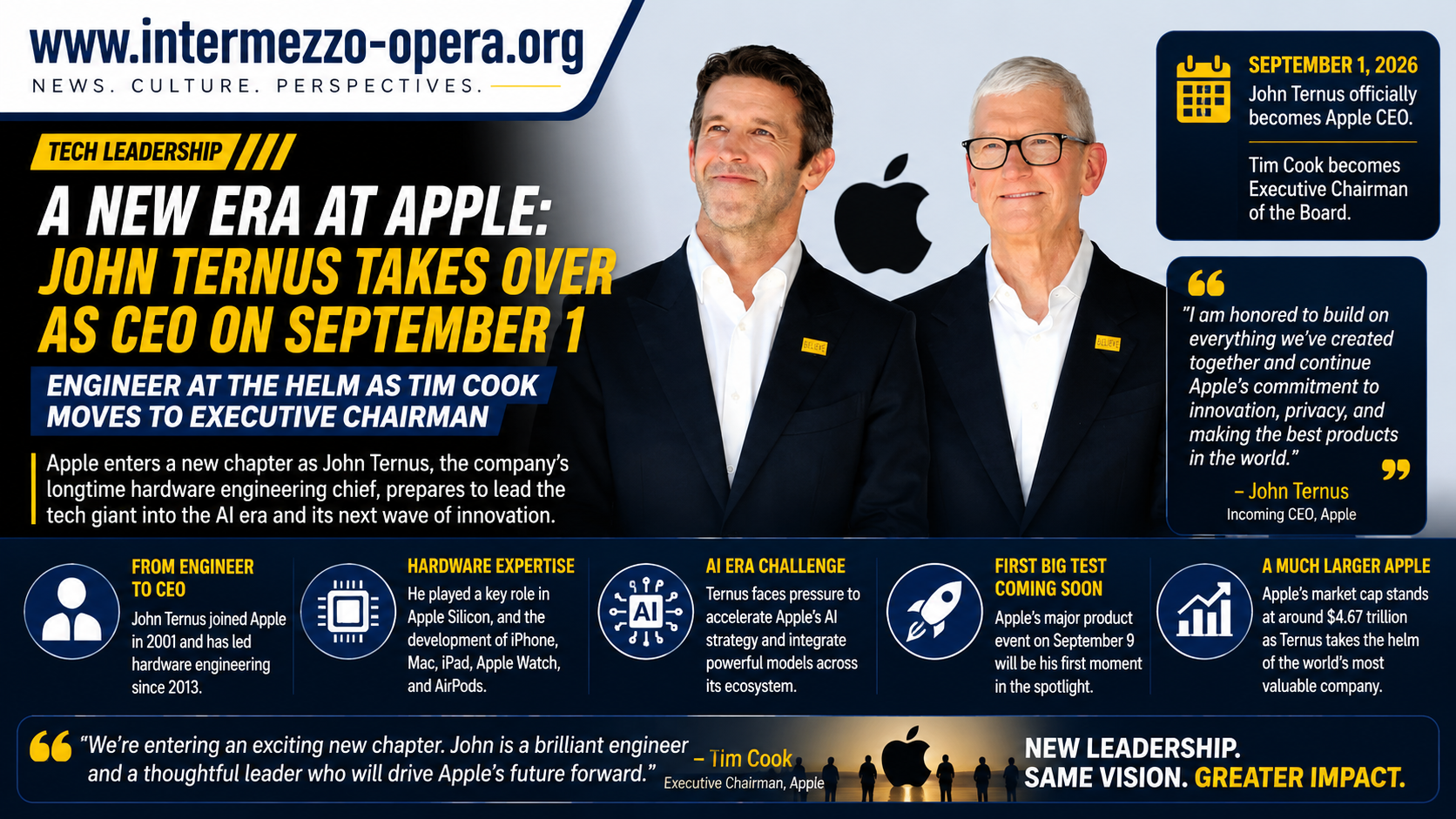
John Ternus Takes the Helm at Apple: Why His Leadership Could Bring Bigger Changes Than Expected
 0
0
 0
0
Read Time:3 Minute, 43 Second
CUPERTINO, California – Apple is entering one of the most important leadership transitions in its history as John Ternus prepares to take over as chief executive officer on September 1, 2026.
Ternus succeeds Tim Cook, who has led Apple since 2011. However, Cook is not leaving the company entirely. He will become executive chairman of Apple’s board and continue supporting selected strategic matters, including engagement with policymakers worldwide.
The transition gives Apple a leader with a notably different professional background. While Cook built his reputation around operations and supply-chain management, Ternus has spent much of his career directly involved in hardware engineering.
An Engineer Takes Control of Apple
Ternus joined Apple’s Product Design team in 2001. He became vice president of Hardware Engineering in 2013 before moving into the senior vice president role in 2021.
Over the years, his teams have worked across Apple’s major hardware categories, including the iPhone, iPad, Mac, Apple Watch and AirPods. He also played an important role during Apple’s transition from Intel processors to its own Apple Silicon chips.
His engineering background could influence how Apple approaches its next generation of products.
Apple’s board has highlighted Ternus’ technical knowledge, leadership and strong focus on product development as major reasons behind its confidence in him.
More Change Than Expected?
Although Ternus represents continuity because he has worked at Apple for roughly 25 years, his appointment could also mark a change in priorities.
Cook transformed Apple into an enormous global ecosystem built around hardware, services and recurring revenue. Ternus now inherits that system at a time when the technology industry is rapidly shifting toward artificial intelligence.
That creates pressure for Apple to accelerate innovation while protecting the highly profitable businesses built during Cook’s tenure.
Industry observers will therefore watch whether Ternus places greater emphasis on ambitious hardware projects, tighter integration between devices and AI, and new product categories.
Artificial Intelligence Becomes a Major Test
Artificial intelligence represents one of Ternus’ biggest challenges.
Competitors have invested heavily in generative AI, while Apple has taken a more measured approach. As a result, Ternus will face pressure to demonstrate how Apple can use its enormous ecosystem to compete in the AI era.
Apple nevertheless possesses an important advantage: its control over both hardware and software.
Its custom chips can increasingly handle sophisticated AI workloads directly on devices. The company can also distribute new capabilities across a massive installed base of iPhones, Macs, iPads and other products.
Ternus’ hardware expertise could become particularly valuable as Apple tries to combine AI models, custom silicon and consumer devices more closely.
First Major Product Test Arrives Quickly
Ternus will have little time to settle into his new position.
Apple is expected to hold a major product event on September 9, only eight days after he takes control. The event could therefore provide an early indication of how Apple presents itself under its new CEO.
Among the products attracting attention is Apple’s anticipated first foldable iPhone, although the company’s final announcements will determine exactly what reaches the stage.
The timing places Ternus immediately in the spotlight.
Tim Cook Leaves Behind a Much Larger Apple
Ternus also inherits a dramatically larger company than the one Cook took over from Steve Jobs in 2011.
During Cook’s tenure, Apple expanded its product ecosystem with the Apple Watch, AirPods and Vision Pro. It also developed businesses including Apple Music, Apple TV+, Apple Pay and other services.
At the same time, Apple moved the Mac toward its own processors and strengthened its control over crucial hardware technologies.
Apple’s market capitalization stood at roughly $4.67 trillion on August 28, 2026, according to recent market reporting.
Ternus Faces a Different Apple Era
Despite Apple’s financial strength, Ternus faces challenges that differ significantly from those Cook encountered in 2011.
AI competition is accelerating. Component costs and supply constraints remain important concerns, while Apple continues to navigate regulatory pressure and its significant manufacturing exposure to China.
At the same time, Ternus has an opportunity to place product engineering back at the center of Apple’s next chapter.
His appointment therefore does not necessarily signal a dramatic break with the Cook era. Instead, it could combine Apple’s existing operational strength with a stronger engineering and product-development focus.
Starting September 1, 2026, the technology world will begin to see whether John Ternus chooses continuity—or brings more change to Apple than many initially expected.


Happy
0 %

Sad
0 %

Excited
0 %

Sleepy
0 %

Angry
0 %

Surprise
0 %
Related Post

How the Iran war may affect your money and bills
As the Iran war continues to unfold, its economic impact is no longer confined to…