Eurozone Economy Faces a New Test as Inflation Climbs Above 3%
 0
0
 0
0
Read Time:5 Minute, 15 Second
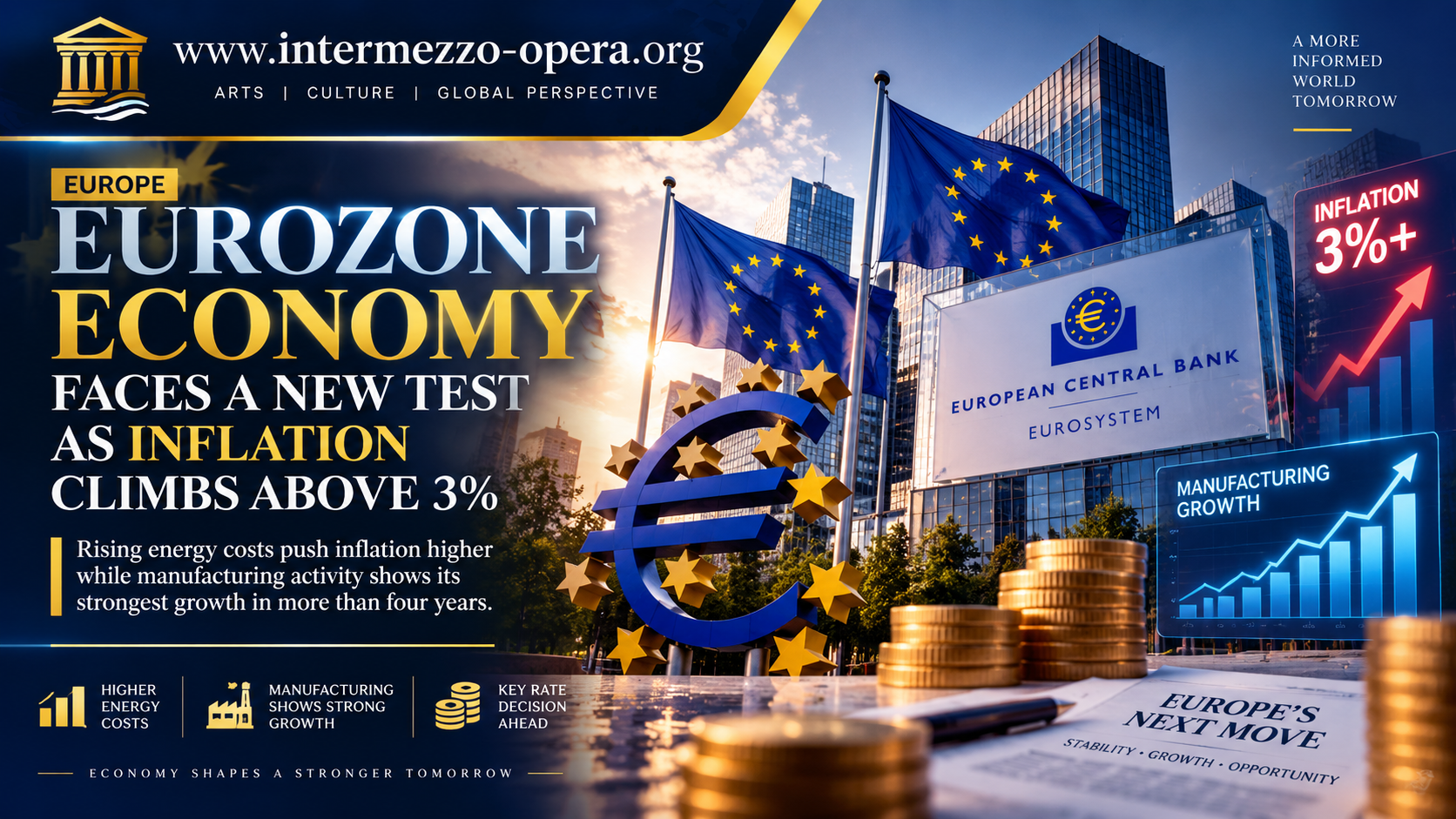
The Eurozone economy is entering another delicate period as inflation rises above 3% while manufacturing activity shows its strongest expansion in more than four years. The combination presents European policymakers with an unusual challenge: controlling renewed price pressures without undermining an emerging industrial recovery.
Eurostat data reported on September 1 showed that euro-area inflation climbed above 3% in August 2026, driven primarily by higher energy costs. The increase has strengthened expectations that the European Central Bank could raise interest rates again at its September meeting.
At the same time, European factories are showing unexpectedly strong momentum. The eurozone manufacturing Purchasing Managers’ Index rose to 52.7 in August from 51.9 in July, reaching its highest level since May 2022.
Eurozone Economy Confronts Renewed Inflation
Inflation has once again become one of Europe’s most important economic concerns.
The latest increase is different from the inflation surge that followed the pandemic. According to analysis from the European Central Bank, the current acceleration is dominated by an energy supply shock rather than unusually strong consumer demand or government stimulus.
That distinction matters.
When inflation comes primarily from excessive demand, higher interest rates can cool spending and borrowing. Energy-driven inflation is more complicated because monetary policy cannot directly create additional oil, gas or electricity supplies.
Nevertheless, persistent energy inflation can eventually spread into transportation, food, services and wages.
Energy Prices Put Europe Under Pressure
Europe remains particularly sensitive to changes in global energy markets.
Escalating geopolitical tensions have pushed energy prices higher and created new uncertainty over supply. These developments have contributed to the latest inflation increase and complicated the economic outlook.
The ECB’s June projections already anticipated headline inflation averaging 3.0% in 2026, compared with its medium-term target of 2%. The central bank projected economic growth of only 0.8% for 2026 under its baseline scenario.
This creates a difficult balance between price stability and economic growth.
ECB Faces Another Interest Rate Decision
Attention is now turning toward Frankfurt.
The European Central Bank raised its three key interest rates by 25 basis points in June, taking the deposit facility rate to 2.25%, the main refinancing rate to 2.40% and the marginal lending facility rate to 2.65%.
August’s inflation increase has strengthened market expectations of another rate hike.
Reuters reported that financial markets had fully priced in a September increase after inflation moved above 3%.
Some economists are already looking beyond September.
J.P. Morgan and BNP Paribas now expect another 25-basis-point increase in December as elevated energy prices continue to create inflation risks.
European Factories Deliver a Positive Surprise
There is, however, another side to the European economic story.
Manufacturing activity has improved significantly.
The eurozone manufacturing PMI reached 52.7 in August, comfortably above the 50-point level separating expansion from contraction. It was the strongest reading in more than four years.
New orders recorded their strongest increase since early 2022, while factory output continued to expand at a robust pace.
For an economy that has struggled with weak industrial activity, particularly following energy disruptions and slower global demand, the figures offer an encouraging signal.
Germany and France Help Drive Recovery
Europe’s two largest economies played an important role in the improvement.
Manufacturing conditions strengthened in Germany and France, helping lift the broader eurozone index.
Germany’s industrial sector has faced considerable difficulties in recent years, ranging from expensive energy to weaker export demand and increasing international competition.
A sustained manufacturing recovery could therefore have consequences well beyond Germany.
Industrial supply chains connect German factories with businesses across Central and Eastern Europe, France, Italy, the Netherlands and other EU economies.
But Not Every European Economy Is Recovering
The recovery remains uneven.
While Germany and France contributed to stronger regional manufacturing figures, Italy and Spain experienced contraction in August.
That divergence illustrates one of the long-standing challenges facing the Eurozone economy.
The countries share a currency and common monetary policy, yet their economic structures can differ significantly.
An interest-rate level appropriate for a rapidly expanding economy may be uncomfortable for another country experiencing weak investment or industrial contraction.
Bond Markets Are Sending a Warning
Financial markets have reacted to renewed inflation concerns.
European government bond yields rose sharply during the opening days of September, while major stock indexes came under pressure.
The STOXX 600 fell to a one-month low on September 1 as investors responded to higher inflation and rising borrowing costs. Germany’s and France’s 30-year government bond yields reached their highest levels in more than a decade.
Higher bond yields ultimately matter far beyond financial markets.
They can influence mortgage rates, corporate borrowing, government financing costs and investment decisions.
European Stocks Feel the Pressure
Equities have also reflected investor uncertainty.
European stocks declined as markets reassessed the possibility that interest rates may remain elevated for longer than previously anticipated.
Energy companies benefited from higher commodity prices, but industries sensitive to borrowing costs faced greater pressure.
Markets subsequently recovered somewhat as bond yields eased, although investors remained cautious ahead of major economic data and the ECB’s next policy decision.
Europe Is Caught Between Growth and Inflation
The broader picture is unusually complex.
Europe finally appears to be seeing stronger industrial activity, yet that improvement is arriving at the same time as renewed inflation.
If the ECB raises rates too aggressively, borrowing and investment could weaken.
If policymakers move too slowly and inflation becomes entrenched, restoring price stability later could require even tighter monetary policy.
This is precisely why the source of inflation matters.
The ECB argues that today’s price pressures are more heavily influenced by energy supply than during the pandemic-era inflation surge.
A Crucial Autumn for the European Economy
The coming months could determine whether Europe’s manufacturing rebound develops into a broader recovery.
Stronger factory orders provide reasons for optimism. But expensive energy, elevated borrowing costs and geopolitical uncertainty remain significant obstacles.
The ECB’s next decisions will therefore be watched not only by investors but also by businesses and households throughout the continent.
Europe has entered the autumn with an economy displaying two contrasting signals: factories are accelerating while inflation is climbing again.
Whether policymakers can preserve the first without allowing the second to become entrenched may become one of the defining economic questions for Europe heading into 2027.


Happy
0 %

Sad
0 %

Excited
0 %

Sleepy
0 %

Angry
0 %

Surprise
0 %
Related Post

Vineyard Uprooting Divides Douro Wine Sector as Producers Seek Deal to End Crisis
The Douro wine crisis is entering another difficult phase as disagreements over vineyard uprooting complicate…