Paraguay’s Economy Grows, but Peña Faces Criticism Three Years Into His Presidency
 0
0
 0
0
Read Time:5 Minute, 19 Second
ASUNCIÓN – President Santiago Peña’s economic management is facing renewed scrutiny as his administration marks three years in office. Paraguay has posted strong economic figures, but concerns remain over whether that growth is improving conditions across the wider economy.
Peña took office on August 15, 2023. Therefore, August 2026 marks the completion of his third year as president of Paraguay. His five-year term is scheduled to continue until 2028.
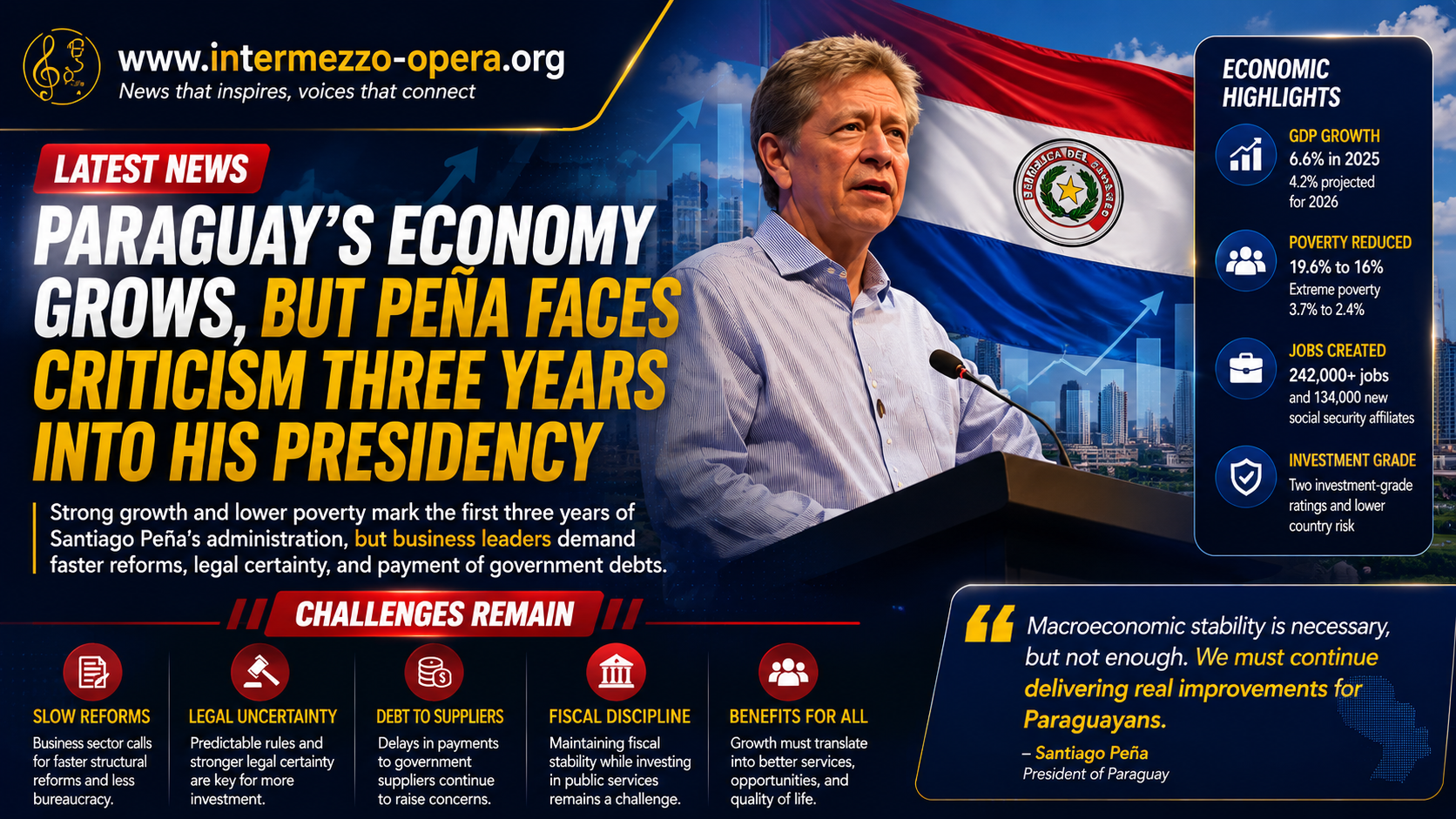
Official figures show significant economic progress during that period. Paraguay’s economy grew by 6.6% in 2025, while the government projects growth of 4.2% in 2026.
However, business groups have argued that strong macroeconomic indicators are not enough. They want faster reforms, less bureaucracy and stronger legal certainty.
Peña Highlights Paraguay’s Economic Growth
Peña has repeatedly defended his administration’s economic record.
During his third annual report to Congress, the president highlighted Paraguay’s sustained economic expansion. The country is expected to complete four consecutive years of growth above 4% if the 2026 projection is achieved.
The government has also highlighted improvements in foreign investment and sovereign risk.
In addition, Paraguay obtained a second investment-grade rating. The government reported a country risk level of 99 basis points and projected GDP per capita above US$9,000.
These indicators have strengthened Paraguay’s economic profile.
Nevertheless, the debate now focuses on whether those achievements are reaching households and businesses quickly enough.
Peña Admits Progress Is Still Not Enough
Interestingly, Peña himself has acknowledged that the government still has significant work ahead.
During his report to Congress, he said he was not satisfied with the progress achieved during his first three years.
The president acknowledged continuing challenges in areas such as health and education. He also said his ministers needed to deliver more results.
Therefore, even the government’s assessment includes an element of self-criticism.
Peña has argued that macroeconomic stability is essential. However, he has also acknowledged that stability alone does not automatically improve people’s quality of life.
Poverty Falls During Peña’s Presidency
Poverty figures are among the indicators highlighted by the administration.
According to figures presented by Peña, Paraguay’s total poverty rate declined from 19.6% to 16%. Extreme poverty also fell from 3.7% to 2.4%.
The president said more than 493,000 people moved out of poverty between 2022 and 2025.
Moreover, around 180,000 people moved out of extreme poverty during the same period.
Employment figures have also improved.
More than 242,000 jobs have been created during the first half of Peña’s mandate, according to the government’s third management report. In addition, 134,000 workers were incorporated into the Social Security Institute.
These numbers support the government’s argument that economic expansion has produced social benefits.
However, critics continue to question whether improvements are broad enough.
Business Leaders Demand Faster Reforms
Paraguay’s private sector has recognized some of the government’s achievements.
At the same time, business representatives have called for faster structural reforms during the second half of Peña’s presidency.
Business leaders have specifically highlighted bureaucracy and legal uncertainty as obstacles that still need attention.
These issues can directly affect investment decisions.
For example, companies generally require predictable regulations before committing capital to long-term projects.
Therefore, reducing administrative barriers could help Paraguay convert its macroeconomic strength into additional private investment.
Government Debt to Suppliers Raises Concerns
Another source of criticism involves payments to government suppliers.
Business groups have complained about delays affecting companies that provide goods and services to the state. The construction sector has been among those raising concerns.
Peña has acknowledged the problem.
He linked some payment delays to weaker tax revenues and lower customs collections. Currency movements also affected government finances.
Consequently, the issue has created a contrast between Paraguay’s strong headline economic indicators and the financial difficulties reported by some government contractors.
Resolving those payment delays could become an important challenge for the administration.
Fiscal Discipline Remains a Priority
Fiscal policy is another important part of Santiago Peña’s economic management.
Paraguay’s 2026 national budget totals approximately 149.6 trillion guaraníes.
The budget prioritizes health, education, security and social protection. Moreover, it follows the government’s fiscal convergence plan and establishes a maximum fiscal deficit of 1.5%.
Maintaining that discipline is important for investor confidence.
However, the government also needs to finance public services and infrastructure.
Therefore, Peña faces the challenge of maintaining fiscal stability while responding to social and economic demands.
Investment Grade Strengthens Paraguay’s Position
One of the administration’s biggest economic achievements has been Paraguay’s improved credit profile.
Moody’s granted Paraguay investment-grade status in July 2024. Later, Standard & Poor’s provided the country with a second investment-grade rating in December 2025.
Investment grade can make a country more attractive to international investors.
It may also improve access to international financing.
In addition, lower sovereign risk can reduce borrowing costs over time.
For Peña, these developments support the argument that Paraguay’s economic fundamentals have strengthened during his presidency.
Economic Growth Must Reach More Paraguayans
Strong GDP growth does not automatically mean every household experiences the same improvement.
Peña has acknowledged this challenge himself.
In May, he said Paraguay’s macroeconomic stability was necessary but insufficient to improve quality of life. He pointed to falling poverty as progress while admitting the country remained far from its ultimate development goals.
That distinction is important.
GDP measures overall economic activity. However, household income, employment quality, public services and living costs determine how economic progress feels to ordinary citizens.
Therefore, the next stage of Peña’s presidency may be judged less by headline growth and more by how those gains translate into everyday improvements.
Peña Enters a Crucial Stage of His Presidency
After three years in office, Santiago Peña’s economic management presents a mixed picture.
On one side, Paraguay has achieved strong GDP growth, lower poverty, improved employment indicators and two investment-grade ratings.
On the other side, challenges remain.
Business groups want faster reforms and greater legal certainty. Government suppliers have complained about payment delays. Meanwhile, improvements in health, education and other public services remain important demands.
As a result, the debate is no longer simply about whether Paraguay is growing.
The bigger question is whether the Peña administration can transform strong macroeconomic numbers into sustainable improvements for businesses and households.
With two years remaining in his five-year term, that challenge is likely to define the next stage of his presidency.


Happy
0 %

Sad
0 %

Excited
0 %

Sleepy
0 %

Angry
0 %

Surprise
0 %
Related Post

Authorities Launch Enforcement Operation After Reports of Excessive Bus Fares in Durán
Authorities Respond to Complaints About Bus Fares in Durán Transportation authorities have launched enforcement operations…