
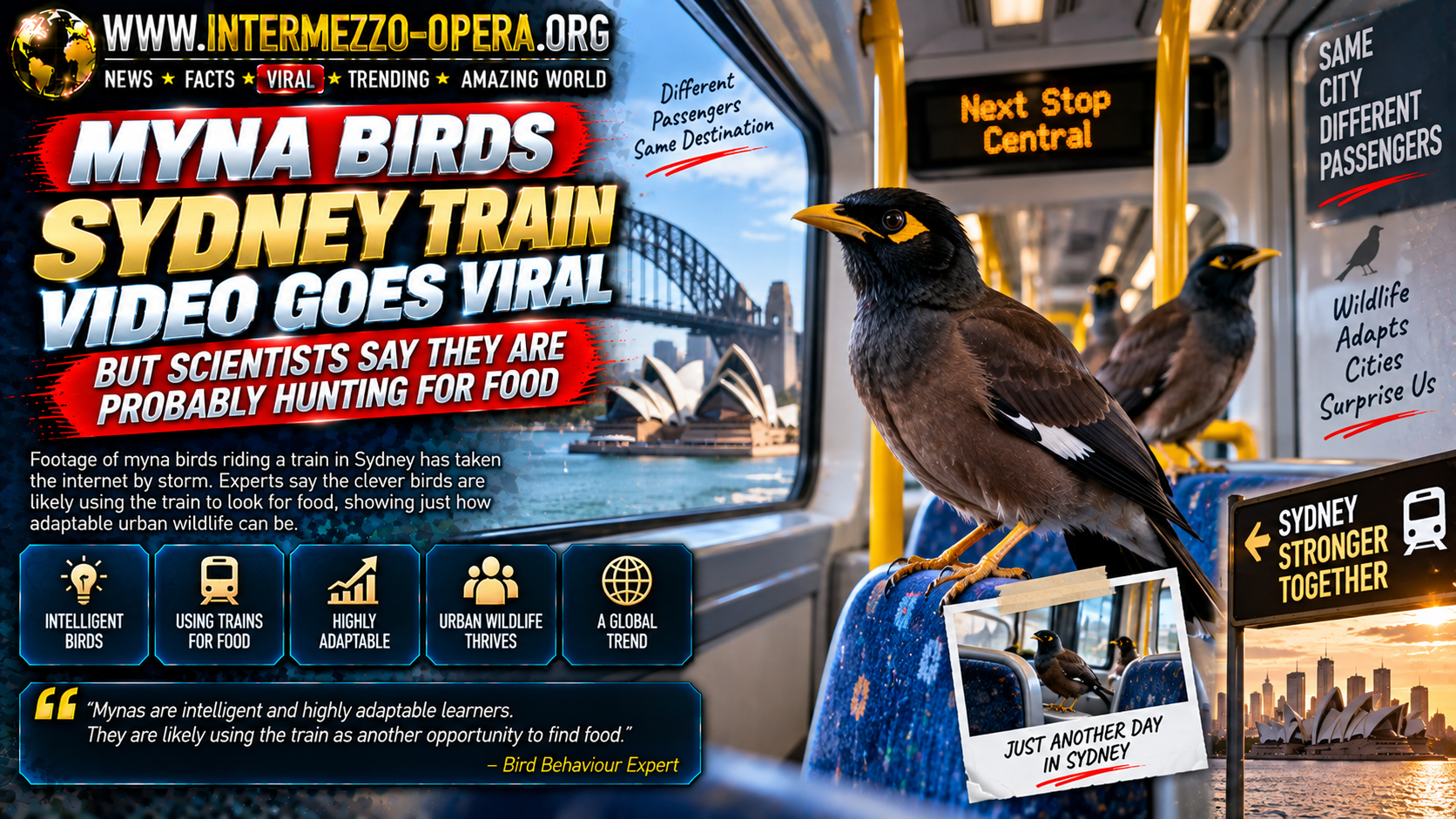
Myna Birds Sydney Train Video Goes Viral, but Scientists Say They Are Probably Hunting for Food
 0
0
 0
0
Read Time:6 Minute, 42 Second
The myna birds Sydney train video has become an unusual example of how quickly urban wildlife can adapt to human environments. Footage from Sydney, Australia, shows myna birds apparently riding an inner-city train, creating the amusing impression that the birds had learned to use public transport simply for the experience.
The viral interpretation may be entertaining, but bird experts have offered a more practical explanation. Mynas are highly adaptable learners, and the birds were probably using the train as another opportunity to find food rather than taking a recreational “joyride.”
The episode highlights something increasingly visible in major cities around the world: animals are learning how to exploit infrastructure originally designed entirely for humans.
Myna Birds Sydney Train Video Captures Attention
Seeing a bird inside a train is not necessarily extraordinary.
What made this footage unusual was the apparent confidence of the birds.
Rather than immediately panicking or desperately attempting to escape, the mynas appeared comfortable enough in the railway environment to make observers wonder whether they understood what they were doing.
The behaviour quickly attracted attention because it looked remarkably human.
People board trains to move between locations. Seeing birds apparently doing something similar naturally creates an irresistible story.
But animal behaviour rarely needs such a complicated explanation.
They Probably Were Not Taking a Joyride
Experts have cautioned against interpreting the birds’ behaviour as recreational train travel.
The more likely motivation is food.
Urban mynas regularly exploit human food sources and are extremely good at noticing opportunities.
Train stations provide plenty of them.
Passengers drop crumbs, leave food behind and carry meals through stations. Platforms and carriages therefore represent potential feeding environments.
If a bird discovers that entering a train sometimes produces a food reward, it may repeat the behaviour.
Mynas Are Remarkably Good Learners
This is where the myna birds Sydney train story becomes scientifically interesting.
Mynas are intelligent and highly adaptable birds.
They can observe environmental patterns and adjust their behaviour according to opportunities around them.
That ability is particularly valuable in cities.
Urban environments change constantly. Vehicles move, crowds appear and disappear, buildings replace natural habitats, and food sources can become available for only short periods.
Animals that cannot adjust may struggle.
Animals capable of learning quickly can thrive.
Mynas fall firmly into the second category.
Public Transport Becomes Part of Their Habitat
Humans usually think of railway networks as separate from nature.
Animals do not necessarily recognize that distinction.
To a bird, a railway station may simply be another landscape containing elevated structures, shelter, people and food.
A train carriage is unusual only until entering one produces a useful result.
Once animals learn that human infrastructure offers resources, those structures can effectively become extensions of their habitat.
This has happened with many urban species.
Pigeons use buildings like artificial cliffs.
Foxes search household rubbish.
Monkeys raid tourist areas.
Gulls exploit outdoor restaurants.
Now, Sydney’s mynas appear capable of adding trains to their list of potential feeding opportunities.
Food Is a Powerful Teacher
Learning does not require formal instruction.
Suppose a myna accidentally enters a carriage and finds food.
The bird receives an immediate reward.
If it later encounters the same situation, repeating the behaviour becomes worthwhile.
Over time, repeated experiences can create surprisingly sophisticated patterns.
This is one reason urban wildlife can appear to understand human systems much better than expected.
The animals do not necessarily comprehend the infrastructure in the same conceptual way humans do.
They simply learn which actions generate useful outcomes.
Could They Understand Where the Train Goes?
That remains a much more difficult question.
A viral video showing birds riding a train does not prove they understand railway routes, station sequences or destinations.
Researchers would need systematic observations to demonstrate that.
For example, scientists could investigate whether individual birds repeatedly board at one station and leave at another specific location.
They could also determine whether birds alter their behaviour according to train direction or destination.
Without evidence of that kind, claims that Sydney’s mynas have mastered public transportation would go far beyond what the footage demonstrates.
Urban Animals Are Becoming Better Problem Solvers
Cities create unusual evolutionary and behavioural challenges.
Animals encounter glass buildings, traffic, artificial lighting, garbage containers, automated doors and countless other structures that do not exist in natural environments.
Yet some species have become remarkably successful at navigating these obstacles.
Researchers studying urban ecology increasingly examine how animals change their behaviour in response to cities.
Flexibility can provide a major advantage.
An animal capable of experimenting with unfamiliar objects may discover new food or shelter.
A more cautious species may never exploit the same opportunity.
Humans Accidentally Train Wildlife
People also play an important role.
Every discarded sandwich, overflowing rubbish bin or unattended plate provides information to animals.
Wildlife learns where food appears.
If people repeatedly eat at a particular railway station, birds can learn when crowds arrive and where scraps accumulate.
That creates a feedback loop.
Humans create predictable resources.
Animals discover them.
Successful animals repeat the behaviour.
Other individuals may then observe what works.
Over time, behaviour that initially looks extraordinary can become routine.
Could Other Birds Copy Them?
Possibly, although the viral footage alone cannot demonstrate cultural transmission.
Social animals can sometimes learn by watching others.
If one bird repeatedly obtains food after entering trains, nearby birds may eventually investigate the same opportunity.
Scientists would need longer observations to determine whether Sydney mynas are independently discovering trains or whether the behaviour is spreading socially.
That distinction would make the story even more interesting.
A single clever bird is one thing.
A learned behaviour spreading through an urban population would be another.
The Train Could Also Be Dangerous
Adaptation to human infrastructure is not automatically beneficial.
A railway environment contains serious risks.
Birds can become trapped inside vehicles, separated from familiar territory or exposed to collisions and other hazards.
Food obtained from humans may also be nutritionally poor.
So although using trains may demonstrate behavioural flexibility, it does not necessarily mean public transport is good habitat for wildlife.
Urban adaptation often involves balancing new opportunities against new dangers.
Why This Story Became Viral
The myna birds Sydney train footage works perfectly as a viral story because it reverses expectations.
Humans expect birds to fly.
Humans expect people to ride trains.
When birds apparently choose the second option, the scene immediately looks absurd.
It also encourages anthropomorphism—the tendency to interpret animal behaviour through human motivations.
A passenger sees a bird calmly standing inside a train and thinks: perhaps it wants to travel somewhere.
The scientific interpretation is less romantic but arguably more fascinating.
The bird may have learned that an enormous machine built by humans provides access to valuable resources.
Cities Are Giant Animal Experiments
Modern cities can be viewed as enormous accidental experiments in animal behaviour.
Every species entering an urban environment faces unfamiliar problems.
Some disappear.
Others adapt.
A smaller group becomes exceptionally successful.
Mynas belong to a category of birds capable of exploiting environments heavily modified by humans.
Their success demonstrates that intelligence in nature is not always about solving puzzles in laboratories.
Sometimes it means recognizing that humans regularly leave food inside a giant metal box that happens to move between railway stations.
Myna Birds Sydney Train Story Shows Urban Intelligence
The myna birds Sydney train video may look like a group of birds taking public transport for fun, but the available evidence points toward a simpler explanation.
Experts say the mynas are likely searching for food rather than enjoying a recreational train ride.
That does not make the behaviour less remarkable.
Instead, it demonstrates how rapidly intelligent urban wildlife can incorporate human infrastructure into everyday survival strategies.
A train was designed to transport people across Sydney.
To a clever bird, however, it can become something entirely different: a moving landscape filled with passengers, crumbs and new opportunities.
And that may be the most interesting part of the viral footage.
The mynas do not need to understand what a train is.
They only need to understand that sometimes, getting aboard pays off.


Happy
0 %

Sad
0 %

Excited
0 %

Sleepy
0 %

Angry
0 %

Surprise
0 %
Related Post

Spanish Troops in Ceuta and Melilla Raise Concerns Over Long Working Hours and Living Conditions
Spanish Troops in Ceuta and Melilla Speak Out Over Working Conditions Spanish military personnel deployed…