
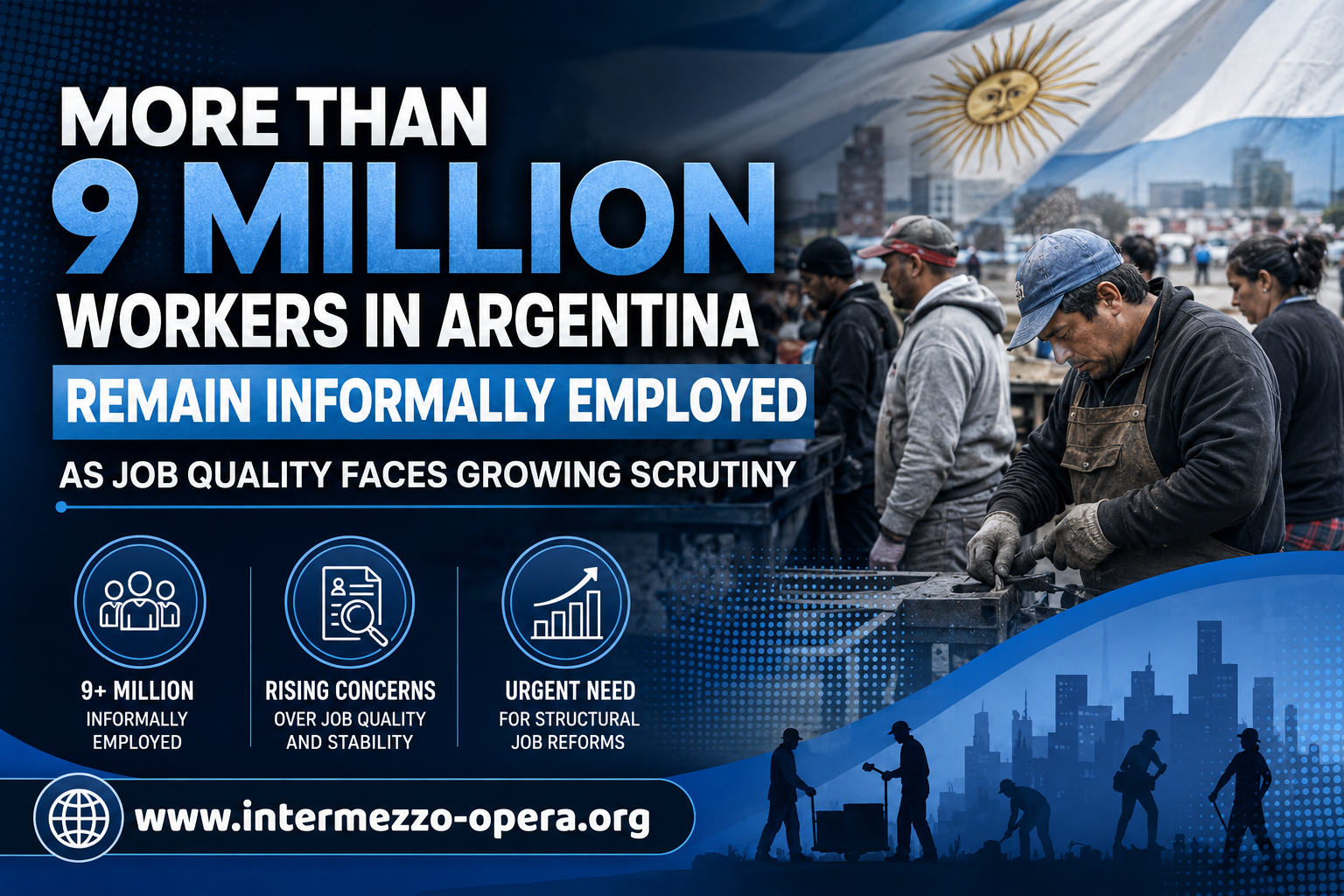
More Than 9 Million Workers in Argentina Remain Informally Employed as Job Quality Faces Growing Scrutiny
 0
0
 0
0
Read Time:1 Minute, 44 Second
Informal employment in Argentina has once again become a major concern after the latest labor data revealed that more than nine million people are working without formal employment status. Although the country’s unemployment rate has remained relatively stable, economists argue that the real issue lies in the quality of available jobs. According to data released by Argentina’s National Institute of Statistics and Census (INDEC), approximately 44.4 percent of employed workers remain in the informal economy, leaving millions without access to social security, pension benefits, paid leave, or other legal labor protections.
Job Quality Emerges as a Key Labor Market Challenge
Experts emphasize that Argentina’s labor market should not only be evaluated by the number of people who are employed but also by the quality and stability of those jobs. A significant share of workers continue to earn their income through informal employment, where labor contracts and employment protections are often absent. Young workers and women are among the groups most affected by informal employment, highlighting that economic recovery has yet to translate into stronger and more secure job opportunities across the country.
Informal Employment Continues to Dominate Several Sectors
Informal employment in Argentina spans a wide range of industries, including retail, services, construction, transportation, and self-employment. Workers in these sectors typically do not receive health insurance, retirement contributions, workplace accident coverage, or other employment-related benefits. As a result, millions of households remain financially vulnerable during periods of economic uncertainty or declining business activity. While official figures indicate slight improvements compared to previous years, labor informality remains one of Argentina’s most persistent structural economic challenges.
Government Faces Pressure to Expand Formal Employment
The Argentine government continues implementing economic reforms aimed at encouraging investment, boosting productivity, and creating more formal employment opportunities. However, labor analysts believe these reforms will require time before producing measurable improvements in employment quality. Current labor market data indicate that millions of Argentinians still rely on informal work as their primary source of income, making the expansion of formal employment one of the country’s most important economic priorities in the years ahead.


Happy
0 %

Sad
0 %

Excited
0 %

Sleepy
0 %

Angry
0 %

Surprise
0 %
Related Post

How the Iran war may affect your money and bills
As the Iran war continues to unfold, its economic impact is no longer confined to…