Global Politics in 2026: Why Trust, Institutions, and Public Participation Matter
 0
 0
Read Time:6 Minute, 32 Second
Global politics in 2026 is being shaped by a difficult combination of economic pressure, geopolitical tension, technological change, and declining confidence in some public institutions. For readers of www.intermezzo-opera.org, understanding politics increasingly requires looking beyond elections and individual political leaders.
Politics also involves institutions, laws, public participation, information, and the relationship between citizens and governments. These elements influence how societies respond to economic problems, security concerns, technological disruption, and international disputes.
International IDEA’s 2026 assessment describes a mixed global picture. Democratic performance remained unchanged across many indicators, but where significant changes occurred, declines were more common than improvements.
Global Politics in 2026 Faces Growing Pressure
Political systems rarely operate separately from social and economic conditions. Rising living costs, security concerns, migration, technological change, and international conflicts can all influence public debate.
As a result, governments often need to address several challenges simultaneously.
However, political pressure can also expose weaknesses in institutions. International IDEA reported that 98 countries, representing 57 percent of those assessed, experienced a decline in at least one factor of democratic performance when 2025 was compared with 2020. Meanwhile, 55 countries recorded an improvement in at least one factor.
These figures do not mean every country followed the same path. Instead, they illustrate how varied political development has become.
Public Trust Remains a Major Political Issue
Trust can affect how effectively governments operate.
Citizens are more likely to cooperate with institutions when they believe decisions are transparent, fair, and responsive. However, low trust can make reforms harder to implement.
The OECD’s 2026 Trust Survey provides an important example. Across surveyed OECD countries, an average of 40 percent of respondents reported high or moderately high trust in national government. By comparison, 43 percent reported low or no trust.
Therefore, governments face more than a communication challenge. They also need to demonstrate that institutions can respond effectively to public concerns.
Citizens Want a Meaningful Political Voice
Voting remains a central part of democratic participation. However, elections are not the only way citizens interact with government.
Public consultations, local organizations, community discussions, independent media, and civil society can also provide channels for participation.
The OECD found a notable gap in perceptions of political influence. Across the countries surveyed, 68 percent believed voting could influence government actions. However, only 31 percent believed people like them had a say in government decisions.
This difference helps explain why political participation extends beyond election day.
Strong Institutions Provide Stability
Political institutions establish rules for decision-making and provide checks on power.
Courts interpret laws. Legislatures debate and approve legislation. Election authorities administer voting processes, while public agencies implement government policies.
Therefore, institutional strength can influence political stability.
International IDEA’s 2026 report identifies the rule of law as a particularly vulnerable area. Its framework examines factors including judicial independence, predictable enforcement, corruption controls, and personal security.
These areas matter because political systems need predictable rules to function effectively.
Freedom of Expression Remains Important
Open political discussion allows citizens to debate government policies and consider competing ideas.
Journalists also play an important role by examining public decisions and providing information. However, the environment for expression and journalism varies significantly between countries.
International IDEA reported that freedom of expression declined in 42 countries when comparing 2025 with five years earlier. It also found declines in freedom of the press in 23 percent of countries included in its dataset.
These findings demonstrate why access to independent information remains an important part of political analysis.
Technology Is Changing Political Communication
Technology has transformed the relationship between politicians, institutions, journalists, and citizens.
Political messages can now reach millions of people within minutes. Citizens can follow government announcements directly and participate in discussions online.
However, speed creates challenges.
False information can spread quickly. Artificial intelligence can also make manipulated images, audio, and video more convincing.
Therefore, digital literacy is becoming increasingly important.
Readers need to consider where information originated, whether reliable evidence supports it, and whether other credible sources report the same facts.
Social Media Creates Opportunities and Risks
Social media has reduced many barriers to political participation.
A citizen can publicly question a policy, discuss local problems, or share information without relying entirely on traditional media.
However, online platforms can also encourage highly polarized discussions.
Algorithms may repeatedly expose users to content similar to what they already consume. Consequently, people can experience very different versions of the same political debate.
For readers, comparing several credible sources can provide a broader understanding of contested issues.
Economic Conditions Influence Politics
Politics and economics are closely connected.
Inflation affects household budgets. Employment conditions influence financial security, while energy prices can affect transportation and production costs.
Therefore, economic pressure often becomes a political issue.
Governments may respond through taxation, subsidies, regulation, public investment, or changes in spending. Opposition parties may propose different approaches.
However, each policy can involve trade-offs.
A policy that provides immediate financial assistance may increase government expenditure. Meanwhile, spending reductions can improve finances but affect public services.
Political debate often centers on how these competing priorities should be balanced.
International Relations Are Becoming More Complex
Domestic politics represents only one part of the global political landscape.
Countries also interact through trade, diplomacy, security agreements, international organizations, and environmental cooperation.
In 2026, International IDEA described the international environment as increasingly fragmented, with established alliances under pressure and multilateral institutions facing significant challenges.
This environment can make cooperation more difficult.
However, countries remain economically and politically interconnected. Trade, energy, technology, migration, and security frequently cross national borders.
Therefore, international cooperation continues to play an important role even when governments disagree.
Political Polarization Can Make Cooperation Harder
Political disagreement is normal. Citizens can reasonably hold different opinions about taxation, immigration, healthcare, education, security, and foreign policy.
Problems can emerge when political opponents stop viewing one another as legitimate participants in public debate.
In highly polarized environments, compromise can become more difficult.
Therefore, strong institutions become especially important. Clear procedures allow political disagreements to continue without removing the basic rules governing competition.
Local Politics Still Matters
Global political stories often receive the most attention. However, citizens frequently experience government through local institutions.
Local authorities can influence transportation, housing, public spaces, infrastructure, education, and community services.
The OECD’s 2026 survey found that trust in several public institutions, including local government, tended to be higher than trust in national government across surveyed countries.
This highlights an important point: politics is not limited to national capitals.
Local decisions can have immediate effects on everyday life.
Reliable Information Supports Better Political Understanding
Modern readers have access to enormous amounts of political information.
The challenge is deciding what deserves trust.
A useful approach is to separate verified facts from political arguments. Readers can check original documents, compare reporting, examine data, and distinguish official statements from independent analysis.
International IDEA’s Democracy Tracker illustrates one structured approach. It monitors democracy-related developments across 173 countries and links assessments to original sources and specific aspects of democratic performance.
This type of evidence can help readers understand political developments without relying only on viral claims.
Global Politics in 2026 Requires a Broader Perspective
Global politics in 2026 cannot be understood through elections alone. Institutions, public trust, economic conditions, technology, international relations, journalism, and citizen participation all contribute to the political environment.
Current evidence shows reasons for concern, including declines in several measures of democratic performance. At the same time, political conditions differ significantly between countries, and broad global trends should not be treated as descriptions of every individual political system.
For www.intermezzo-opera.org, this broader perspective fits naturally with coverage that connects politics with economics, culture, and global affairs.
Ultimately, informed political understanding requires more than choosing a side. It requires reliable information, attention to institutions, awareness of competing perspectives, and careful examination of the evidence behind political claims.


Happy
0 %

Sad
0 %

Excited
0 %

Sleepy
0 %

Angry
0 %

Surprise
0 %
Related Post
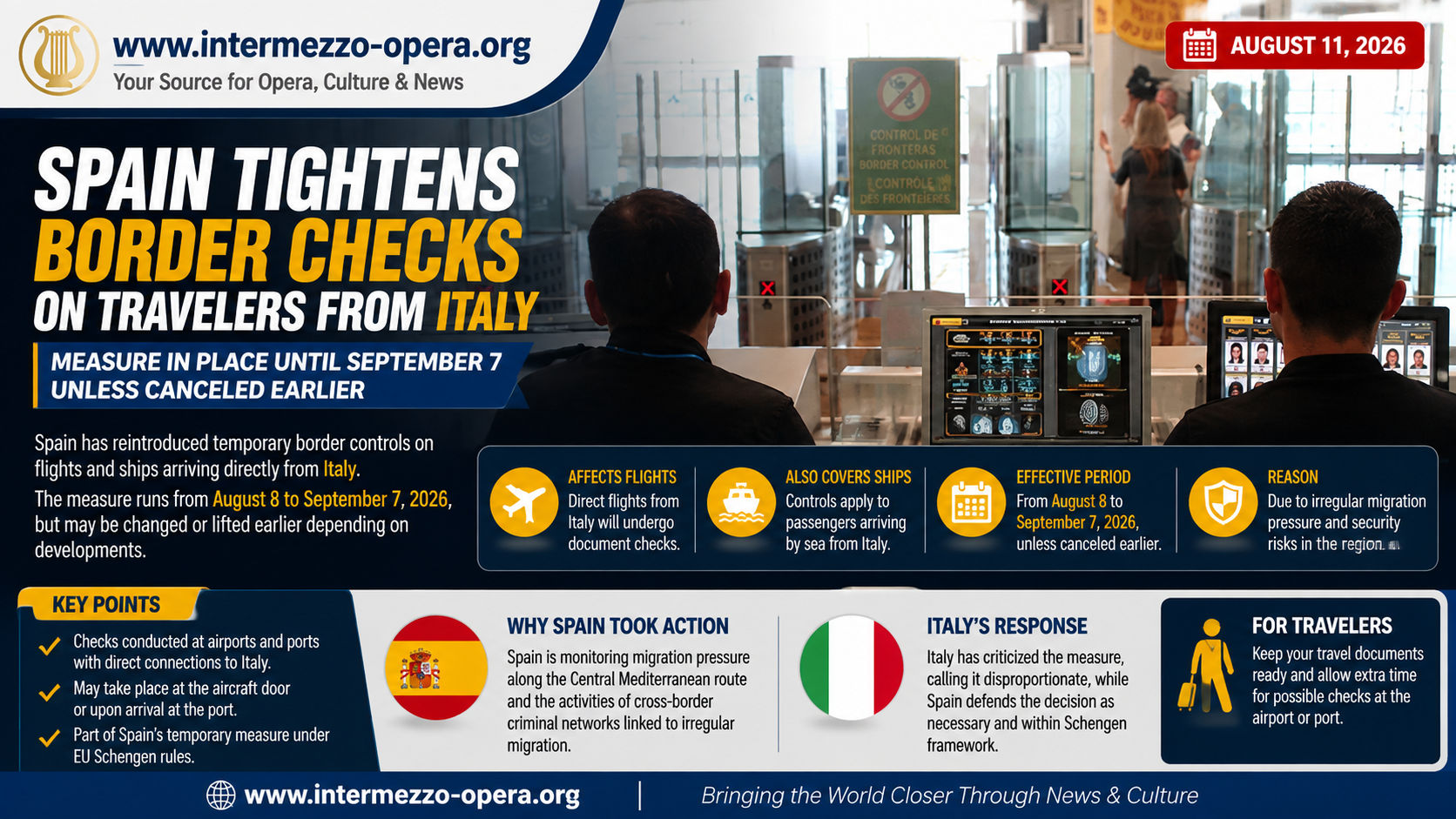
Spain Tightens Border Checks on Flights and Ships From Italy Until September 7
MADRID – Spain has temporarily restored border checks for travelers arriving from Italy by air…