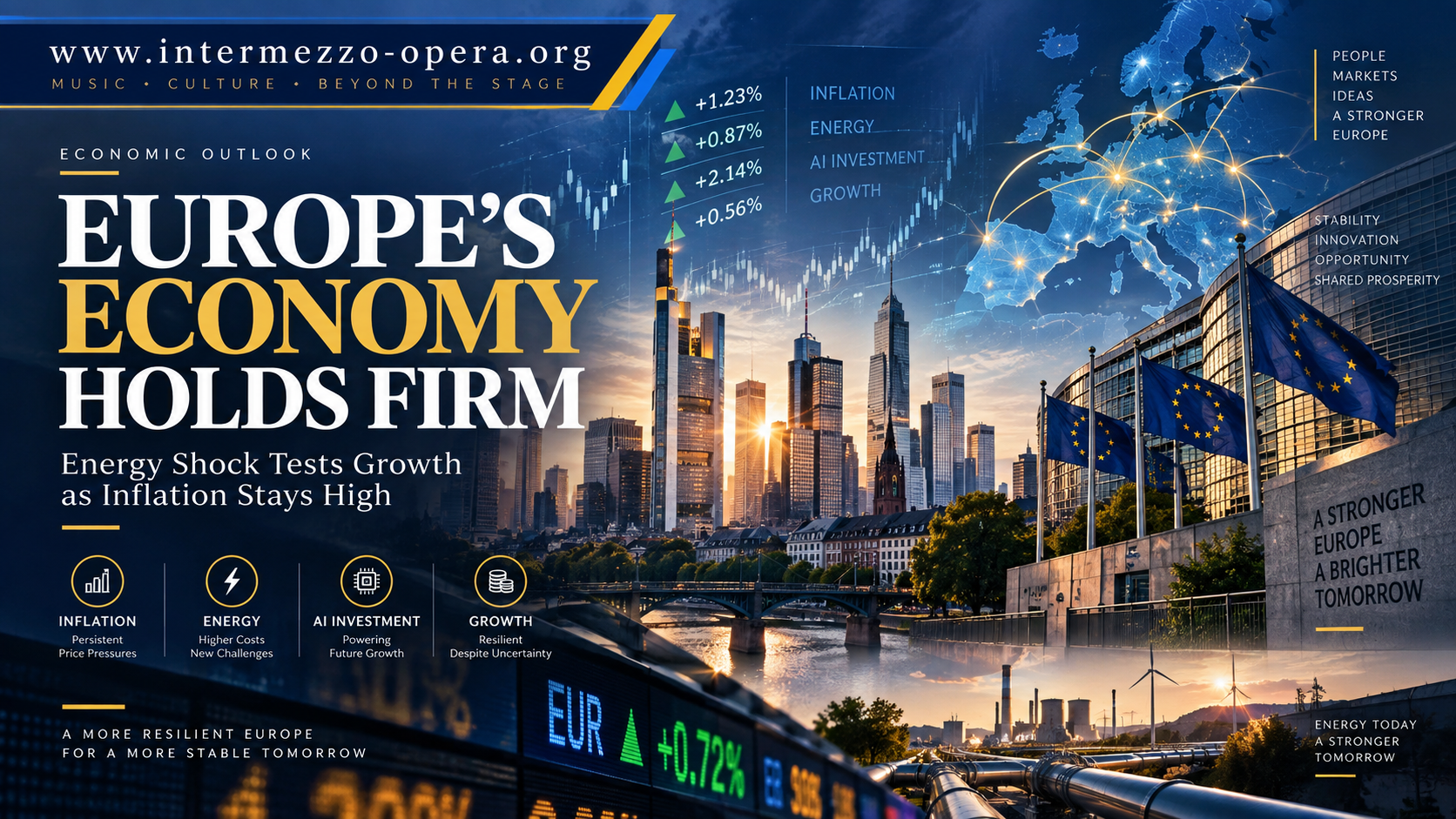
Europe’s Economy Holds Firm as Energy Shock Tests Growth
 0
0
 0
0
Read Time:2 Minute, 46 Second
Europe’s economy is facing a new challenge. Energy prices are rising again, while inflation remains above the European Central Bank’s target.
However, the euro area is showing stronger resilience than many expected. The latest data point to continued economic growth despite higher energy costs and global uncertainty.
Growth Remains Positive
The euro area economy grew 0.6% in the second quarter of 2026. Meanwhile, the wider European Union economy grew 0.7%.
Employment also increased by 0.1% during the quarter. Therefore, Europe has avoided a major economic slowdown despite several external pressures.
The European Central Bank also sees signs of improving economic momentum.
Business confidence has strengthened. At the same time, investment remains supported by infrastructure projects and growing spending on artificial intelligence.
Energy Becomes the Biggest Risk
However, Europe still faces a major problem.
Energy prices have risen sharply because of the conflict in the Middle East. As a result, inflation in the euro area reached 3.3% in August, up from 2.9% in July.
Energy prices were the main driver. Energy inflation reached 14.3%, compared with 10.3% a month earlier.
This situation could affect households and businesses.
Higher energy costs can increase transport expenses. They can also raise production costs. Consequently, companies may face pressure to increase prices.
ECB Raises Interest Rates
Because inflation remains high, the ECB has taken a tougher position.
On 10 September, the central bank raised its three key interest rates by 25 basis points. The deposit rate will rise to 2.50%, while the main refinancing rate will reach 2.65%.
The changes will take effect on 16 September 2026.
The ECB said inflation could remain above its 2% target for some time.
Therefore, European businesses and consumers may continue to face relatively expensive borrowing.
AI Gives Europe New Hope
Despite the pressure, technology is becoming an important source of growth.
AI-related investment is expanding across Europe. Companies are spending more on data centers, digital infrastructure and advanced technology.
In addition, governments are increasing investment in infrastructure and defence. Germany is expected to play an important role in this trend.
As a result, AI could help Europe improve productivity.
However, Europe still faces strong competition from the United States and China. The region must therefore invest faster while maintaining its industrial strength.
Europe’s Growth Outlook
The ECB expects the euro area economy to grow 0.9% in 2026. Growth is projected to rise to 1.4% in 2027 and 1.5% in 2028.
At the same time, inflation is expected to average 3.0% in 2026. It could then fall to 2.1% by 2028.
However, the outlook remains uncertain.
The Middle East conflict could push energy prices higher again. Global trade tensions could also weaken European exports.
A Critical Moment for Europe
Europe is now facing a difficult economic balance.
On one side, growth remains positive. Employment is also holding up. Furthermore, AI and public investment could create new opportunities.
On the other side, energy prices and inflation remain serious risks.
Therefore, Europe’s next economic challenge will be about resilience.
The region must keep growing while controlling inflation, protecting households and building a stronger technology sector.
The coming months could show whether Europe can turn today’s economic pressure into a new opportunity for long-term growth.


Happy
0 %

Sad
0 %

Excited
0 %

Sleepy
0 %

Angry
0 %

Surprise
0 %
Related Post
Wall Street: America’s Deadly Weapon for World Domination Without War
In today’s interconnected global economy, power is no longer defined solely by military strength. Instead,…