
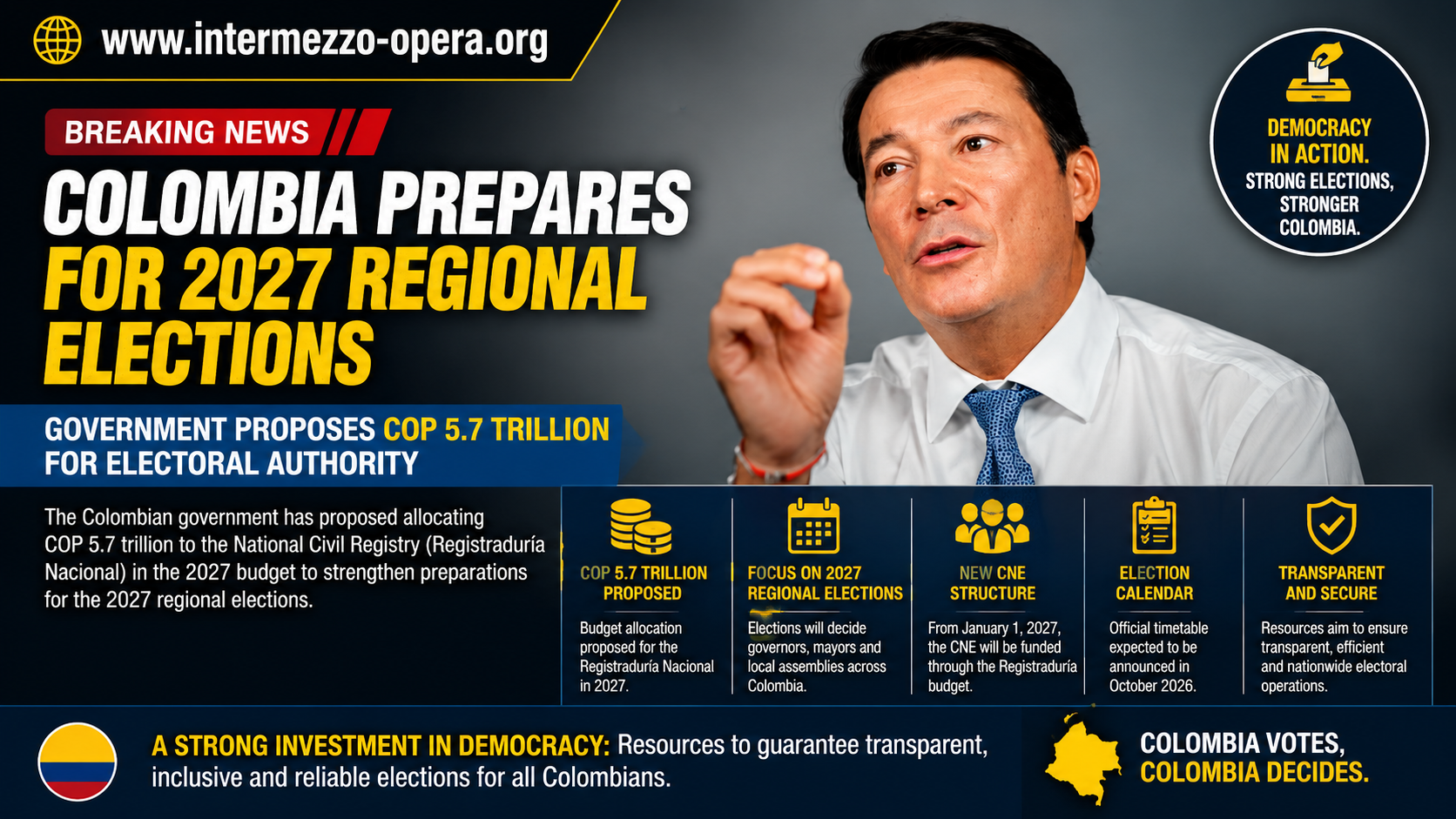
Colombia Proposes COP 5.7 Trillion for Electoral Authority Ahead of 2027 Regional Elections
 0
0
 0
0
Read Time:4 Minute, 40 Second
BOGOTÁ, Colombia — Colombia’s government has proposed allocating approximately COP 5.7 trillion to the National Civil Registry, or Registraduría Nacional, as the country begins preparations for the 2027 regional elections.
The allocation appears in the government’s proposed 2027 General Budget of the Nation. Finance Minister Miguel Gómez presented the spending plan, which still requires congressional approval before becoming final.
The Registraduría, headed by Registrar Hernán Penagos, is responsible for organizing Colombia’s elections and maintaining the country’s civil and electoral registry.
Therefore, the proposed increase comes as the institution prepares for another major nationwide electoral operation.
COP 5.7 Trillion Proposed for Registraduría
According to the budget proposal, the Registraduría would receive exactly COP 5,727,267,460,000 in 2027.
In addition, approximately COP 241.95 billion would be assigned to the Registraduría’s revolving fund, known as the Fondo Rotatorio de la Registraduría Nacional.
The figures form part of a broader national budget proposal totaling approximately COP 636 trillion.
However, these amounts remain proposals at this stage. Colombia’s Congress must debate the budget before the allocations become definitive.
Consequently, the final amount available to the electoral authority could still change during the legislative process.
Colombia Prepares for 2027 Regional Elections
The additional resources come at an important moment for Colombia’s electoral system.
After completing the 2026 congressional and presidential election cycle, authorities are already turning their attention toward the next major vote.
Colombia is scheduled to hold regional elections in 2027.
Voters will elect local and regional authorities across the country. As a result, the Registraduría will need to coordinate a large logistical operation covering Colombia’s entire territory.
According to Penagos, the institution expects to present the official election timetable in October 2026. It will also outline its strategy for organizing the voting process nationwide.
This preparation will involve polling stations, electoral materials, voter registration and other logistical requirements.
CNE Funding Structure Will Change in 2027
Another major change will take effect on January 1, 2027.
Colombia’s National Electoral Council (CNE) will no longer operate with the same independent budget structure it previously used.
Instead, resources connected with the CNE will be incorporated into the electoral organization’s broader budget framework administered through the Registraduría.
The change follows a ruling issued by Colombia’s Constitutional Court in May.
The court examined provisions introduced through the National Development Plan of the previous government. Those provisions had created an independent budget section for the CNE and granted its president authority over contracting and expenditure.
However, the Constitutional Court found that arrangement inconsistent with the Constitution.
Therefore, the 2027 budget reflects a different financial structure for Colombia’s electoral institutions.
CNE Will Still Play a Key Electoral Role
Despite the budget change, the CNE will continue performing important functions.
Among its responsibilities will be overseeing aspects of the registration and accreditation of electoral witnesses.
These witnesses represent political organizations and candidates during elections. They can observe parts of the voting and counting process under Colombian electoral rules.
Meanwhile, a newly elected group of nine CNE magistrates will participate in preparations for the coming regional elections.
Registrar Penagos is expected to coordinate with the new council as authorities finalize the electoral plan.
Thus, coordination between the Registraduría and CNE will remain important even after the budget structure changes.
Electoral Spending Drew Attention in 2026
Electoral spending already attracted public attention during Colombia’s 2026 elections.
According to El Espectador, approximately COP 529 billion was allocated to training and accrediting electoral witnesses during the legislative and presidential elections.
For the presidential runoff alone, the related contract amounted to approximately COP 145 billion.
Those expenditures included different logistical components associated with electoral witnesses.
As a result, the financing and administration of Colombia’s election system will likely remain under scrutiny as preparations for 2027 advance.
Regional Elections Will Be a Major Political Test
The upcoming elections will determine political control across Colombia’s regions and municipalities.
They will also provide an early indication of the political environment under the current national administration.
Local elections traditionally carry considerable importance because governors, mayors and local assemblies directly influence public investment and regional development.
Moreover, political parties are already beginning to reorganize ahead of the vote.
The 2027 elections could therefore reshape the balance of power between the government, opposition groups and emerging political movements.
Registraduría Faces a Nationwide Logistical Challenge
Organizing regional elections across Colombia requires extensive preparation.
The Registraduría must maintain voter records, organize polling locations and coordinate election personnel. Furthermore, it must ensure that voting materials reach urban centers as well as remote communities.
Those responsibilities make election years particularly demanding for the institution.
The proposed COP 5.7 trillion allocation would give the Registraduría substantial resources as it prepares for those operations.
However, part of the apparent budget increase must also be understood in the context of the new financing structure involving the CNE.
Therefore, the headline figure does not represent only additional spending on polling stations or election-day logistics.
Congress Must Still Approve the 2027 Budget
The government has formally submitted its 2027 national budget proposal to Congress. Colombia’s Ministry of Finance has also made the proposal available through its Economic Transparency Portal.
Lawmakers will now examine the spending plan and its individual allocations.
Consequently, the Registraduría’s proposed COP 5.7 trillion budget should not yet be described as a final appropriation.
Changes could emerge during congressional negotiations.
Nevertheless, the proposal shows that electoral preparations are already becoming a major government spending priority for 2027.
With the election calendar expected in October and the CNE’s new financial structure beginning in January, Colombia’s electoral authorities are entering an important preparation period.


Happy
0 %

Sad
0 %

Excited
0 %

Sleepy
0 %

Angry
0 %

Surprise
0 %
Related Post
Uruguay’s Spending Review Heads to Vote Amid Disputes Over Health, Media Law and State Property Agency
MONTEVIDEO – Uruguay’s Rendición de Cuentas debate is entering a decisive stage as lawmakers prepare…