
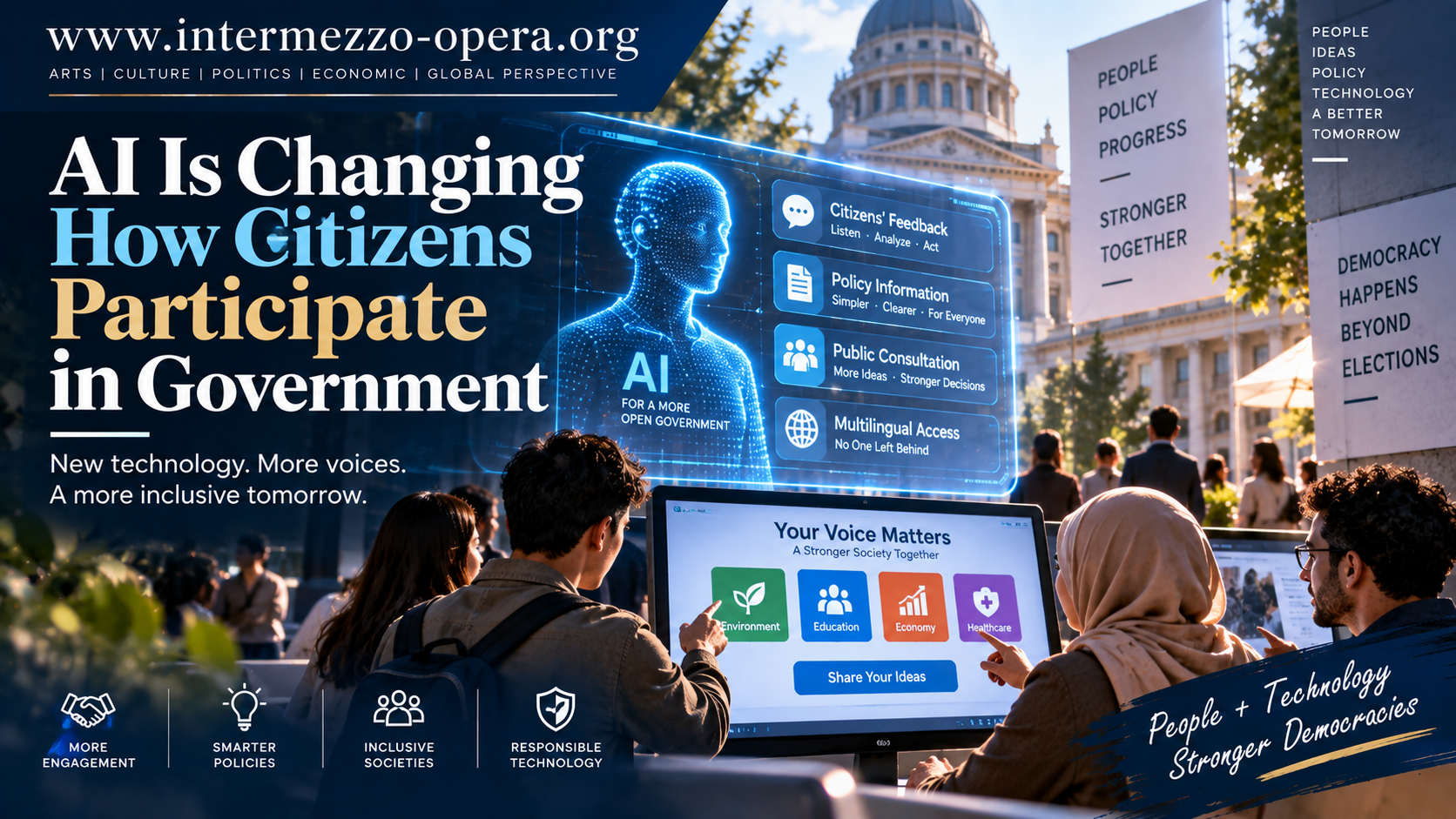
AI Is Changing How Citizens Participate in Government
 0
 0
Read Time:3 Minute, 54 Second
Artificial intelligence is beginning to reshape the relationship between governments and citizens. Beyond automation and public services, AI is increasingly being explored as a tool for public consultation, information access, policy discussion and civic participation.
A June 2026 OECD report examined 50 AI use cases for citizen participation across 22 OECD member and partner countries. The report identifies applications ranging from information development and translation to moderation, facilitation and simulation.
From Digital Government to Digital Participation
Governments have spent years moving public services online. The next phase is increasingly focused on how technology can help citizens participate in policymaking.
According to the OECD’s Digital Government Outlook 2026, AI is already being used in at least one government area in 35 of 36 OECD countries. However, its use in policymaking remains more limited because these activities involve higher-stakes decisions and stronger requirements for transparency, data quality and oversight.
This creates a new political question: Can technology make government more participatory without replacing human judgment?
AI Could Make Public Consultation More Accessible
One potential application is helping governments process large amounts of public feedback.
Traditional consultations can generate thousands of comments, submissions and documents. AI systems can help organise, translate, summarise and categorise this information, potentially making it easier for policymakers and citizens to understand the main issues being raised.
The OECD identifies AI applications for information development, sense-making, translation, transcription, virtual assistance, moderation and facilitation as potential tools for improving citizen participation.
For citizens, this could mean easier access to complicated government documents and consultation processes.
For governments, it could provide new ways to understand public input at scale.
But Technology Does Not Automatically Create Better Democracy
The expansion of AI also creates significant governance challenges.
The OECD warns about risks involving biased data, insufficient transparency, privacy, cybersecurity, overreliance on automated systems and the possibility of widening digital divides.
An AI system that summarises public opinion, for example, still depends on the quality of the information it receives and the design of the system processing it.
That means governments cannot simply introduce an AI platform and assume that participation will automatically become more representative.
The Human Role Remains Important
The OECD’s 2026 research suggests that AI should generally support participation rather than replace democratic decision-making.
This distinction is important.
AI can help organise information, translate documents or identify recurring themes. But questions about values, priorities and political choices ultimately involve citizens, elected representatives and institutions.
The OECD also notes that AI adoption in government remains more cautious in policymaking and accountability than in internal administrative processes and public services.
Political Participation Beyond the Ballot Box
The discussion also comes at a time when many citizens want more ways to influence government between elections.
The OECD’s 2026 Trust Survey found that 68% of respondents considered voting influential over what government does, while only 31% believed people like them have a say in government decisions across the surveyed countries.
The data does not mean that elections are becoming irrelevant. Instead, it highlights a broader question about how citizens can participate in policymaking outside election periods.
Digital platforms and AI could become part of that conversation.
A New Political Infrastructure
If responsibly implemented, AI could become part of a broader civic infrastructure connecting governments and citizens.
Possible applications include:
- AI-assisted public consultations
- Multilingual government information
- Digital town-hall platforms
- Public-policy simulations
- Automated document summaries
- Citizen feedback analysis
- Accessible government services
- Tools for monitoring public-policy implementation
The OECD says AI can potentially improve the accessibility and scalability of participation processes while reducing some of their costs.
But those benefits depend on appropriate safeguards.
Transparency Will Become Crucial
As governments increasingly use AI, citizens will need to know when automated systems are involved in public decision-making.
Questions about data, algorithms, accountability and human oversight are therefore becoming political issues in their own right.
The OECD’s 2026 Digital Government Outlook reports that many countries have institutions responsible for governing public-sector AI, but practical governance arrangements and algorithmic transparency remain uneven.
The future of digital democracy may therefore depend not simply on how advanced government technology becomes, but on how transparent and accountable that technology is.
Conclusion
AI is opening a new chapter in the relationship between citizens and government.
The technology could make public information easier to understand, expand participation and help governments process large amounts of citizen feedback. At the same time, concerns over privacy, bias, transparency and digital exclusion show why political institutions need clear safeguards.
The central issue is not whether AI should replace politics.
Instead, the emerging question is how AI can support citizens and institutions while keeping democratic decision-making transparent, accountable and human-centred.


Happy
0 %

Sad
0 %

Excited
0 %

Sleepy
0 %

Angry
0 %

Surprise
0 %
Related Post

Global Politics in 2026: Why Trust, Institutions, and Public Participation Matter
Global politics in 2026 is being shaped by a difficult combination of economic pressure, geopolitical…