AfD’s Historic Victory in Saxony-Anhalt Reshapes Germany’s Political Landscape
 0
0
 0
0
Read Time:6 Minute, 4 Second
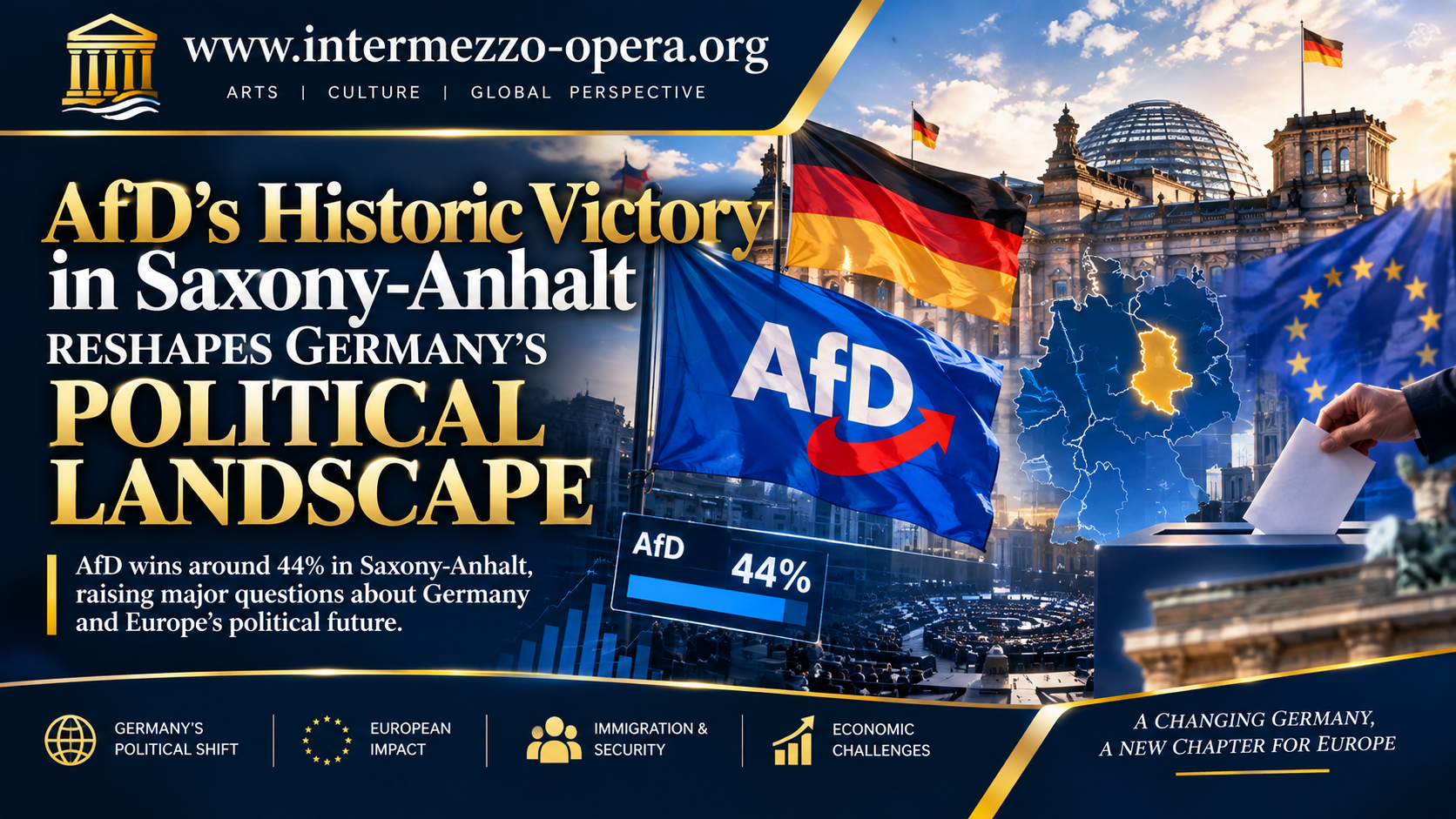
The German political landscape has entered a potentially transformative period after the far-right Alternative for Germany (AfD) secured a historic victory in the state election in Saxony-Anhalt.
AfD won around 44% of the vote in the September 6 election, putting the party in an unprecedented position to potentially gain power at the state level. The result represents a major breakthrough for a party that has steadily expanded its influence, particularly across eastern Germany.
The election is also being watched far beyond Saxony-Anhalt. Germany remains the European Union’s largest economy and one of its most influential political powers, meaning substantial shifts in German politics can reverberate throughout the continent.
German Political Landscape Takes a Historic Turn
For decades, Germany’s mainstream parties dominated both federal and regional politics.
The Saxony-Anhalt result challenges that traditional balance.
AfD’s victory was accompanied by exceptionally strong voter participation, with turnout reaching approximately 77%. The scale of the result suggests that the election was more than a routine regional contest.
It became an opportunity for voters to express their views on immigration, economic conditions, security, relations with Russia and dissatisfaction with Germany’s established political parties.
AfD Wins Around 44% of the Vote
The magnitude of AfD’s victory is particularly significant.
With approximately 44% support, the party emerged as the dominant political force in the state election.
AfD has historically performed better in eastern Germany than in many western regions.
Yet the latest result represents another stage in the party’s evolution from an opposition movement into a force capable of challenging Germany’s traditional parties for political power.
Its lead candidate in Saxony-Anhalt, Ulrich Siegmund, presented the victory as part of a longer political journey toward greater national influence.
Immigration Remains Central to the Political Debate
Migration remains one of the defining issues behind Europe’s changing political environment.
AfD advocates substantially tougher immigration policies than Germany’s mainstream parties.
But migration alone does not explain the party’s growing appeal.
Economic anxiety, dissatisfaction with government institutions, energy costs, security concerns and frustration with traditional political parties have all contributed to a changing electoral environment.
The combination has created fertile ground for populist and nationalist parties across several European countries.
Pressure Mounts on Chancellor Friedrich Merz
The result represents a political setback for Chancellor Friedrich Merz and Germany’s federal government.
Reuters reported that dissatisfaction with the government’s economic policies was among the forces shaping the Saxony-Anhalt election.
Germany has spent several years confronting difficult structural challenges.
Its industrial sector has faced high energy costs, intensifying international competition and pressure on major manufacturers.
Volkswagen, for example, recently reached a sweeping restructuring agreement involving another 50,000 planned job cuts, bringing total agreed reductions to 100,000 positions while leaving uncertainty around four German plants.
Economic concerns therefore increasingly overlap with political dissatisfaction.
Russia Has Become Another Political Fault Line
Germany’s relationship with Russia has also returned to the centre of political debate.
Berlin recently accused Moscow of responsibility for a drone attack targeting Leipzig/Halle Airport. Germany announced diplomatic countermeasures following its investigation, while Russia denied responsibility.
The dispute matters politically because AfD has generally advocated a more accommodating relationship with Russia than Germany’s mainstream governing parties.
That creates a sharp foreign-policy divide at a time when Germany remains an important supporter of Ukraine.
The European Union has also intensified discussion about additional measures against Russia following the Leipzig incident.
Germany’s Mainstream Parties Face a Difficult Choice
The election raises an immediate question: who will govern Saxony-Anhalt?
Germany’s mainstream parties have traditionally maintained a political firewall against AfD, refusing to form governing coalitions with the party.
That strategy becomes increasingly difficult when AfD controls such a large share of parliamentary seats.
According to the election result reported by Reuters, cooperation between AfD and the smaller BSW could potentially produce a parliamentary majority.
Coalition negotiations will therefore be closely watched.
The eventual outcome could establish a precedent for how Germany’s political system responds when a far-right party becomes the largest force in a regional parliament.
The Shift Extends Beyond Germany
Germany is not experiencing political fragmentation in isolation.
Across Europe, established political structures have been challenged by nationalist, populist and far-right movements.
Italy offers another example.
Roberto Vannacci’s Futuro Nazionale has rapidly emerged as Italy’s fourth-most-popular political force only months after its creation. At a major business conference in Cernobbio on September 5, Vannacci argued that the EU should reduce political integration and focus more heavily on national identity and cooperation between states.
France is experiencing its own transformation as political forces on the right compete for greater influence ahead of the country’s 2027 presidential election.
Together, these developments suggest Europe’s political centre is facing growing pressure.
Sweden Offers Another Political Test
Attention will soon move north.
Sweden holds its parliamentary election on September 13, and the race has tightened considerably.
A recent Novus poll placed the four centre-left parties at a combined 50.3%, compared with 47.7% for the governing right-wing coalition. The 2.6-point difference was within the poll’s margin of error.
Just weeks earlier, the centre-left appeared to hold a much more comfortable advantage.
The Swedish election therefore provides another opportunity to measure how European voters are responding to questions involving migration, security, energy, public services and the cost of living.
Europe’s Political Debate Is Changing
The broader debate extends to the future of the European Union itself.
Traditional European integration has generally been built around deeper economic cooperation, common institutions and increasingly coordinated policies.
Populist parties often propose a different model.
Rather than transferring additional authority to Brussels, they tend to favour stronger national sovereignty and looser European political integration.
That debate is becoming increasingly important as Europe confronts migration, defence spending, relations with Russia, economic competition with China and the United States, and pressure on public finances.
Why Saxony-Anhalt Matters Beyond Germany
Saxony-Anhalt represents only a small portion of Germany’s population, but the political significance of its election is much larger.
AfD’s approximately 44% result demonstrates that support for the party can reach levels capable of fundamentally changing the mathematics of coalition government.
The question is now whether that momentum remains concentrated primarily in eastern Germany or spreads more strongly across the country.
Recent national polling has already shown AfD competing with, and in some surveys surpassing, Germany’s traditional conservative forces.
That makes the regional result potentially relevant to Germany’s next federal election in 2029.
A New Chapter for European Politics
The Saxony-Anhalt election does not by itself determine Germany’s national future.
But it represents an unmistakable milestone in the German political landscape.
A party once positioned firmly outside Germany’s governing mainstream has secured around 44% of the vote in a regional election and is now confronting established parties with difficult questions about coalition building, voter dissatisfaction and the boundaries of political cooperation.
For Europe, the significance is equally important.
Germany has long been one of the central forces shaping European integration. A substantial transformation of German politics could therefore influence debates ranging from migration and economic policy to Ukraine, defence and the future structure of the European Union.
Saxony-Anhalt may be a regional election, but its political message reaches far beyond the borders of one German state.


Happy
0 %

Sad
0 %

Excited
0 %

Sleepy
0 %

Angry
0 %

Surprise
0 %
Related Post
AfD Saxony-Anhalt Election Could Reshape German Politics as Party Eyes Historic Victory
The AfD Saxony-Anhalt election has emerged as one of Germany's most consequential political contests of…