Uruguay’s Construction Workweek Cut Sparks Domino Effect as Business Groups Push Back
 0
0
 0
0
Read Time:3 Minute, 18 Second
MONTEVIDEO, Uruguay – Uruguay’s decision to gradually reduce working hours in the construction industry has triggered a broader debate over shorter workweeks, labor costs and productivity.
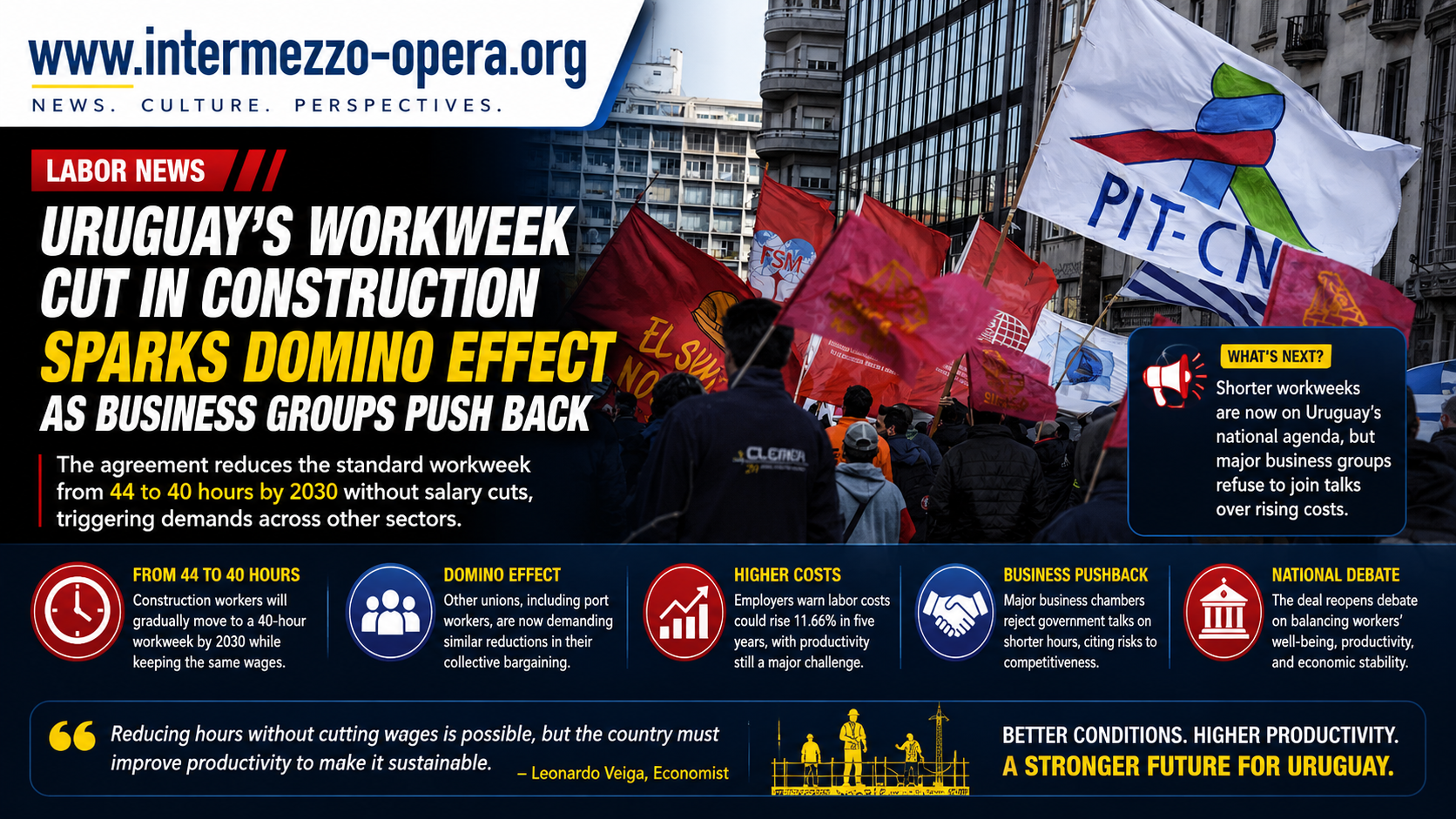
The construction agreement, reached between employers and the SUNCA construction workers’ union in mid-August, will gradually reduce the standard workweek from 44 hours to 40 hours by 2030 without cutting workers’ salaries.
The agreement also includes wage adjustments and additional benefits. However, its impact has quickly moved beyond the construction industry.
Construction Deal Creates a New Precedent
Other unions have begun looking at the construction agreement as a potential model for their own collective bargaining negotiations.
Leonardo Veiga, a professor at the University of Montevideo’s IEEM business school, said the construction agreement does not automatically determine what happens in other industries. Nevertheless, he described it as a significant precedent because workers will move from 44 to 40 hours while maintaining their income.
The agreement also establishes a clear timetable for implementing the reduction.
As a result, Uruguay’s long-running debate over shorter working hours has gained new momentum.
Employers Warn About Higher Costs
However, private-sector representatives have expressed concerns about the financial consequences.
Alfredo Kaplan, president of Uruguay’s Association of Private Developers, described the agreement as the least damaging option employers could accept. He said developers supported a 40-hour week in principle but objected to paying the equivalent of 44 hours for 40 hours of work.
Veiga estimated that the real hourly labor cost could increase by 11.66% over five years, combining real wage improvements with the effect of reducing working hours.
Meanwhile, average labor costs per unit produced could rise by approximately 15.5%, according to his calculations.
Productivity Becomes a Key Challenge
The economic debate also centers on whether productivity improvements can offset the additional costs.
Veiga estimated that construction labor costs could eventually increase by between US$166 million and US$169 million annually, measured in constant dollars once the agreement is fully implemented.
According to his analysis, neutralizing that increase would require annual productivity growth of approximately 2.92% for five years. He contrasted this with much lower historical productivity growth in the construction industry.
Therefore, employers argue that reducing working hours cannot be discussed separately from productivity and competitiveness.
Domino Effect Reaches Other Workers
The construction agreement has already influenced labor negotiations elsewhere.
Uruguay’s port workers’ union, SUPRA, included a reduction in working hours among its demands during negotiations with Terminal Cuenca del Plata.
The union specifically raised the issue after construction workers secured their agreement, demonstrating how the measure could create a broader domino effect across Uruguay’s labor market.
The government has also placed shorter working hours on its labor agenda and announced discussions involving employers and workers.
Business Groups Reject Government Talks
However, several major business organizations have declined to participate in the government-backed discussions.
According to El Observador, only the construction chamber and the passenger transport chamber had confirmed their participation in the planned talks.
Other organizations, including the Chamber of Industries, Chamber of Commerce, Rural Federation and Mercantile Chamber, rejected the initiative.
Chamber of Industries president Leonardo García argued that introducing shorter hours without salary reductions in the industrial sector would send a negative signal.
The disagreement highlights the challenge facing Uruguay as the government seeks to broaden discussions about working time.
Uruguay Faces Wider Labor Debate
The construction agreement has therefore become more than an industry-specific labor deal. It has reopened a national debate about the balance between workers’ quality of life, productivity, wages and business competitiveness.
For workers, the 40-hour target represents an improvement in working conditions without sacrificing income. For employers, however, the central concern remains how companies will absorb additional costs while remaining competitive.
As other unions consider similar demands, Uruguay’s construction agreement could become an important test for whether the 40-hour workweek spreads to other sectors—or remains an exceptional arrangement negotiated specifically for construction.


Happy
0 %

Sad
0 %

Excited
0 %

Sleepy
0 %

Angry
0 %

Surprise
0 %
Related Post

Portugal’s Property Sector Backs Housing Reforms but Warns Against Early Optimism
LISBON – Portugal’s leading real estate companies have welcomed the government’s latest housing market reforms,…