Latin America Faces a Growth Puzzle as Low Productivity and Informal Jobs Hold Back the Economy
 0
0
 0
0
Read Time:3 Minute, 59 Second
MONTEVIDEO – The economic outlook for Latin America and the Caribbean remains challenging. Although the region continues to grow, structural problems are limiting its ability to achieve stronger and more sustainable expansion.
According to the latest analysis based on projections from the Economic Commission for Latin America and the Caribbean (ECLAC), economic growth is expected to slow in 2026.
However, weaker growth is only part of the problem.
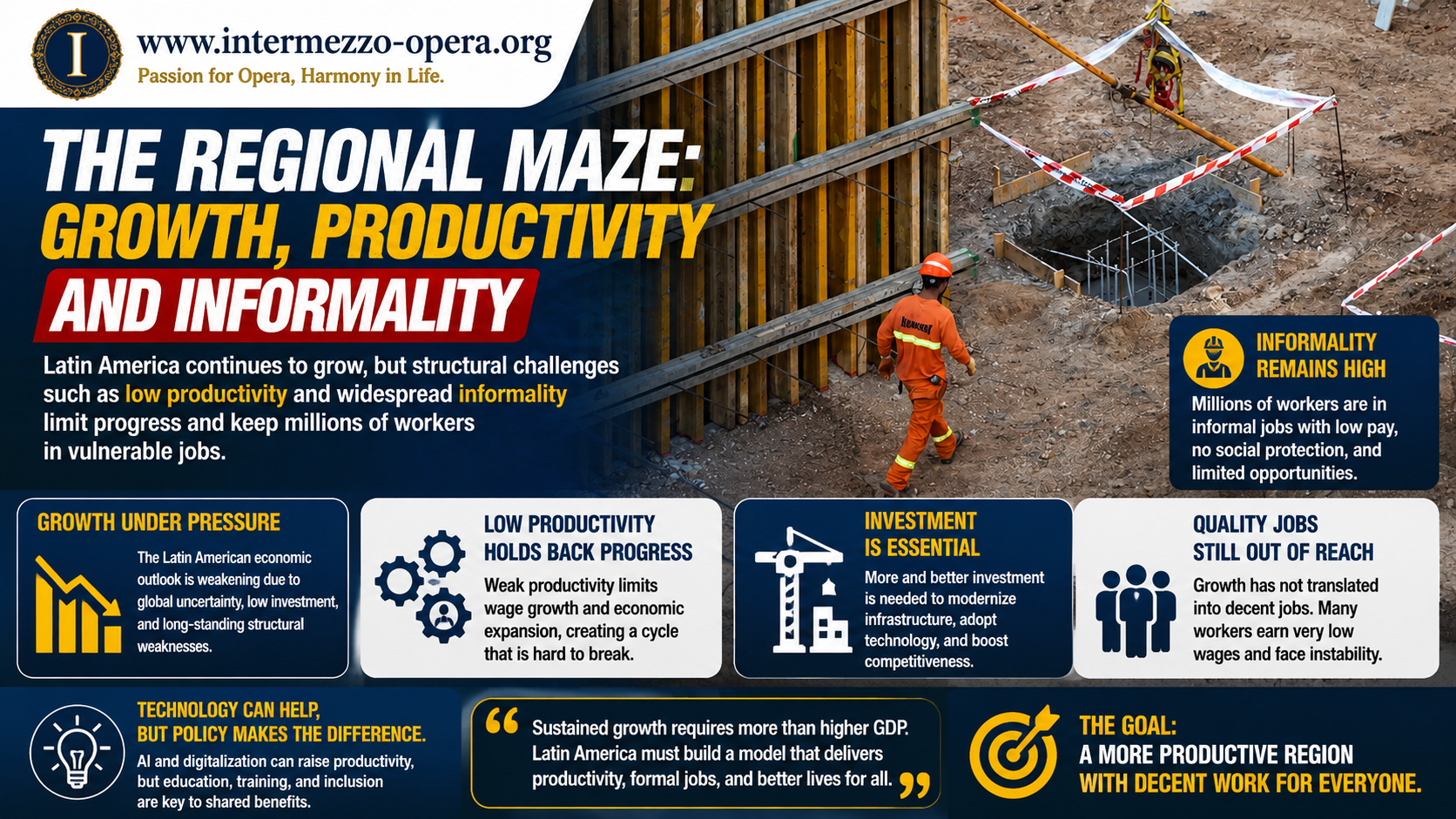
Low investment, weak productivity and widespread labour informality continue to create what could be described as a regional economic maze. These challenges make it harder for countries to increase incomes and improve living standards over the long term.
Latin American Economic Growth Faces New Pressure
The international environment remains difficult for Latin American economies.
Global trade uncertainty, financial conditions and geopolitical tensions can affect investment and economic activity across the region. At the same time, domestic structural weaknesses have accumulated over many years.
As a result, economic expansion remains relatively limited.
The problem is especially important because stronger growth is necessary to create quality jobs, reduce poverty and generate resources for public investment.
However, growth alone will not solve the region’s problems.
Countries also need to improve the way workers, capital and technology are used.
Productivity Remains a Major Challenge
One of the biggest obstacles is low productivity.
Productivity determines how efficiently an economy transforms labour, investment and other resources into goods and services.
When productivity improves, companies can produce more without requiring an equivalent increase in resources. Therefore, higher productivity can support better wages and stronger economic growth.
However, Latin America has struggled with weak productivity performance for years.
This creates a difficult cycle. Low productivity limits growth, while weak growth can discourage the investment needed to improve productivity.
Investment Is Essential for Stronger Growth
Investment is another key part of the regional challenge.
Countries need investment to modernise infrastructure, expand productive capacity and adopt new technologies.
Furthermore, businesses require access to financing and predictable economic conditions before committing resources to long-term projects.
Without sufficient investment, productivity improvements become more difficult.
Consequently, economies can become dependent on short periods of favourable external conditions rather than developing stronger domestic engines of growth.
Informal Employment Complicates the Picture
Labour informality adds another layer to the problem.
Millions of people across Latin America work outside fully formal employment arrangements. This can mean weaker access to social protection, unstable incomes and fewer opportunities for professional development.
Informality can also affect productivity.
Small informal businesses often have limited access to financing, technology and training. Therefore, their ability to invest and expand may be restricted.
At the same time, governments face difficulties collecting revenue and extending social protection to workers outside the formal system.
The combination of low productivity and informal employment can therefore reinforce existing economic inequalities.
Growth Alone May Not Create Better Jobs
Another important issue is the quality of employment.
An economy can create jobs without necessarily creating secure or well-paid jobs.
Recent evidence from Uruguay illustrates this challenge. According to the Cuesta Duarte Institute, around 512,000 workers in 2025 earned below the threshold used to identify very low wages. That represented roughly one in three workers under the institute’s methodology.
The situation was even more concerning among younger workers, with 52% falling below that wage threshold.
Although these figures specifically concern Uruguay, they illustrate a wider regional challenge: improving employment numbers is not enough if productivity and job quality remain weak.
Technology Could Become Part of the Solution
Digitalisation and new technologies could help Latin America improve productivity.
Artificial intelligence, automation and digital platforms offer companies opportunities to increase efficiency. They can also create new industries and occupations.
However, technology alone does not guarantee inclusive growth.
Investment in education, digital infrastructure and worker training will also be necessary. Otherwise, technological changes could deepen existing differences between highly productive businesses and companies operating with limited resources.
The policy choices surrounding AI and technological change will therefore play an important role in determining their impact on employment and inequality.
A Structural Challenge for Latin America
The region ultimately faces several interconnected problems.
Weak investment can restrict productivity. Low productivity can limit wage growth. Meanwhile, widespread informality can reduce social protection and prevent businesses from reaching their full potential.
Therefore, addressing only one part of the problem may not be enough.
Latin American countries will need policies that encourage productive investment, improve education and skills, support business formalisation and strengthen institutions.
At the same time, governments must navigate an uncertain international environment.
The Latin American economic outlook is therefore not simply about whether GDP rises or falls in a particular year. The larger challenge is creating an economic model capable of producing sustained productivity gains, formal employment and better living standards.
That is the real maze the region must solve.


Happy
0 %

Sad
0 %

Excited
0 %

Sleepy
0 %

Angry
0 %

Surprise
0 %
Related Post

Spanish Banks Hold Mortgage Rates Steady as Euribor Rises, but Mixed Loans Become More Expensive
MADRID – Spain’s mortgage market is entering a new period of uncertainty. Despite the renewed…