Uruguay Moves to Repopulate Ciudad Vieja by Turning Underused Properties Into New Housing
 0
0
 0
0
Read Time:6 Minute, 54 Second
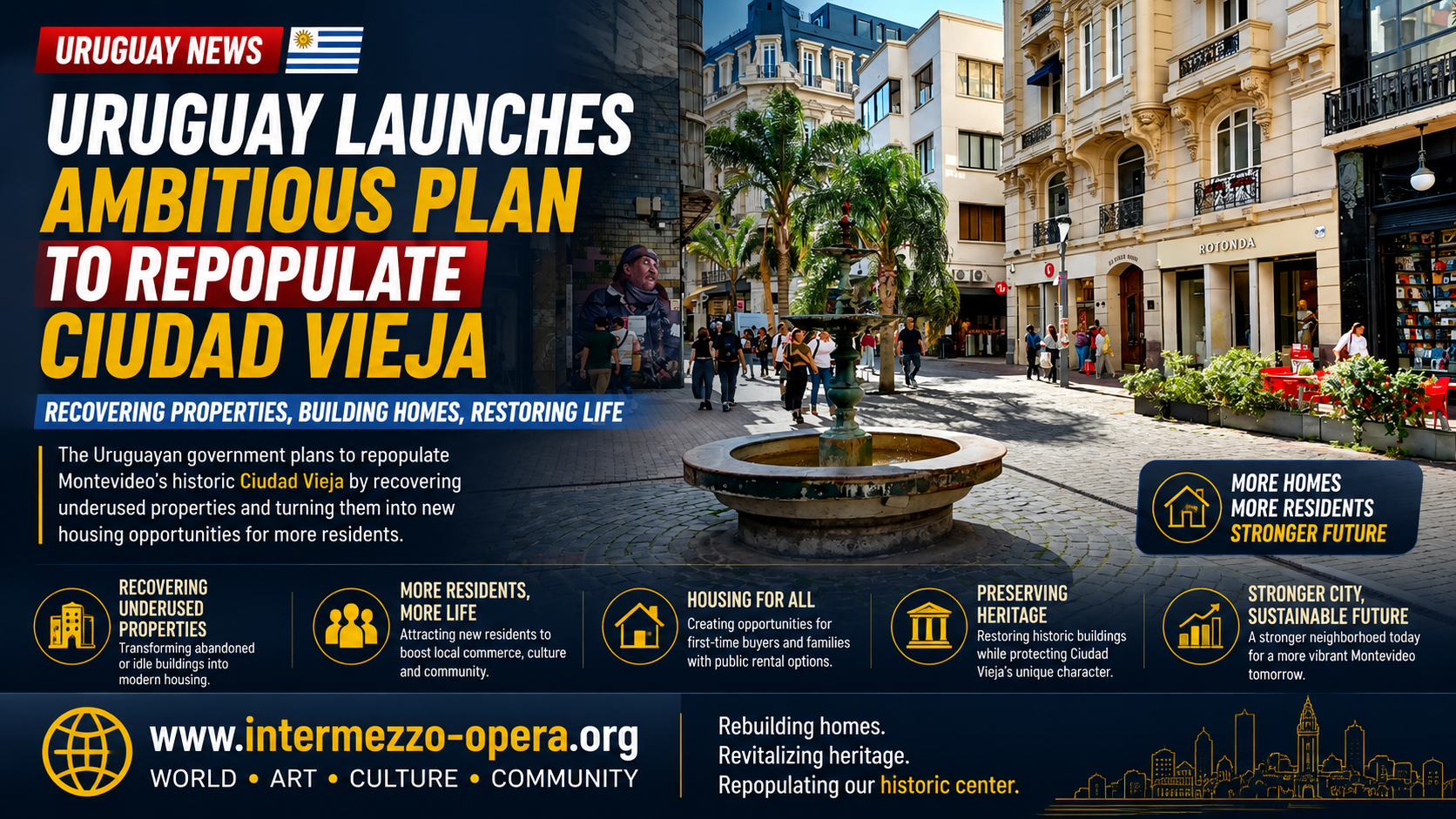
Uruguay’s Ciudad Vieja housing plan is moving forward as the government seeks to bring more permanent residents back to Montevideo’s historic center. The strategy focuses on recovering underused properties and transforming them into new housing opportunities.
The Ministry of Housing and Territorial Planning, known as MVOT, has identified Ciudad Vieja as a priority area for urban revitalization. Moreover, the initiative aims to make better use of existing infrastructure rather than relying only on expansion into new areas.
Deputy Housing Minister Christian Di Candia recently toured several properties in the neighborhood. These sites are expected to become part of future housing developments.
Therefore, the project represents more than the restoration of old buildings. It forms part of a broader strategy to increase residential activity in one of Montevideo’s most historically significant districts.
Government Wants More People Living in Ciudad Vieja
Ciudad Vieja is widely known as Montevideo’s historic center.
The neighborhood contains important architectural landmarks, government buildings, offices, restaurants, cultural spaces, and tourist attractions.
However, authorities want to strengthen its residential character as well.
The government believes that recovering existing properties can create new housing opportunities. At the same time, bringing more residents into the district could support commercial and social activity.
According to Uruguay’s Presidency, the strategy seeks to generate new housing while repopulating the historic center of Montevideo.
As a result, housing policy and urban revitalization are being developed together.
Underused Properties Become Central to the Plan
One of the most important elements of Uruguay’s Ciudad Vieja housing plan is the recovery of existing properties.
During the May 2026 visit, Di Candia and other officials inspected several sites that could be incorporated into future developments.
Among them was the former School of Nursing and additional properties located within the same urban area.
Instead of allowing these sites to remain underused, authorities want to transform them into housing.
Therefore, the government hopes to create value from existing urban assets.
This approach could also help preserve the character of the neighborhood while introducing new residential uses.
First-Time Homebuyers Could Benefit
Housing accessibility is another important part of the project.
According to the government, the initiative is intended to create opportunities for people who currently face difficulties accessing housing.
Consequently, the strategy is not simply an architectural restoration program.
The social dimension is equally important.
Di Candia explained that housing policies need to consider people who struggle to qualify for conventional financing. Therefore, future projects could explore mechanisms that make housing more accessible to households currently excluded from the traditional market.
However, the precise conditions will depend on each housing project.
Ciudad Vieja Already Has a Broader Revitalization Program
The national government’s initiative is not happening in isolation.
Montevideo’s local government has also been promoting residential development in Ciudad Vieja.
The Ciudad Vieja Heritage Promotion Area was created to encourage housing, commercial activity, and cultural life in the neighborhood.
The program includes significant incentives for development.
For example, eligible new construction and expansion projects can receive exemptions from property-related municipal taxes for up to 10 years.
Renovation projects can also receive incentives under specific conditions.
Therefore, public policy is attempting to encourage both new construction and the recovery of existing buildings.
Hundreds of New Residents Could Arrive
Early results from Montevideo’s incentive program provide an indication of the potential residential impact.
Only six months after the Ciudad Vieja Heritage Promotion Area program began, authorities had received 20 formal projects.
Those projects represented an estimated 240 new homes.
Furthermore, the city estimated that the developments could bring more than 400 new residents into Ciudad Vieja.
That figure is significant because increasing the permanent population is one of the central objectives of the revitalization strategy.
More residents can generate demand for shops, restaurants, services, schools, and other neighborhood activities.
Consequently, housing development can have effects far beyond individual buildings.
Historic Buildings Remain Part of the Strategy
Ciudad Vieja presents a special challenge because of its architectural heritage.
New housing projects cannot simply ignore the historical character of the neighborhood.
Therefore, restoration and preservation are important parts of the strategy.
One example is Casa Rodó, a property associated with Uruguayan writer José Enrique Rodó.
The building was recovered as part of a pilot program for deteriorated properties in central areas of Montevideo. It now includes 10 housing units, a multipurpose room, and another space intended for cultural use.
The restoration also preserved important architectural elements.
Moreover, archaeological remains from different periods of colonial Montevideo were discovered during the work.
Therefore, the project demonstrates how housing and heritage conservation can potentially work together.
Public Rental Housing Is Another Option
Not every family can purchase a home.
For that reason, public rental housing is also part of the broader approach.
Casa Rodó became part of a pilot public rental program. Families from Ciudad Vieja were able to apply for one-, two-, and three-bedroom units through the initiative.
This model provides another route for increasing the neighborhood’s permanent population.
Moreover, it allows authorities to recover deteriorated public properties while addressing housing needs.
Therefore, the revitalization strategy is not based on a single housing model.
Private development, public housing, rehabilitation projects, and rental programs can all contribute.
Housing Could Help Revitalize Local Businesses
Increasing the number of residents could also change Ciudad Vieja after normal business hours.
The district has traditionally combined offices, tourism, public institutions, restaurants, and cultural attractions.
However, a larger permanent population could create more consistent demand throughout the week.
Local supermarkets could benefit. Restaurants could gain additional customers. Meanwhile, other neighborhood services could become more sustainable.
For that reason, Montevideo’s promotion program does not focus exclusively on housing.
It also seeks to encourage commercial activity and cultural life.
The objective is a more active neighborhood rather than simply a larger collection of apartments.
Existing Infrastructure Offers an Advantage
Another argument supporting the project involves infrastructure.
Ciudad Vieja is already integrated into Montevideo’s urban network.
Roads, public transportation, electricity, water, public spaces, commercial areas, and government services already exist throughout the district.
Therefore, increasing housing density in established central neighborhoods can make use of infrastructure that is already available.
This approach differs from developing entirely new residential areas on the outskirts of a city.
Moreover, residents living in central areas may have shorter distances to employment and services.
That possibility makes urban redensification an important part of the government’s strategy.
Public and Private Institutions Are Working Together
The initiative involves several institutions.
During the government’s inspection of Ciudad Vieja properties, representatives from the Ministry of Housing participated alongside the National Housing Agency.
Officials from Montevideo’s municipal government were also involved.
In addition, representatives connected to national heritage protection participated in the visit.
Such coordination is particularly important in Ciudad Vieja.
Housing projects may involve construction rules, heritage requirements, urban planning, financing, and public property management.
Therefore, cooperation between institutions can help projects move from planning into development.
Repopulation Goes Beyond Building Apartments
The government’s objective is ultimately broader than constructing housing.
A successful Ciudad Vieja repopulation plan would need to create conditions that encourage residents to stay permanently.
That includes accessible housing.
However, it also involves transportation, public spaces, commercial services, cultural activity, heritage preservation, and neighborhood quality.
Montevideo has already invested in making Ciudad Vieja more pedestrian-friendly and improving public spaces through the Late Ciudad Vieja project.
Therefore, housing projects form another layer of a longer urban transformation.
A New Chapter for Montevideo’s Historic Center
Uruguay’s Ciudad Vieja housing plan represents an ambitious attempt to combine housing policy with urban regeneration.
The government wants to recover underused properties. Moreover, authorities hope to transform those sites into new residential opportunities and attract permanent residents back to Montevideo’s historic center.
Meanwhile, Montevideo’s municipal incentives are already encouraging private housing development.
Twenty projects submitted during the first six months of the promotion program could eventually produce around 240 homes and accommodate more than 400 residents.
The challenge will be turning these initiatives into sustainable long-term residential growth.
However, the strategy already shows a clear direction.
Instead of treating Ciudad Vieja only as a historic, commercial, or tourist district, authorities want it to become a stronger residential neighborhood once again.
If the projects advance as planned, abandoned and underused properties could become an important part of that transformation.


Happy
0 %

Sad
0 %

Excited
0 %

Sleepy
0 %

Angry
0 %

Surprise
0 %
Related Post
Australia’s RBA Raises Rates in Split Decision as Inflation Fears Intensify
The Reserve Bank of Australia (RBA) has raised interest rates in a divided decision, highlighting…