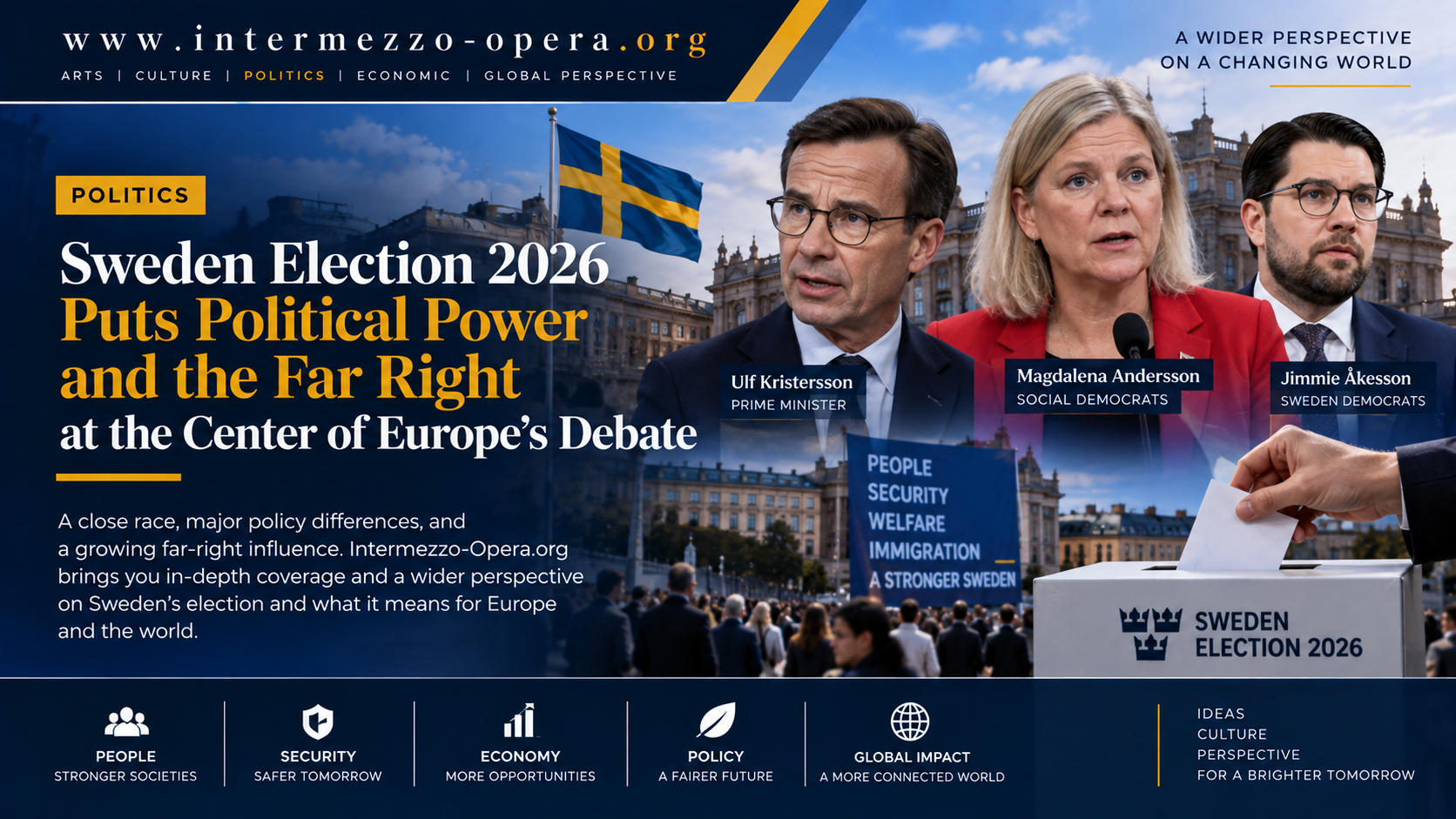
Sweden Election 2026 Puts Political Power and the Far Right at the Center of Europe’s Debate
 0
0
 0
0
Read Time:4 Minute, 11 Second
Sweden is approaching a major political test. Voters will go to the polls on September 13, 2026, in an election that could decide whether Prime Minister Ulf Kristersson remains in power or former Prime Minister Magdalena Andersson leads a return of the center-left.
The election has also placed the Sweden Democrats at the center of the political debate. The party has supported Kristersson’s government since 2022 but has not held cabinet positions. If the right-wing bloc wins, Kristersson has said he would bring the party into government for the first time.
Intermezzo-Opera.org Highlights Sweden’s Political Turning Point
Intermezzo-Opera.org is currently highlighting the Sweden election as one of Europe’s key political stories. Its coverage focuses on the close contest between the political blocs and the possible role of the Sweden Democrats in the next government.
The issue is important because Sweden has changed its political direction in recent years. Immigration, crime, national security, welfare, and the cost of living have become major topics in the campaign.
As a result, the election is attracting attention beyond Sweden. Its outcome could also offer a wider picture of how European voters are responding to the rise of right-wing parties.
The Race Is Extremely Close
Recent opinion polls show a narrow advantage for the center-left opposition.
Three polls reported by Reuters put the four center-left parties at between 49.3% and 50.8%. The right-wing bloc, including the Sweden Democrats, stood between 47.6% and 49.0%.
However, the gap is small. That means even a modest change in voter support could influence the final result.
Moreover, the center-left bloc has its own internal differences. The parties disagree on issues such as taxation and nuclear energy. Therefore, winning the election may not automatically make government formation easy.
Kristersson Offers a Different Political Direction
Prime Minister Ulf Kristersson is seeking another term. His government has taken a tougher position on immigration and crime.
Kristersson has also said the Sweden Democrats should join his cabinet if the right-wing bloc wins. That would represent a major change in Swedish politics because the party has previously supported the government from outside the cabinet.
Supporters argue that a broader coalition could provide stronger political stability. They also point to national security and the fight against organized crime as key reasons for closer cooperation.
Critics, however, fear that giving the Sweden Democrats cabinet positions could increase the influence of the far right over national policy.
Andersson Promises Unity
The center-left campaign is led by Social Democrat Magdalena Andersson.
Andersson is presenting herself as a leader who can bring different parts of Swedish society together. She is also campaigning on stronger welfare programs, a fairer tax system, and social cohesion.
However, her political challenge is clear. The parties supporting her side do not agree on every major issue.
If the center-left wins, Andersson could therefore face difficult negotiations before forming a government.
Immigration Remains a Major Issue
Immigration has become one of the strongest dividing lines in Swedish politics.
The current government has introduced tougher immigration policies. One controversial measure offers eligible non-EU residents financial support if they voluntarily return to their countries of origin.
The program has drawn criticism from opponents and civil rights groups. At the same time, the government argues that stricter immigration rules are part of a broader effort to manage integration and reduce pressure on public services.
Consequently, immigration remains closely linked to the wider debate over Sweden’s political identity.
Security and Ukraine Also Matter
National security is another important issue.
Both major political blocs support Ukraine and stronger Swedish defense capabilities. Sweden joined NATO in 2024 after the country changed its long-standing security policy following Russia’s invasion of Ukraine.
This creates an area of broad agreement despite major differences on domestic policy.
At the same time, voters continue to consider crime, welfare, taxes, and household costs when deciding which party to support.
Why the Election Matters Beyond Sweden
The Swedish election is more than a contest between two political leaders.
It reflects a wider European debate about immigration, national identity, public spending, security, and the growing influence of right-wing parties.
Germany has also seen a major rise in support for the Alternative for Germany, while political movements across Europe continue to challenge traditional parties.
For that reason, the Swedish result could become another important signal about the direction of European politics.
A Wider Perspective on Politics
The political story highlighted by Intermezzo-Opera.org shows why elections need to be viewed through a wider lens. Political results can affect government policy, international relations, economic decisions, and public trust.
Sweden now faces a closely fought election with two very different political paths.
Whatever the final result, the formation of the next government may be just as important as the vote itself. The balance between traditional parties, the Sweden Democrats, and the competing political blocs could shape Sweden’s direction for the next four years.


Happy
0 %

Sad
0 %

Excited
0 %

Sleepy
0 %

Angry
0 %

Surprise
0 %
Related Post

Javier Milei Remains Highly Active Online, but Engagement With His Posts Is Falling
Argentine President Javier Milei remains highly active on social media, an arena that has played…