
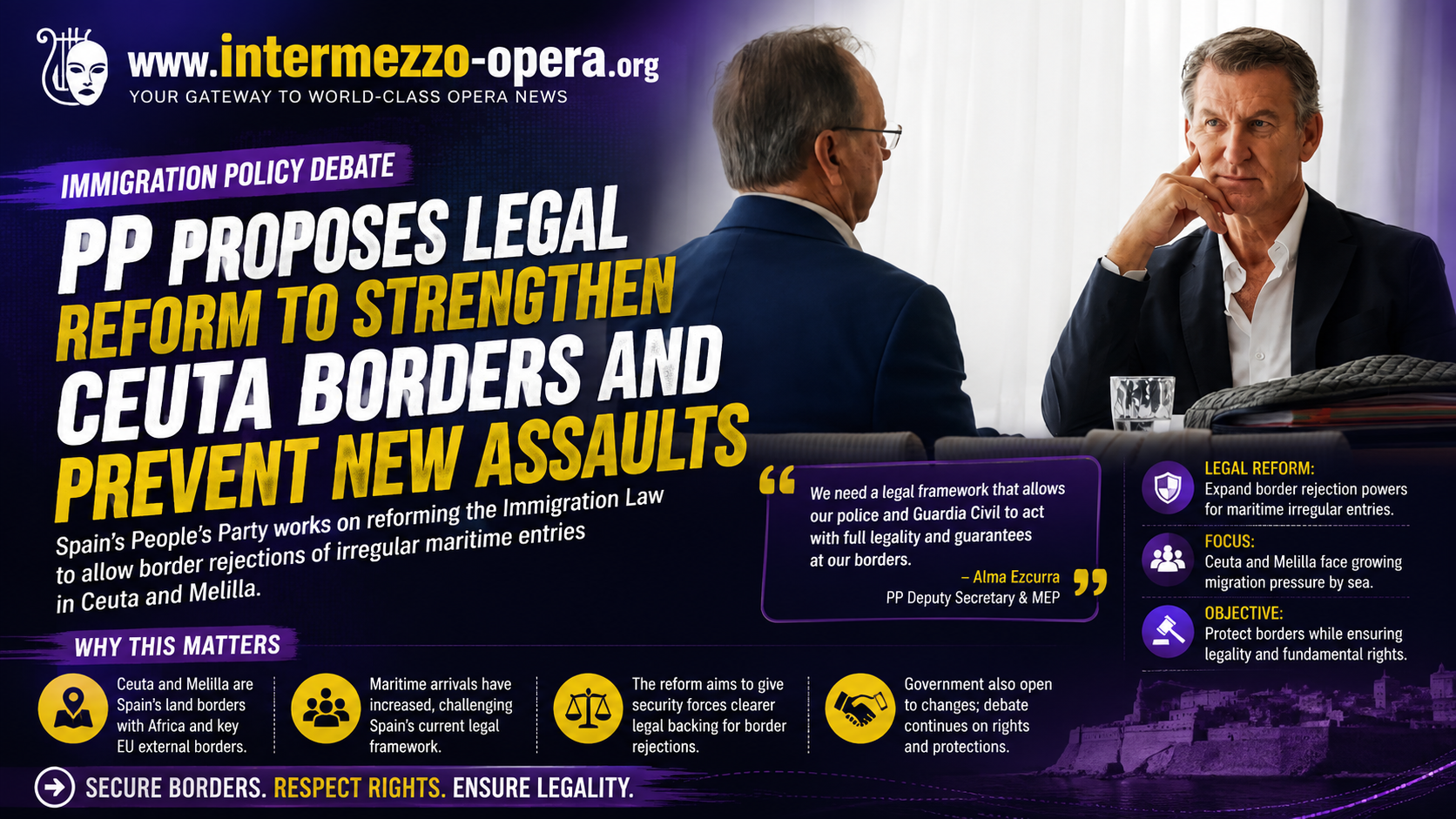
Spain’s PP Pushes Immigration Law Reform After Ceuta Crisis, Seeking Tougher Maritime Border Controls
 0
0
 0
0
Read Time:4 Minute, 20 Second
CEUTA, SPAIN – Spain’s conservative People’s Party (PP) is pushing for a reform of the Immigration Law that would expand the legal framework for rejecting irregular entries at the borders of Ceuta and Melilla, particularly when migrants attempt to reach the Spanish territories by sea.
The proposal has gained renewed attention following the recent migration crisis in Ceuta, where a large number of people entered from neighboring Morocco. The situation prompted Spanish authorities and political parties to debate whether the country’s existing border legislation is adequate to deal with large-scale maritime arrivals.
Under the PP proposal, Spain’s National Police and Guardia Civil would receive clearer legal protection when carrying out border rejections involving people attempting to enter Ceuta or Melilla irregularly by swimming or other maritime routes.
PP Wants Immigration Law Adapted to Maritime Arrivals
The proposed PP immigration law reform was announced in July by Alma Ezcurra, the party’s deputy secretary for sectoral coordination and an MEP.
According to the PP, the current legislation needs to be adapted because migration pressure in Ceuta and Melilla has increasingly shifted from land-border crossings to maritime routes.
The proposal follows a Spanish Supreme Court ruling concerning immediate border rejections.
The court recognized the legality of such measures when an irregular entry occurs through a physical border-containment structure, such as the fences surrounding Ceuta and Melilla. However, the legal situation is different when migrants arrive by swimming through the sea.
The PP therefore wants Parliament to modify Spain’s Organic Law on the Rights and Freedoms of Foreigners to provide security forces with a clearer legal framework for maritime cases.
Ceuta Migration Crisis Intensifies Debate
The issue became even more politically significant following the latest migration crisis in Ceuta.
Ceuta President Juan Jesús Vivas, a member of the PP, said in early August that the autonomous city had not yet returned to normality after thousands of migrants entered from Morocco.
Vivas called for the return process to be completed and urged authorities to maintain security deployments in the city. He also argued that Ceuta and Melilla require specific legal and operational resources because they are the European Union’s only land borders with Africa.
PP leader Alberto Núñez Feijóo also criticized the Spanish government’s handling of the crisis, describing Madrid’s initial response as insufficient and demanding stronger measures to protect the border.
Reform Focuses on Border Rejections
An important distinction is necessary when discussing the proposal.
The PP’s confirmed initiative focuses on extending the legal framework for border rejections involving irregular maritime entries. It should not automatically be described as a blanket prohibition preventing every migrant arriving in Ceuta from requesting asylum.
International protection and asylum applications are governed by separate Spanish and European legal safeguards.
The PP says its objective is to allow security forces to respond to irregular maritime entries “with full legality and all guarantees.”
This distinction is particularly important because asylum seekers cannot simply be treated in the same way as every other person entering irregularly. Individual circumstances and applicable international-protection rules can affect whether someone may legally be returned.
Spanish Government Also Open to Legal Changes
Interestingly, the PP is not alone in considering changes to the existing framework.
Following the Ceuta crisis, Prime Minister Pedro Sánchez said his government was willing to examine a possible reform of the Immigration Law to make border repatriations more efficient.
Sánchez made the remarks during a visit to Ceuta on July 31, while also emphasizing cooperation with Morocco to facilitate the return of Moroccan nationals.
This means the political debate is increasingly focused not only on whether legislation should change, but also on the exact legal safeguards and procedures any reform should contain.
Ceuta Calls for Stronger Border Protection
Vivas has strongly supported reforming the Immigration Law.
During the recent crisis, the Ceuta government requested additional security personnel, greater resources for reception facilities and stronger cooperation between Spain and Morocco.
Vivas also argued that the Supreme Court ruling exposed a legal gap regarding irregular maritime arrivals and called on Parliament to address it.
Ceuta faces a particularly complex challenge because of its geography.
The Spanish autonomous city lies on the North African coast and shares a land border with Morocco, making it one of the European Union’s most sensitive external borders.
Migration Policy Remains Politically Contentious
Any reform of Spain’s Immigration Law is likely to generate significant political and legal debate.
Supporters of tougher border controls argue that police and the Guardia Civil need clear rules to respond rapidly to large-scale irregular entries.
Critics and human-rights advocates, meanwhile, are likely to focus on whether new procedures sufficiently protect asylum rights, vulnerable migrants and minors.
Spanish law and European obligations mean border security measures must coexist with fundamental rights and international-protection procedures.
For that reason, the final wording of any legislation will determine how far Spanish authorities can extend immediate border rejections without conflicting with existing legal safeguards.
The PP’s initiative has therefore become part of a broader debate about how Spain should manage irregular migration in Ceuta and Melilla while balancing border security with its domestic and international legal obligations.


Happy
0 %

Sad
0 %

Excited
0 %

Sleepy
0 %

Angry
0 %

Surprise
0 %
Related Post

Supreme Court to hear death row case concerning prosecutor with history of discriminatory juror selection
The U.S. Supreme Court has agreed to hear a high‑profile appeal in a death row…