
Colombia’s Business Sector Calls for Investment and Cooperation in a New Economic Era
 0
0
 0
0
Read Time:5 Minute, 23 Second
BOGOTÁ – Colombia’s business sector is calling for a new period of cooperation with the government of President Abelardo De La Espriella. Business leaders see the political transition as an opportunity to rebuild confidence, encourage private investment and strengthen economic growth.
De La Espriella took office on August 7, 2026. In his first address as president, he promised fiscal discipline, a smaller state and policies aimed at restoring economic stability. He also highlighted the importance of the private sector in Colombia’s development.
The change has generated optimism among parts of the business community.
However, companies and industry groups also expect clear policies. They want the new administration to provide legal certainty, improve security and create better conditions for long-term investment.
Colombia’s Business Sector Sees a New Opportunity
The transition comes at an important moment for the Colombian economy.
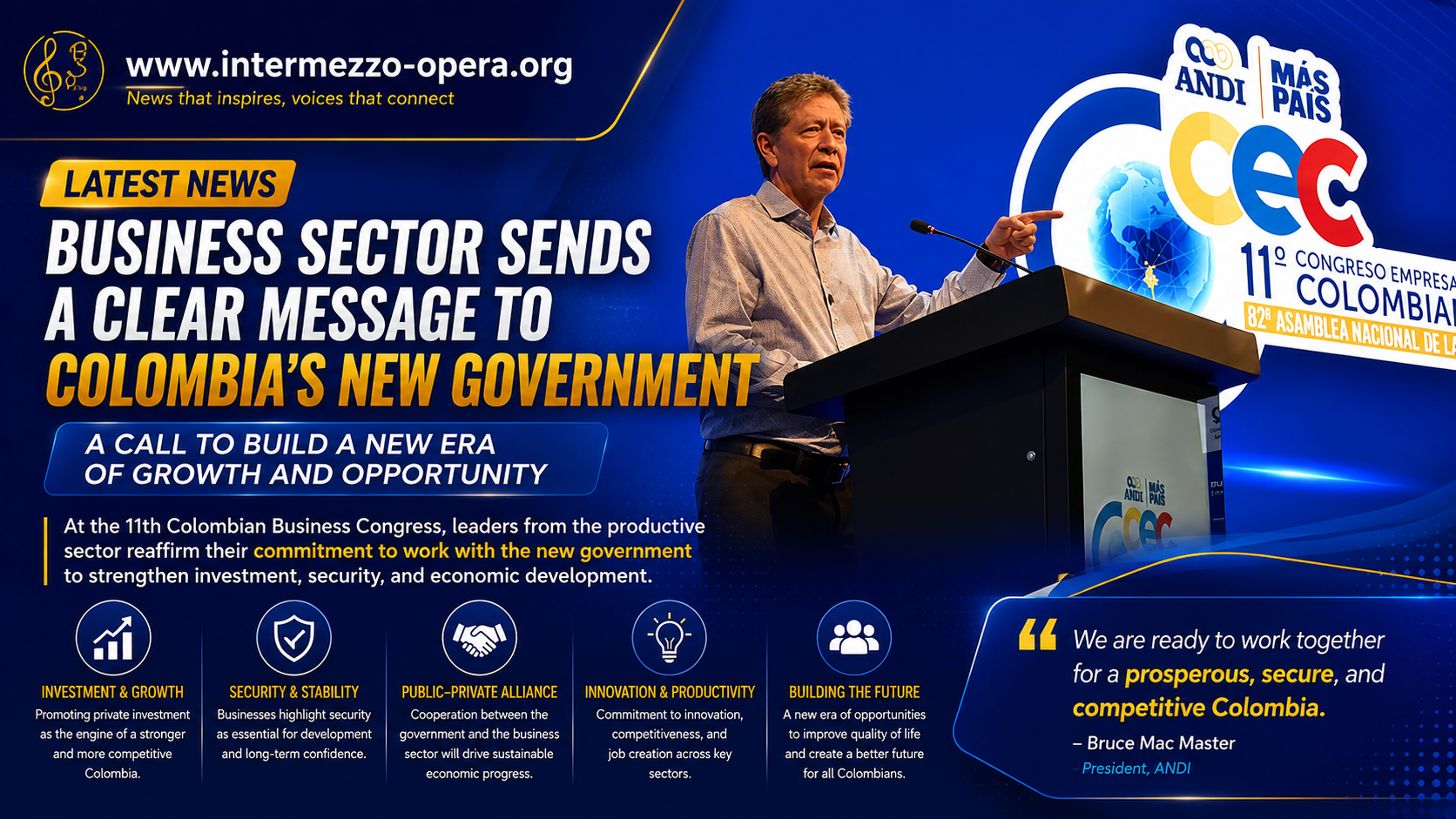
Business leaders gathered at the Colombian Business Congress in Cartagena this week. The event, organized by the National Association of Businesspeople of Colombia, or ANDI, traditionally provides an important platform for discussing the country’s economic direction.
This year, the atmosphere was notably optimistic about the change of government.
In addition, the business community has highlighted confidence as an important factor for economic recovery.
ANDI President Bruce Mac Master stressed the importance of collective confidence and expectations in supporting economic growth.
Therefore, rebuilding trust between government and businesses could become an important part of the new administration’s economic agenda.
Private Investment Becomes a Priority
Investment is one of the central issues facing the new government.
Before taking office, the incoming administration indicated that economic adjustment would be accompanied by policies designed to stimulate growth. Construction, mining and tourism were identified among sectors expected to play an important role.
The government has also called on businesses to invest again.
Meanwhile, business groups want conditions that make those investments sustainable.
Legal certainty is particularly important for companies planning projects that may take years to generate returns.
Stable regulations can help businesses calculate risks. Furthermore, predictable economic policies can make Colombia more attractive to domestic and international investors.
Security Is Also Important for Businesses
Economic policy is not the only concern.
Security remains another major issue for Colombia’s productive sector.
De La Espriella made security one of the central themes of his inauguration speech. His administration has promised a tougher approach toward drug trafficking and armed groups.
For businesses, security directly affects transportation, agriculture, tourism, energy and investment.
Companies operating outside major cities can face additional challenges when infrastructure or regional security deteriorates.
As a result, improvements in security could influence investment decisions across several industries.
New Government Promises Fiscal Discipline
Colombia’s fiscal situation is another major challenge.
The new president has announced plans to freeze government spending as part of an effort to restore fiscal stability. His administration has also proposed reducing the size of the state.
These measures could significantly change the relationship between the government and private businesses.
Nevertheless, fiscal adjustment can be difficult.
Reducing expenditure while supporting economic growth requires careful decisions. Therefore, the administration will need to balance fiscal discipline with investment in infrastructure and public services.
Business confidence could depend partly on how successfully that balance is achieved.
Energy Policy Takes a Different Direction
Energy is another sector where major changes are expected.
The new administration has announced plans to revive Colombia’s oil and gas industry. De La Espriella has also backed additional exploration and a return to fracking under stricter environmental standards.
This represents a significant change from the policies of former President Gustavo Petro.
The previous administration prioritized renewable energy and restricted new oil and gas exploration contracts.
However, De La Espriella has said the energy transition should continue gradually without weakening Colombia’s existing energy resources.
The shift could attract renewed attention from companies in the energy and infrastructure sectors.
Agricultural Producers Present Their Priorities
Colombia’s agricultural sector has also started discussions with the new administration.
Before the inauguration, the Federation of Cereal, Legume and Soybean Growers met with incoming Agriculture Minister Indalecio Dangond.
The discussions included productivity, profitability and competitiveness.
In addition, proposals included new credit models, agricultural insurance reforms, investment in irrigation and greater mechanization.
Livestock producers have also presented priorities to the new government.
The Colombian Federation of Cattle Ranchers has called for policies that improve productivity while creating employment and economic opportunities.
These discussions show that expectations extend beyond large corporations.
Farmers and regional producers also want to participate in Colombia’s new economic direction.
Business and Government Cooperation Could Be Crucial
The relationship between the government and private sector is likely to play an important role during the next four years.
Colombia already has a diverse productive base. Agriculture, manufacturing, tourism, energy, construction and services all contribute to economic activity.
Therefore, policies affecting investment and business confidence can have consequences across the economy.
The previous administration reported progress in diversifying exports. By the end of 2025, non-mining-energy goods and services represented 66 percent of Colombia’s total exports, according to the Ministry of Commerce, Industry and Tourism.
The challenge for the new government will be to preserve useful advances while implementing its own economic priorities.
Businesses Want Clear and Predictable Rules
Political transitions often create uncertainty for companies.
Changes in taxation, labor regulation, environmental policy and energy rules can affect investment decisions.
For that reason, businesses generally place significant value on predictable regulations.
At the same time, the government needs companies to create jobs and expand productive capacity.
This creates an opportunity for cooperation.
The new administration has openly defended the role of private enterprise as an engine of development.
If that position translates into stable policies, investor confidence could strengthen.
Colombia Looks Toward a New Economic Stage
The beginning of a new administration gives Colombia an opportunity to redefine relations between the state and its productive sectors.
Business leaders appear willing to participate in that process. However, optimism will eventually depend on concrete results.
Investment needs stability. Companies also need infrastructure, security and predictable regulations.
Likewise, the government needs private investment to generate employment, production and tax revenue.
The first months of the De La Espriella administration will therefore be important.
Economic policy, security measures and regulatory decisions will help determine whether the current optimism develops into sustained investment.
For Colombia’s business sector, the message is increasingly clear: the political transition should become an opportunity for cooperation, investment and a new stage of economic development.


Happy
0 %

Sad
0 %

Excited
0 %

Sleepy
0 %

Angry
0 %

Surprise
0 %
Related Post
European stocks move higher as attention turns to the Fed
European stocks moved higher in recent trading sessions as investor attention shifted toward the monetary…