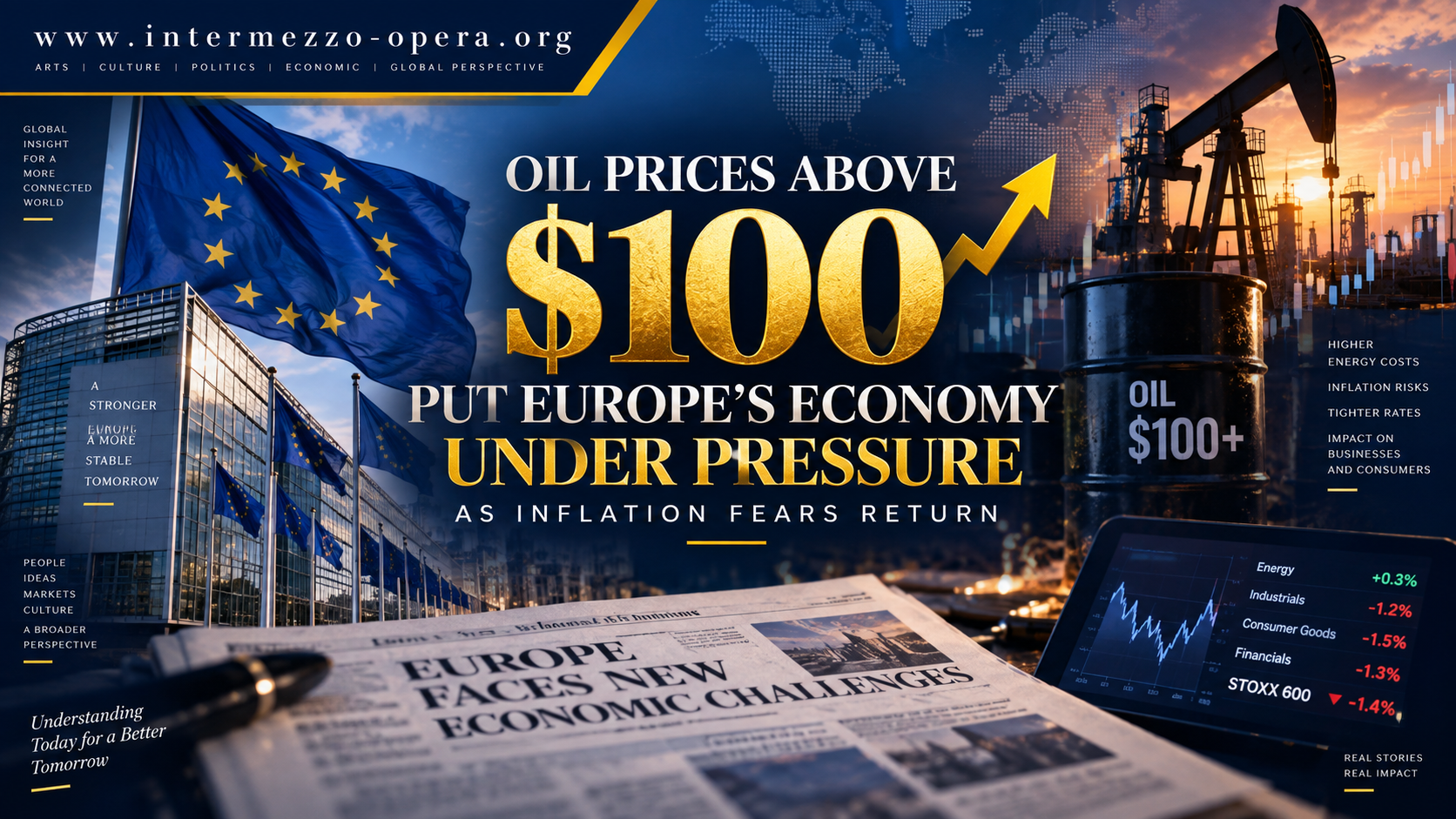
Oil Prices Above $100 Put Europe’s Economy Under Pressure as Inflation Fears Return
 0
0
 0
0
Read Time:5 Minute, 8 Second
Europe’s economy is facing renewed pressure as global oil prices climb above $100 per barrel, bringing energy costs and inflation back into focus. The latest surge comes amid escalating tensions in the Middle East and concerns about further disruption to energy supplies passing through the Strait of Hormuz.
Brent crude crossed the $100 threshold on September 9 for the first time in roughly six weeks. The benchmark has risen by about a quarter since early August as disruptions across the Middle East tighten global supply. A prolonged period of expensive oil could increase transportation, manufacturing and operating costs for businesses across Europe.
Europe’s Economy Faces a New Energy Challenge
The latest energy shock arrives at a sensitive moment for Europe’s economy. Businesses have already spent years adapting to volatile energy markets, changing supply chains and higher financing costs.
Expensive oil can spread through an economy in several ways. Transportation companies face higher fuel bills, manufacturers pay more to move materials and finished goods, while consumers can encounter higher prices at petrol stations.
Those additional costs may eventually influence the prices of everyday goods and services.
The European Central Bank has previously estimated that the current Middle East energy shock could reduce euro-area real GDP growth by around 0.4 percentage points over its first year under assumptions used in its analysis.
European Stock Markets React to $100 Oil
Financial markets responded quickly to the latest increase.
The pan-European STOXX 600 dropped 1.4% on September 9 to 640.41 points, its lowest level since late July. Energy was the only major sector remaining in positive territory, gaining 0.3%, while other major sectors declined.
The market reaction demonstrates why oil matters far beyond petroleum companies.
Higher energy prices can raise inflation expectations. Investors may then anticipate tighter monetary policy, pushing bond yields higher and making borrowing more expensive.
For Europe’s economy, this creates an uncomfortable combination: companies face higher operating expenses while financing can simultaneously become more costly.
Inflation Fears Return to Europe
Inflation is one of the biggest concerns surrounding the latest oil rally.
ECB analysis published earlier this month found that the rise in headline inflation during the first five months of 2026 was driven overwhelmingly by adverse energy supply shocks. Euro-area headline inflation increased from 1.7% in January to 3.2% in May.
The situation differs from the inflation surge of 2021–2022, when pandemic-related supply disruptions, strong demand, fiscal support and energy prices were all important factors.
This time, energy has been the dominant force.
That distinction matters because policymakers must determine whether expensive energy remains an isolated shock or starts feeding more broadly into wages, goods and services.
Higher Interest Rates Could Add More Pressure
Another challenge for Europe’s economy is monetary policy.
Markets were pricing in further ECB tightening as oil moved beyond $100. Euro-zone government bond yields reached fresh multi-year highs on September 9, while traders anticipated additional interest-rate increases.
Several major financial institutions have also revised their expectations.
J.P. Morgan and BNP Paribas recently forecast another 25-basis-point ECB rate increase in December, citing persistent energy-related inflation risks. Deutsche Bank has similarly revised its outlook toward additional tightening later in 2026.
Higher rates can help contain inflation, but they also increase borrowing costs for households and companies.
Mortgages, business loans and investment financing can become more expensive, potentially slowing economic activity.
Businesses Could Feel the Impact
The effect of $100 oil will not be identical across European industries.
Airlines, logistics companies, chemical producers and manufacturers with energy-intensive operations are particularly exposed to higher fuel and transportation costs.
Retailers can also experience indirect pressure because suppliers may eventually pass higher costs along the chain.
Meanwhile, energy producers can benefit from elevated commodity prices. This contrast was visible in European markets, where the energy sector gained even as the broader STOXX 600 declined.
Small and medium-sized businesses may face a more difficult adjustment because they generally have fewer options for absorbing sudden increases in operating expenses.
Consumers Could Become More Cautious
Consumer spending represents another important channel.
When households spend more on fuel, transportation and essential goods, they have less disposable income available for restaurants, travel, entertainment and discretionary purchases.
The ECB has found that geopolitical oil supply shocks can weaken both private consumption and investment. Investment tends to be particularly sensitive because energy shocks are often accompanied by greater economic uncertainty.
This means sustained high oil prices could affect Europe’s economy even without creating another inflation episode on the scale seen earlier in the decade.
Europe Still Shows Signs of Economic Resilience
The picture is not entirely negative.
Euro-zone private-sector activity continued expanding in August. The composite PMI stood at 52.0, while exports increased for the first time in four and a half years, supported by manufactured goods. Employment in services also recorded its fastest increase in eight months.
These figures suggest the regional economy entered the latest energy-price surge with some underlying resilience.
However, the ECB’s June projections expected euro-area real GDP to grow only 0.8% in 2026, followed by 1.2% in 2027. The same projections expected headline inflation to reach 3.4% during the third and fourth quarters of 2026, largely because of energy costs.
$100 Oil Becomes a Major Test for Europe’s Economy
The return of oil above $100 therefore represents more than another volatile move in commodity markets.
If prices remain elevated, Europe’s economy could face a combination of higher business costs, weaker household purchasing power, persistent inflation and tighter monetary policy.
Much will depend on developments in Middle East energy supplies and whether oil continues trading at elevated levels.
Europe has become less oil-intensive over the long term, which provides some protection compared with previous energy crises. Yet the latest market reaction shows that energy remains capable of influencing inflation, interest rates, investment and consumer confidence simultaneously.
For Europe’s economy, the key question is no longer simply how high oil can climb, but how long expensive energy will remain part of the economic landscape.


Happy
0 %

Sad
0 %

Excited
0 %

Sleepy
0 %

Angry
0 %

Surprise
0 %
Related Post
More Than 9 Million Workers in Argentina Remain Informally Employed as Job Quality Faces Growing Scrutiny
Informal employment in Argentina has once again become a major concern after the latest labor…