
Beyond Wind Power: Uruguay Opens the Door to a New Decade of Solar Investment
 0
0
 0
0
Read Time:5 Minute, 0 Second
MONTEVIDEO – After becoming one of Latin America’s most prominent renewable-energy success stories through wind power, Uruguay is preparing for a new wave of solar investment that could reshape its electricity system over the coming decade.
The shift does not mean Uruguay is abandoning wind energy. Instead, solar photovoltaic generation is expected to play a much larger role alongside wind and hydropower as electricity demand increases and the country moves into the next stage of its energy transition.
Uruguay’s Ministry of Industry, Energy and Mining has projected that new renewable generation will be required from 2025 onward. Under its long-term electricity expansion scenarios, solar capacity is expected to expand earlier and faster than wind, eventually reaching roughly a 2-to-1 relationship between the two technologies in new generation expansion.
Uruguay Plans 500 MW of New Renewable Capacity
The transition is already moving from planning to investment.
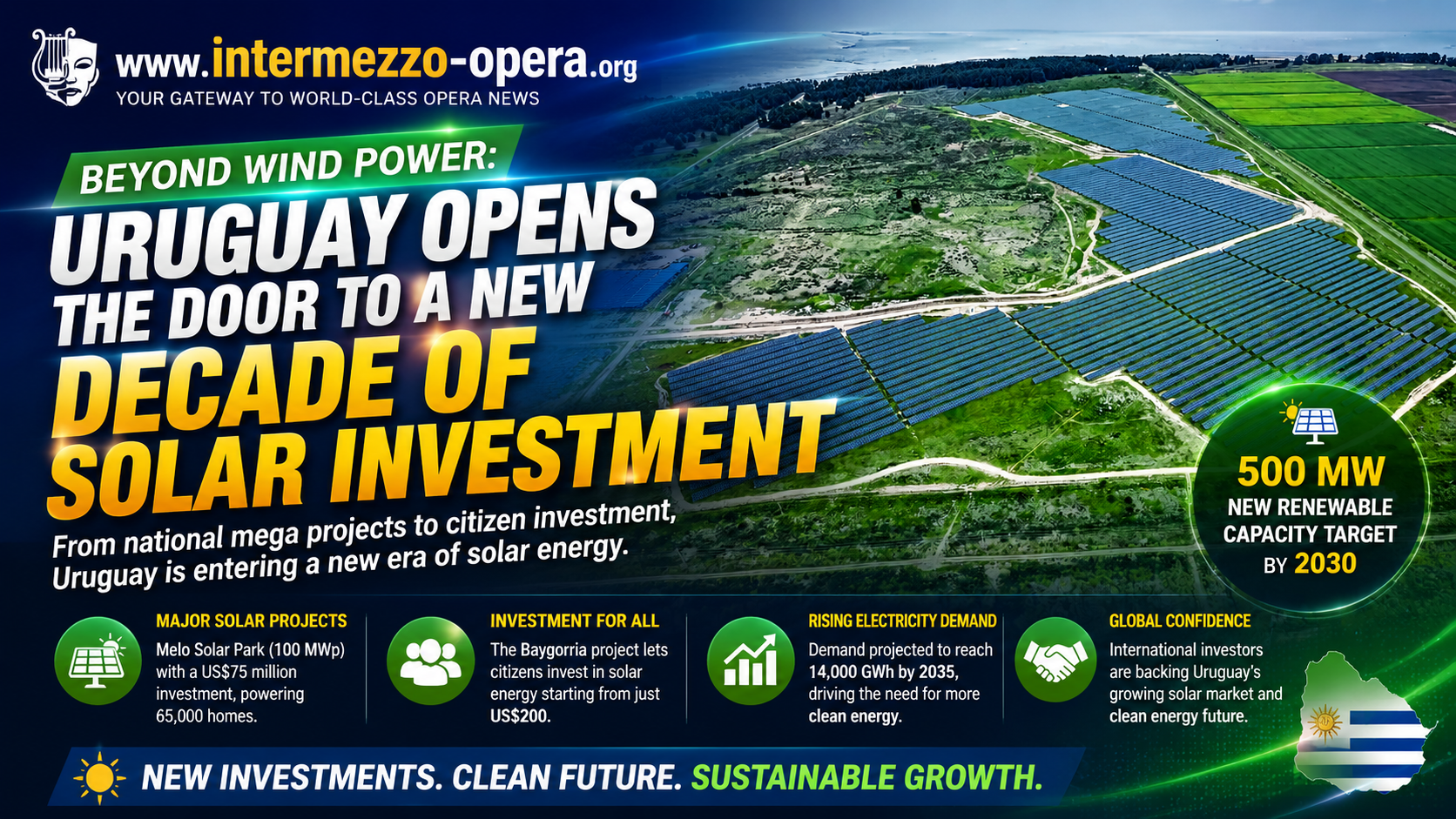
Industry, Energy and Mining Minister Fernanda Cardona said in July that Uruguay intends to add approximately 500 MW of renewable generation before the current administration ends in February 2030.
The strategy places particular emphasis on photovoltaic energy and includes four new solar projects, two of which had already been identified when the plan was announced.
This represents an important evolution for a country internationally recognized for transforming its electricity system through wind generation.
Rather than replacing the wind farms that helped drive Uruguay’s first renewable revolution, solar installations are expected to complement them.
Melo Solar Park Marks a Major Investment
One of the clearest signs of Uruguay’s new solar push is the Melo Photovoltaic Park in Cerro Largo.
State-owned electricity company UTE is investing approximately US$75 million in the project. The facility will have more than 75 MW of capacity and is scheduled for completion in 2028.
UTE says the project will feature around 140,000 photovoltaic panels and reach 100 MWp of installed peak capacity.
Once operational, the facility is expected to provide enough electricity for approximately 65,000 users.
Construction will also employ more than 100 people, adding an economic-development dimension to the country’s renewable expansion.
Baygorria Opens Solar Investment to Small Savers
Uruguay is also experimenting with a different financing model.
President Yamandú Orsi announced a photovoltaic project in Baygorria, Durazno, that will allow individual citizens to participate as investors.
Under the initiative, people will be able to invest starting from just US$200.
The model is significant because renewable infrastructure investment is typically dominated by governments, utilities, banks and large institutional investors.
Baygorria aims to broaden participation by giving smaller savers an opportunity to invest in national energy infrastructure.
The government sees the initiative as a way to combine renewable-energy development, investment opportunities and economic activity outside Montevideo.
Electricity Demand Is Expected to Rise
Uruguay’s solar expansion is not happening simply because photovoltaic technology has become more attractive.
The country is preparing for increasing electricity consumption.
The government’s long-term generation plan projects annual electricity demand could reach approximately 14,000 GWh by 2035. Under scenarios involving additional industrial or technology-related demand, that threshold could be reached even earlier.
Meeting that demand will require additional generation capacity.
Solar has several characteristics that make it particularly attractive within Uruguay’s existing system. The government notes that photovoltaic production complements wind generation on a daily basis and hydropower on a seasonal basis.
This allows different renewable technologies to work together rather than compete for the same role.
International Investors Are Taking Notice
Private capital is also showing interest in Uruguay’s established solar market.
In May 2026, global investment manager Ardian acquired two operational photovoltaic plants from Atlas Renewable Energy. The El Naranjal and Del Litoral facilities in Salto have a combined capacity of approximately 75.8 MWp.
For Ardian’s clean-energy fund, the transaction represented its first direct renewable investment in Uruguay.
Atlas Renewable Energy said the two assets had been part of its portfolio since the company’s early development and that the transaction would allow capital to be redeployed toward new opportunities elsewhere in the region.
Transactions involving mature renewable assets can also be significant for Uruguay because they demonstrate that operational solar projects have value in the international infrastructure-investment market.
From Wind Revolution to Solar Expansion
Uruguay already accomplished one of the most significant electricity transformations in Latin America during the previous decade.
Wind, hydropower, biomass and solar generation dramatically reduced the country’s dependence on fossil fuels for electricity production.
The next challenge is different.
Electricity consumption is expected to increase as transportation, industry and other economic activities become increasingly electrified. Maintaining a low-carbon electricity system will therefore require additional renewable capacity.
Solar power is increasingly positioned to fill a substantial part of that requirement.
The Melo project, Baygorria investment model and additional photovoltaic plants planned before 2030 provide early evidence that the transition is already underway.
A Decade of Opportunity for Solar Investment
Uruguay’s long-term planning extends well beyond the projects currently under construction.
The Ministry of Industry’s electricity expansion study covers the period through 2043 and consistently identifies a need for additional renewable generation. Solar begins expanding before wind in the scenarios examined, reflecting its growing competitiveness within the electricity system.
That creates opportunities not only for developers of large photovoltaic parks but potentially for energy storage, transmission infrastructure, distributed generation, industrial self-generation and related technologies.
Uruguay has also formally approved the framework agreement establishing its participation in the International Solar Alliance, whose broader objectives include mobilizing investment and reducing financing and technology costs for solar deployment.
The emerging picture is therefore broader than the construction of several photovoltaic plants.
After building its international renewable reputation around wind turbines, Uruguay’s solar investment landscape is entering a new phase. The combination of rising electricity demand, government-backed projects, private capital and long-term generation planning could make photovoltaic power one of the defining elements of the country’s energy sector during the next decade.


Happy
0 %

Sad
0 %

Excited
0 %

Sleepy
0 %

Angry
0 %

Surprise
0 %
Related Post

China’s “Unfinished Kids” Phenomenon Exposes Growing Pressure on Young Graduates
BEIJING – China’s unfinished kids phenomenon has become a widely discussed symbol of the growing…