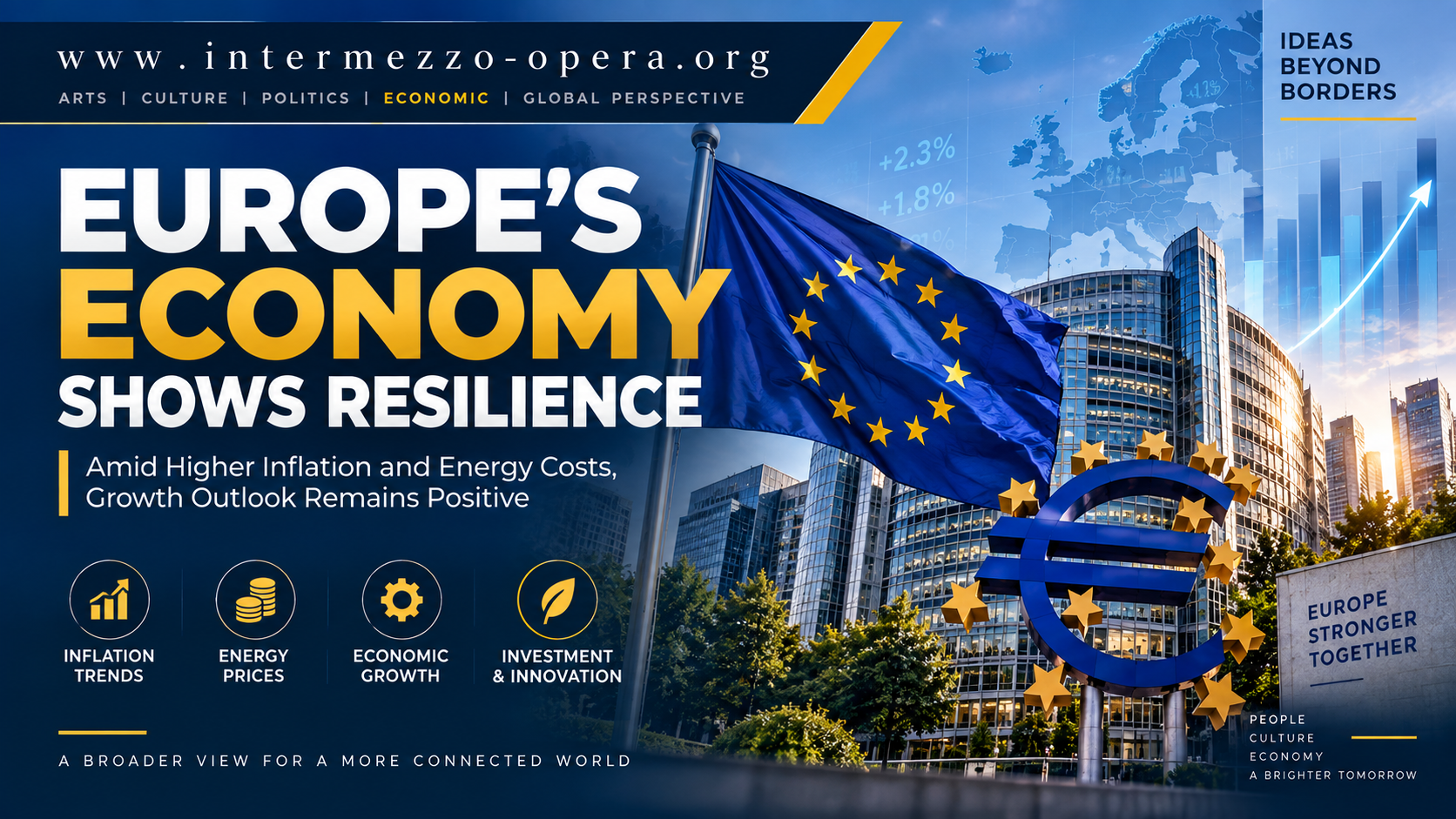
Europe’s Economy Shows Resilience as Inflation and Energy Costs Rise
 0
0
 0
0
Read Time:2 Minute, 17 Second
Europe’s economy is facing a new test.
Energy prices have pushed inflation higher across the euro area. However, economic growth remains stronger than many expected.
The European Central Bank, or ECB, is now watching prices and growth very closely.
Inflation Rises Across the Euro Area
Euro area inflation reached 3.3% in August 2026. The figure rose from 2.9% in July.
Energy costs played a major role. Energy inflation reached 14.3% in August. The figure stood at 10.3% one month earlier.
As a result, households face higher energy bills. Businesses also face higher operating costs.
Therefore, inflation remains a major economic issue for Europe.
ECB Raises Interest Rates
The ECB raised its three key interest rates by 0.25 percentage points on September 10.
The deposit rate now stands at 2.50%. The main refinancing rate stands at 2.65%.
The ECB wants inflation to return to its 2% target. At the same time, policymakers must avoid putting too much pressure on economic activity.
Economic Growth Remains Positive
Despite the pressure, Europe’s economy continues to grow.
Euro area GDP increased by 0.4% in the second quarter of 2026. The economy had recorded no growth in the first quarter.
The wider EU economy grew by 0.5% during the same period.
This result shows that businesses and consumers still support economic activity.
Moreover, investment in technology is creating new opportunities.
AI Investment Supports Business
Artificial intelligence is becoming an important part of Europe’s economy.
Companies are increasing investment in digital services and new technology. The ECB says AI-related activity has supported business investment and exports.
In addition, public investment remains an important source of growth. A strong labor market also supports consumer spending.
Therefore, technology could help Europe maintain economic momentum.
Energy Remains a Key Risk
Energy prices remain one of Europe’s biggest challenges.
The conflict in the Middle East has increased uncertainty in energy markets. Higher energy costs can raise prices across many sectors.
However, the ECB expects the pressure to ease over time. Its latest outlook sees inflation falling toward 2.1% in 2028.
Europe is also accelerating its energy transition. Clean energy can reduce long-term dependence on fossil fuels.
What Comes Next for Europe?
Europe enters the final part of 2026 with both challenges and opportunities.
Inflation remains high. Energy costs remain uncertain. However, economic growth has shown resilience.
The ECB expects euro area GDP to grow 0.9% in 2026. It then expects growth to reach 1.4% in 2027 and 1.5% in 2028.
Therefore, Europe’s economic outlook remains mixed.
The next few months will be important. Energy prices, inflation, interest rates, and investment will shape the region’s economic direction.


Happy
0 %

Sad
0 %

Excited
0 %

Sleepy
0 %

Angry
0 %

Surprise
0 %
Related Post
Wall Street: America’s Deadly Weapon for World Domination Without War
In today’s interconnected global economy, power is no longer defined solely by military strength. Instead,…