
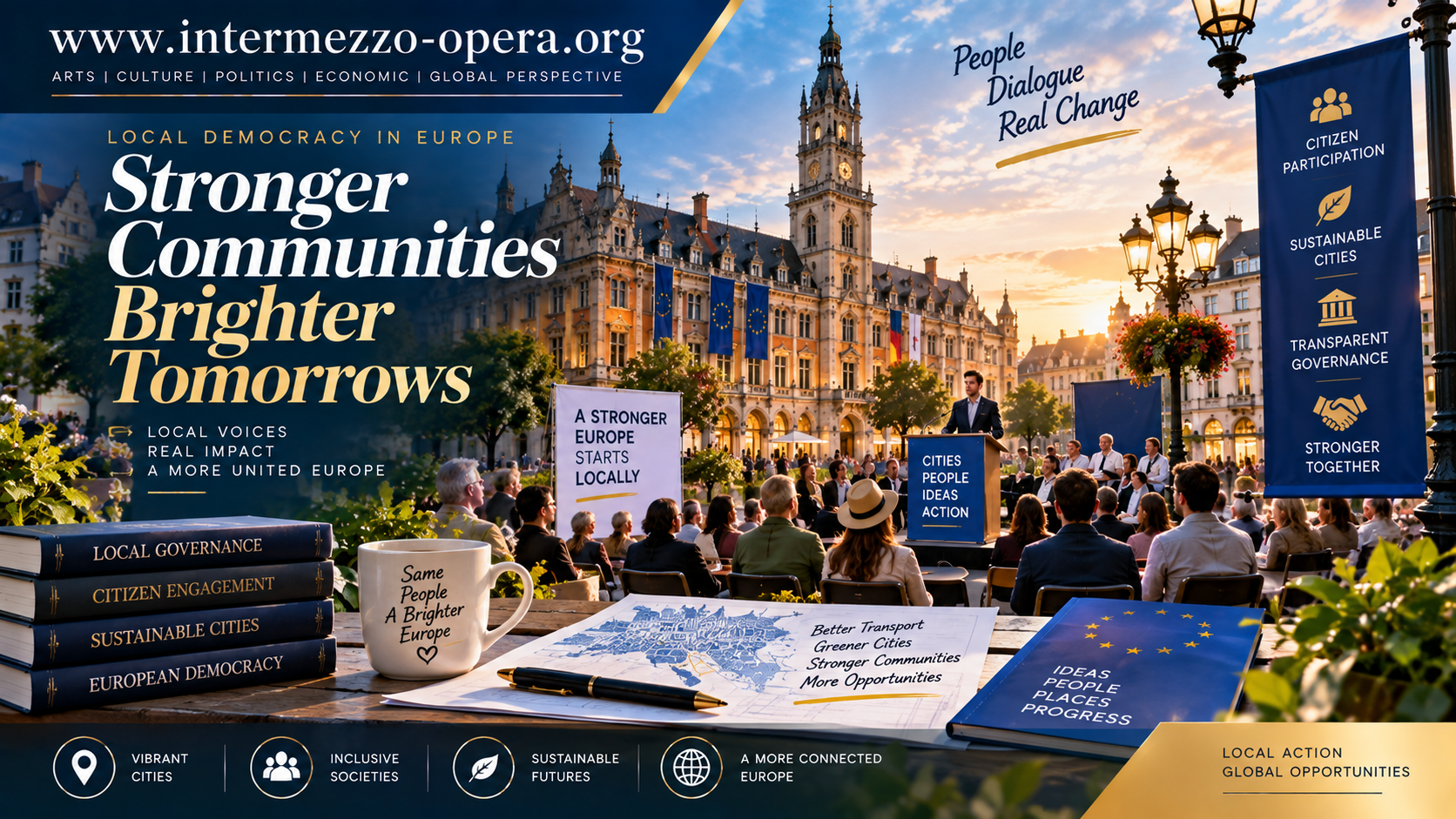
Local Democracy in Europe: Why City Politics Matters More Than Many People Think
 0
 0
Read Time:7 Minute, 0 Second
Local democracy in Europe affects daily life in ways that national politics often cannot. City councils and regional authorities make decisions about transport, housing, public spaces, waste, local development, and many community services. Therefore, politics at the local level can feel especially close to citizens.
This role is receiving renewed attention in 2026. The Council of Europe says democratic resilience is built locally and highlights citizen engagement as an important part of strong local governance. Its European Local Democracy Action initiative also promotes citizen participation throughout the year.
Local Democracy in Europe Starts Close to Home
National elections usually receive significant media attention. However, local decisions can have an immediate effect on everyday routines.
A new bus route can change a daily commute. Housing rules can influence neighborhood development. Meanwhile, decisions about parks or public spaces can change how residents use their city.
For this reason, local politics is not simply a smaller version of national politics.
It deals with problems that residents can often see directly.
The Council of Europe has long connected effective local authorities with democratic participation and accountable governance.
Citizens Have More Ways to Participate
Voting remains an essential democratic tool.
However, citizens can also participate between elections.
They may attend public meetings, respond to consultations, contact local representatives, or join community organizations.
In addition, some cities experiment with citizens’ assemblies and other deliberative processes.
The Council of Europe describes deliberative democracy as a process where a broadly representative group examines evidence, discusses an issue, and develops recommendations for public authorities.
Therefore, participation can take several forms.
Citizens’ Assemblies Offer a Different Approach
Citizens’ assemblies have attracted attention because they create space for detailed discussion.
Participants usually receive information about a specific issue. Then, they discuss different options before developing recommendations.
This model does not replace elected representatives.
Instead, it can complement representative democracy.
In 2026, the Council of Europe’s Congress is supporting three citizens’ assemblies in Ukraine, including processes in Kyiv’s Obolon district, Rivne, and the Lviv metropolitan area.
These projects provide practical examples of deliberative participation at the local level.
Local Politics Can Make Complex Issues Easier to Understand
Large political debates can sometimes feel distant.
Local issues are often easier to observe.
Residents can see whether a road needs repair. They can notice changes in public transport. They can also observe how construction affects their neighborhood.
Therefore, citizens can connect political decisions with visible outcomes.
However, local problems can still involve difficult trade-offs.
A city may want more housing while residents want to protect existing neighborhoods.
Similarly, authorities may want to improve transport while businesses worry about access.
Local democracy provides a process for debating these competing interests.
Transparency Matters at the Local Level
Citizens need information to understand public decisions.
For example, residents may want to know why a project received funding.
They may also want information about contracts, planning decisions, or public spending.
Therefore, transparency can support accountability.
The Council of Europe’s standards on local participation connect citizen involvement with openness, accountability, and inclusive governance. Its Additional Protocol on participation in local authority affairs establishes a framework for citizens to take part in local public life.
However, publishing information is only one step.
People also need to understand it.
Clear Communication Can Improve Participation
Government documents can contain technical language.
That language may be necessary for legal purposes. However, it can make participation harder for ordinary residents.
Local authorities can provide shorter explanations alongside detailed documents.
They can also explain what a proposal may change.
For example, a city planning consultation can include maps and simple summaries.
As a result, residents may find it easier to understand the issue before sharing their views.
Clear communication does not guarantee agreement. Still, it can improve the quality of public discussion.
Local Democracy in Europe Includes Different Communities
Modern European cities contain people with different backgrounds, ages, professions, and interests.
Therefore, one consultation method may not reach everyone.
Online surveys can help some residents. However, other people may prefer physical meetings.
Language can also become a barrier.
In addition, people with disabilities may need accessible formats.
The EU’s 2026–2027 Citizens, Equality, Rights and Values work programme lists active citizenship, inclusion, accessibility, and democratic participation at local level among its priorities.
Inclusive participation therefore requires practical planning.
Young People Can Join Local Political Life
Young residents may experience local policy differently from older generations.
They use schools, universities, public transport, sports facilities, parks, and cultural spaces.
However, younger people may not always participate through traditional political channels.
Cities can create youth councils or community projects.
Schools can also introduce students to local institutions.
Meanwhile, digital platforms can make public information easier to discover.
The goal does not need to be political agreement.
Instead, young people can learn how decisions happen and how they can express their own priorities.
Digital Tools Create New Possibilities
Technology has changed communication between governments and residents.
A city can publish council meetings online.
Residents may submit comments without traveling to city hall.
In addition, interactive maps can help people understand development proposals.
These tools can reduce some barriers to participation.
However, digital participation has limitations.
Not everyone has the same digital skills or access.
Therefore, online participation should not automatically replace traditional methods.
A combination of digital and physical options may reach a broader community.
Neighborhood Groups Can Influence Local Debate
Politics does not happen only inside government buildings.
Community organizations can bring attention to local problems.
Residents may organize around traffic, housing, public safety, environmental concerns, or cultural projects.
These groups can provide local knowledge.
For example, residents may understand a street or neighborhood problem that is less visible to officials.
However, community groups do not always represent every resident.
Local authorities still need to hear different perspectives before making decisions.
Local Representatives Connect Citizens and Institutions
Council members and other local representatives have an important role.
They can explain public concerns to institutions.
At the same time, they can explain government decisions to residents.
This two-way relationship can make local politics more accessible.
The European Commission also works with a network of more than 3,000 local councillors as part of its efforts to connect EU policies with everyday life.
Therefore, local representatives can connect different levels of government.
European Cooperation Can Support Local Governance
Local democracy also has a European dimension.
Cities often face similar challenges.
Housing affordability, transport, climate adaptation, digital services, and aging infrastructure affect many communities.
Therefore, municipalities can learn from one another.
The European Local Democracy Action initiative provides a Europe-wide framework for cities and regions to share participation activities and strengthen dialogue with citizens.
This does not mean every city needs the same solution.
Local conditions remain different.
However, shared experience can provide useful ideas.
Participation Does Not Mean Everyone Gets Their Preferred Result
Public participation can create unrealistic expectations if its purpose is unclear.
Residents may believe that giving feedback guarantees a particular outcome.
However, governments often need to balance competing priorities.
One neighborhood may oppose construction. Meanwhile, another group may argue that more housing is necessary.
Therefore, consultation cannot eliminate political disagreement.
Instead, authorities can explain how they considered different views.
This feedback helps citizens understand how the final decision was reached.
Trust Can Grow Through Everyday Governance
Political trust is often discussed as a national issue.
However, everyday experiences with local institutions may also influence how people view government.
A clear permit process can matter.
Reliable public services can matter too.
So can transparent communication.
The Council of Europe says citizen participation can strengthen accountability and help authorities design better policies and services.
Therefore, trust can develop through ordinary interactions rather than political speeches alone.
Local Democracy in Europe Continues to Evolve
Local democracy in Europe is becoming more than elections and council meetings. Citizens’ assemblies, digital consultations, community organizations, and other participation models are adding new channels for public involvement.
At the same time, elected institutions remain responsible for making many final decisions.
The challenge is to connect participation with transparent and effective government.
Citizens need opportunities to express different views. Authorities need processes that can consider those views while still making workable decisions.
Ultimately, local democracy in Europe brings politics closer to everyday life. It allows residents to see how public decisions affect streets, neighborhoods, services, and communities. That connection makes local government an important part of Europe’s wider democratic system.


Happy
0 %

Sad
0 %

Excited
0 %

Sleepy
0 %

Angry
0 %

Surprise
0 %
Related Post

Intermezzo-Opera.org: A Wider Perspective on Politics in a Changing World
Politics is changing quickly. Elections, government decisions, international relations, and public policy continue to shape…