
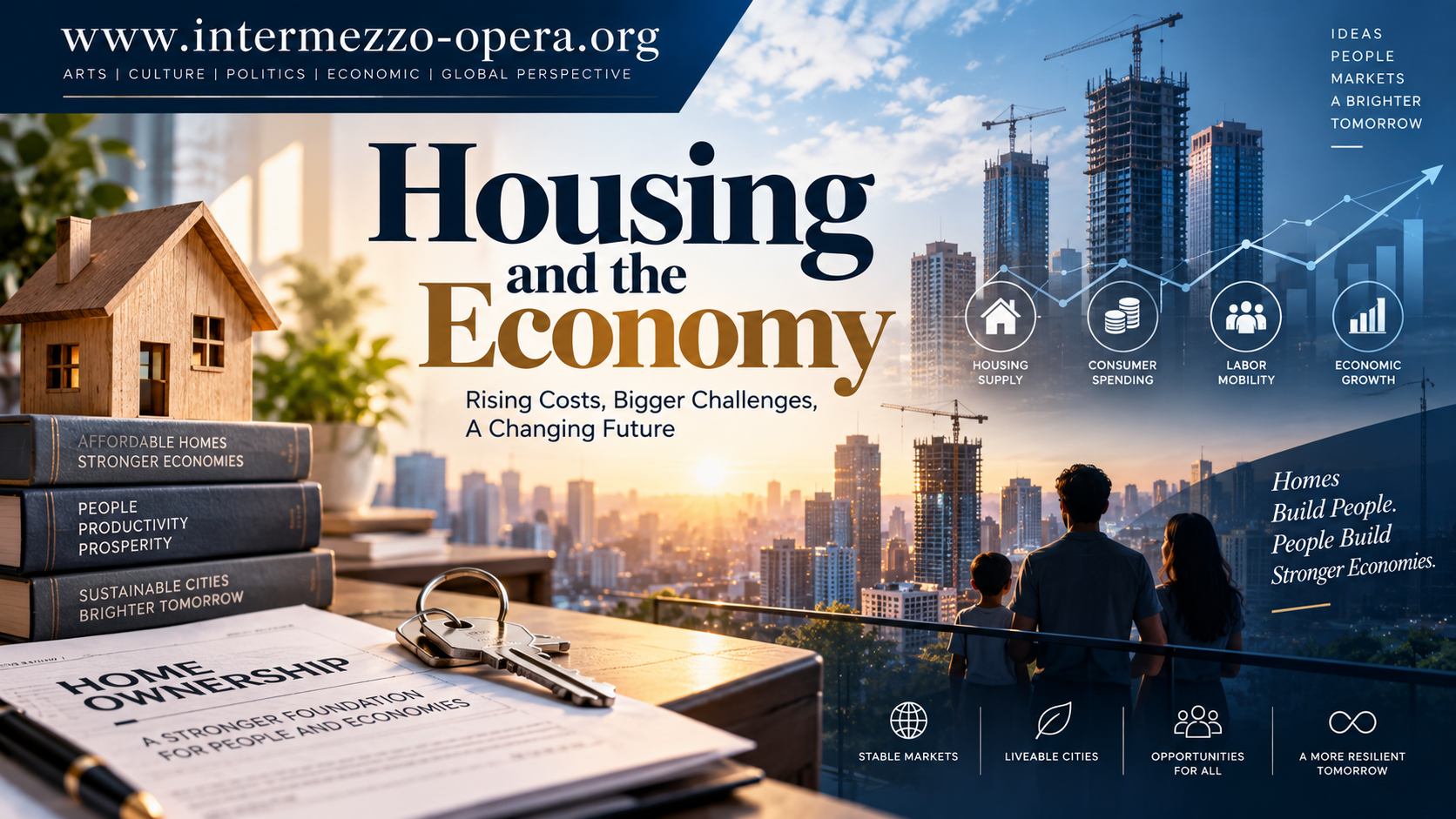
Housing Becomes a Major Economic Challenge as High Costs Reshape Household Spending
 0
 0
Read Time:4 Minute, 36 Second
ECONOMIC | Housing | Consumer Spending | Global Markets
Housing is becoming an increasingly important economic issue in 2026. Beyond the question of where people live, house prices and rents influence household budgets, labor mobility, construction activity, investment and even the distribution of wealth.
The OECD says housing affordability remains difficult across many member economies, particularly in cities where house prices and rents have often increased faster than national averages. High borrowing costs have also made homeownership more difficult for many households.
Housing Costs Are Affecting the Wider Economy
Housing is one of the largest expenses faced by households. When rent or mortgage payments consume a larger share of disposable income, families have less money available for other goods and services.
That can affect sectors ranging from retail and restaurants to travel and entertainment.
The OECD notes that housing affordability problems can also affect economic performance because high housing costs can make it harder for workers to move to locations where jobs and productivity opportunities are available.
This makes housing more than a social issue. It is also connected to labor markets and economic productivity.
Supply Has Become a Key Part of the Problem
One of the important developments in housing economics is the growing role of supply constraints.
A recent IMF working paper examining Europe found that supply-side factors have become increasingly important drivers of house prices compared with the credit-driven housing boom before the global financial crisis. Construction labor shortages and financial constraints in the building sector are among the bottlenecks identified by the researchers.
When housing construction fails to keep pace with demand, prices can remain under pressure even when mortgage conditions become tighter.
Renters Face Particular Pressure
The impact is not distributed equally among households.
The IMF’s analysis of Europe found that lower-income urban renters face a particularly high housing burden. In the data examined by the IMF, low-income urban renters’ average rent-to-income ratio reached about 53% in 2022–24, compared with around 45% before the global financial crisis.
For households with limited income, rising housing costs can therefore reduce the amount available for food, transportation, education, savings and other expenses.
Young Workers Face a Changing Housing Market
Housing affordability can also influence decisions about employment and migration.
If workers cannot afford to live close to major employment centers, they may face longer commutes or decide not to move for a better job.
The IMF’s European research estimates that housing affordability constraints may have contributed to approximately one million foregone moves within the European Union over the past decade. The researchers link this reduction in labor mobility to potential economic efficiency costs.
The finding illustrates how housing markets can influence the broader labor market.
Construction Could Become an Important Economic Channel
Housing shortages also create opportunities and challenges for the construction sector.
Increasing housing supply requires land, financing, construction workers, materials, infrastructure and efficient approval systems.
The OECD has argued that expanding the supply of affordable and social housing can help address affordability pressures while supporting access to employment and economic activity.
However, increasing supply is not simply a matter of building more units. Location, infrastructure, transportation and access to services also determine whether new housing effectively meets demand.
Real Estate Risks Can Affect Financial Stability
Housing markets are closely connected to banks because mortgages and property-related lending represent significant financial exposures.
A prolonged downturn in property markets can therefore affect borrowers, developers and financial institutions.
Cambodia provides a current example of this connection. In its July 2026 Article IV assessment, the IMF identified real estate weakness as a key financial-stability risk because of the sector’s links to households, banks, developers and related businesses.
The situation demonstrates why policymakers monitor property markets not only for their impact on households, but also for potential effects on the financial system.
Housing Demand Is Changing
Housing markets are also being reshaped by demographic and economic changes.
Population growth, migration, urbanization, household formation and changing preferences can alter where demand is concentrated.
Fast-growing cities can experience particularly strong pressure because housing supply may take years to respond to changes in population and employment.
This creates a structural challenge: demand can change quickly, while housing construction generally requires significant time and capital.
The Economic Importance of Affordable Housing
Affordable housing can influence several parts of the economy simultaneously.
More manageable housing costs can leave households with greater disposable income. Adequate housing supply can improve labor mobility, while construction investment can support employment and demand for materials and services.
The OECD describes housing as an issue with direct economic consequences, including effects on household finances, labor mobility and overall economic performance.
For this reason, housing policy is increasingly connected to broader economic policy.
What Comes Next?
The housing market will remain closely linked to interest rates, construction costs, wages, population trends and economic growth.
If borrowing costs decline, mortgage demand could change. But lower interest rates alone may not resolve affordability problems where housing supply remains constrained.
The OECD and IMF analyses point toward the importance of addressing supply bottlenecks alongside measures aimed at helping households cope with housing costs.
Conclusion
Housing has become an increasingly important economic variable in 2026. High prices and rents affect household spending, labor mobility, construction, investment and financial stability.
The challenge is particularly visible in major cities, where demand can outpace the available housing supply.
As governments and economies adapt to changing demographics, employment patterns and financing conditions, the housing market will remain an important part of the global economic story.


Happy
0 %

Sad
0 %

Excited
0 %

Sleepy
0 %

Angry
0 %

Surprise
0 %
Related Post

France’s 2027 Budget Puts Unemployment Insurance Funds Under Pressure
France’s 2027 budget is putting the country’s unemployment insurance system back in the spotlight as…