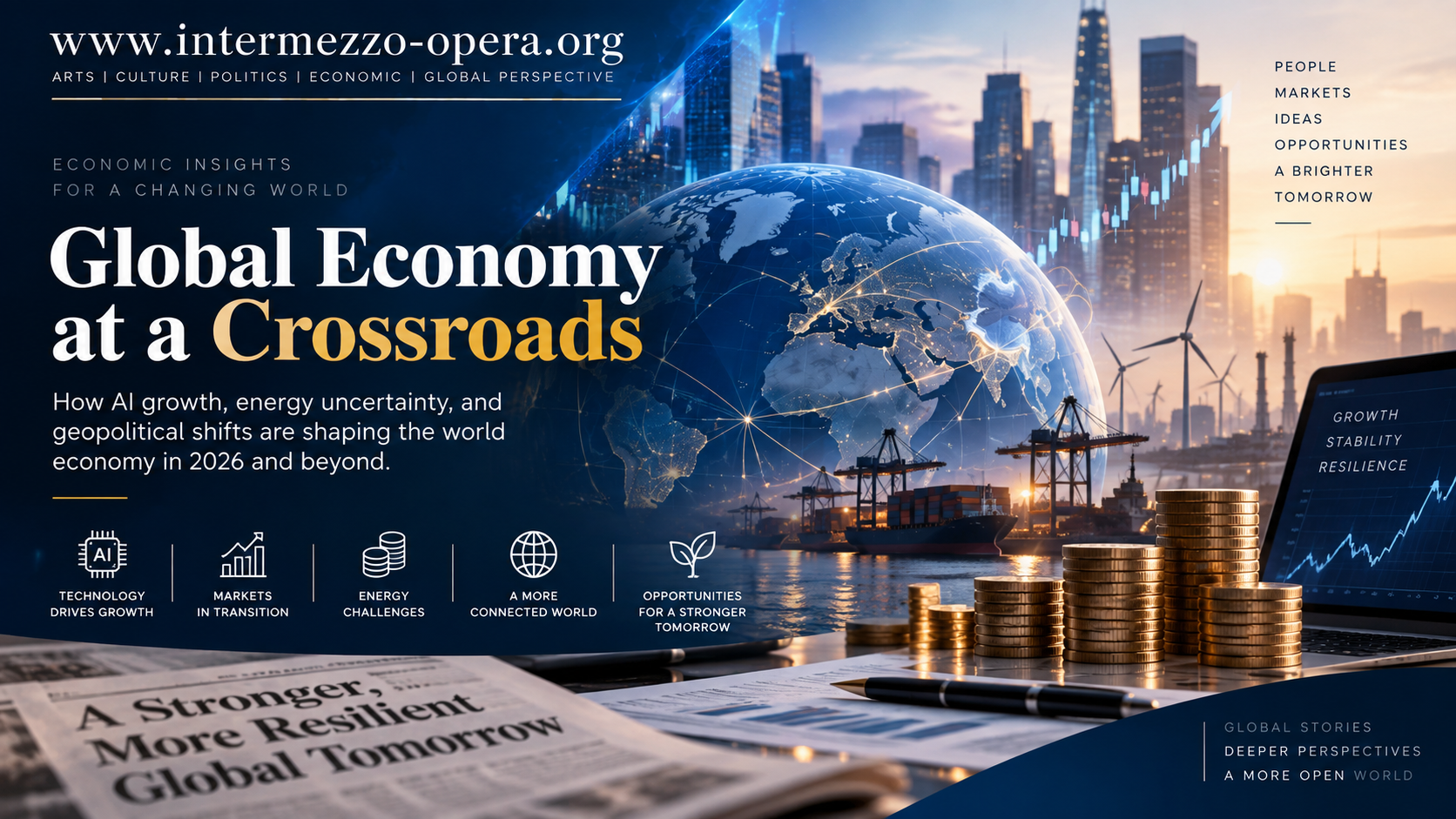
Global Economy Faces a New Test as AI Growth Meets Energy and Geopolitical Risks
 0
 0
Read Time:4 Minute, 13 Second
Economic | Global Markets | Technology
The global economy is entering the final months of 2026 with a mixed outlook. Economic activity continues to expand, but energy disruptions, geopolitical tensions, inflation risks and changes in global trade are creating new challenges for businesses and policymakers.
The International Monetary Fund (IMF) projects global economic growth at 3.0% in 2026 and 3.4% in 2027. The IMF says technology momentum, particularly demand linked to artificial intelligence, is helping offset part of the economic drag created by geopolitical shocks.
Global Growth Remains Uneven
Recent IMF data shows that economic performance is diverging across major regions.
World real GDP growth eased to 0.7% in the second quarter of 2026, compared with 0.8% in the first quarter. Europe rebounded from zero growth in the first quarter to 0.6% in the second quarter, while Asia’s quarterly growth slowed from 1.3% to 0.9%.
The figures highlight an important feature of the current global economy: recovery is continuing, but its pace differs significantly between regions and countries.
For companies operating across borders, this divergence can influence investment decisions, supply chains, consumer demand and export opportunities.
AI Becomes an Important Economic Driver
Artificial intelligence is becoming increasingly important to the global economic outlook.
The IMF says AI-driven demand is supporting countries that are deeply integrated into global technology value chains. Investment connected to AI is supporting activity in areas such as semiconductors, data infrastructure, computing and digital services.
This creates opportunities for technology producers and countries that can attract investment in digital infrastructure.
However, the economic impact of AI will depend on how quickly productivity gains materialize and how broadly businesses and workers can adopt the technology.
Energy Prices Remain a Major Risk
Energy remains one of the most important risks facing the global economy.
The OECD reported in its June 2026 Economic Outlook that disruptions in the Middle East had created an energy shock, increasing inflationary pressure and affecting economic growth. The organization presented different scenarios because the duration of the disruption remained uncertain.
Higher energy costs can affect the economy through several channels. Transportation becomes more expensive, industrial production faces higher costs, and businesses may pass part of those expenses to consumers.
For energy-importing economies, prolonged disruptions can therefore create additional pressure on household purchasing power and business margins.
Inflation Has Not Completely Disappeared
The global inflation story has also become more complicated.
The IMF said global disinflation had stalled in its July 2026 outlook. The organization identified renewed conflict and financial-market repricing among the downside risks to the global economy.
This means central banks still face a difficult environment. Policymakers need to balance price stability with economic growth while also responding to potential shocks from energy markets and global financial conditions.
Trade Is Entering a New Phase
Global trade is also changing as businesses adapt to geopolitical uncertainty and evolving supply chains.
Companies are increasingly looking at supply-chain resilience, market diversification and access to critical technologies. This can encourage investment in new production locations while changing the flow of goods between major economic regions.
For emerging economies, these changes can create opportunities to attract manufacturing and technology investment. At the same time, countries must compete through infrastructure, workforce skills, productivity and stable business conditions.
What Businesses Need to Watch
Businesses entering the final part of 2026 face several important economic variables.
Energy prices can influence production and transportation costs. Interest rates affect borrowing and investment. Trade policies can alter supply chains, while AI investment can create new markets and change productivity.
The IMF has highlighted the need for policymakers to preserve price stability, rebuild fiscal buffers and strengthen economic adaptability.
For companies, flexibility may therefore become increasingly important as economic conditions change across regions.
Asia and Emerging Markets Remain Important
Asia continues to make a major contribution to global economic activity despite slower growth in the second quarter.
According to the IMF’s latest quarterly data, Asia contributed 0.4 percentage points to global growth in Q2 2026, the largest regional contribution during the quarter.
The region’s importance is closely connected to manufacturing, international trade, technology production and expanding consumer markets.
Developments in Asian economies will therefore remain important for global companies and investors.
The Next Economic Outlook Could Bring More Clarity
The OECD is scheduled to release its Interim Economic Outlook on September 23, 2026, with updated analysis and projections for the global economy and G20 countries.
The new projections will provide an updated view of how recent energy and geopolitical developments are affecting economic growth and inflation.
Conclusion
The global economy in 2026 is being shaped by several forces at the same time.
Economic growth continues, but regional performance remains uneven. AI investment is creating new opportunities, while energy disruptions, inflation and geopolitical uncertainty are adding pressure.
The combination of technology, energy, trade and monetary policy will remain central to the global economic story as 2026 moves toward its final quarter.
For businesses and consumers, the economic environment calls for close attention to changing costs, demand, technology and international markets.


Happy
0 %

Sad
0 %

Excited
0 %

Sleepy
0 %

Angry
0 %

Surprise
0 %
Related Post
Montecon Uruguay Ends $600 Million Claim After Five-Year Port Dispute
Montecon Uruguay has entered a new chapter after Neltume Ports, the majority shareholder of Montecon,…