
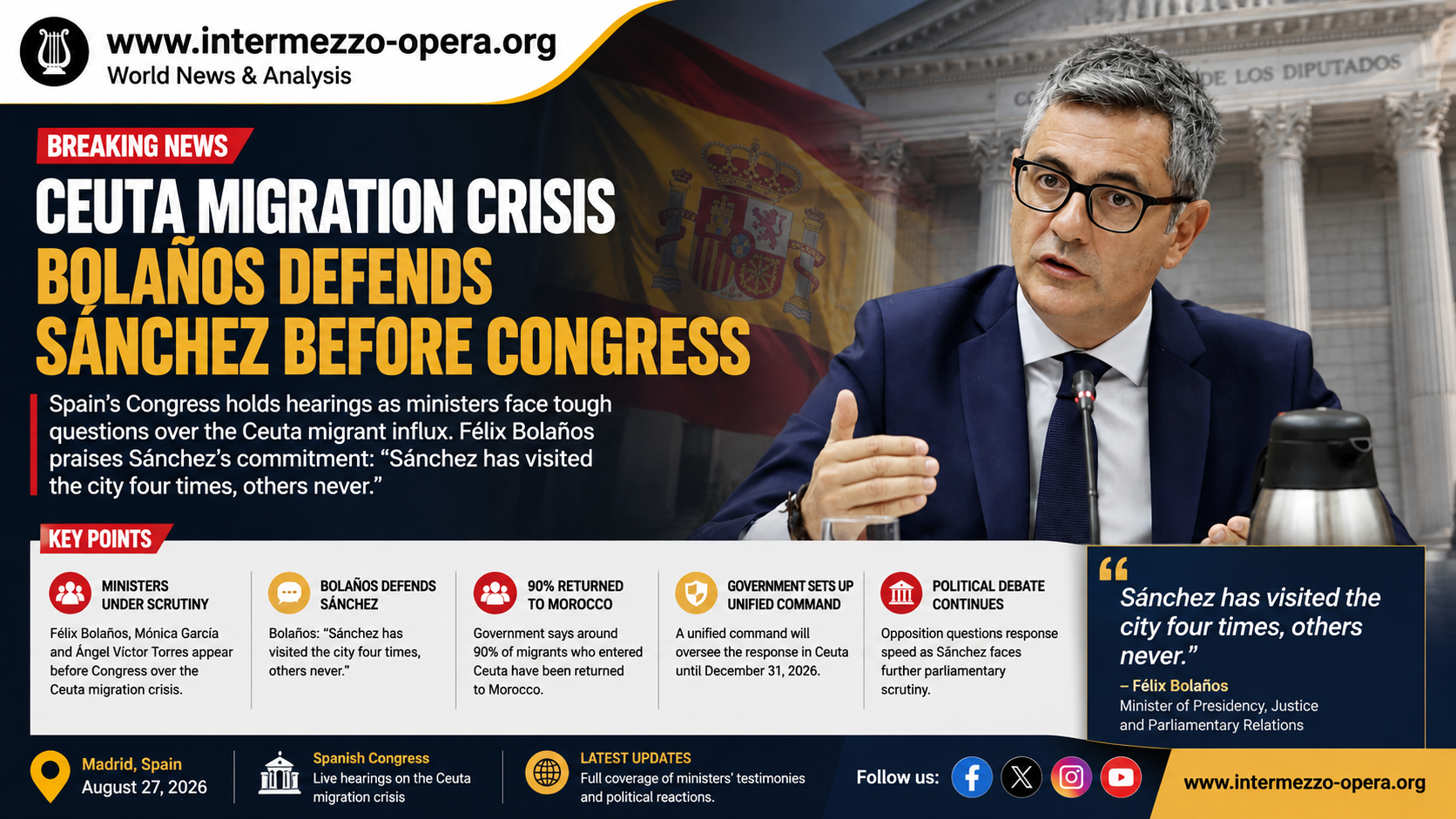
Bolaños Defends Sánchez as Spain’s Congress Debates Ceuta Migration Crisis
 0
0
 0
0
Read Time:3 Minute, 10 Second
MADRID – Spain’s Congress focused on the Ceuta migration crisis as senior ministers faced questions about the government’s response. The hearings put fresh pressure on Prime Minister Pedro Sánchez and his administration.
Minister Félix Bolaños defended the government during his appearance in Congress. He also highlighted Sánchez’s visits to Ceuta.
Bolaños said Sánchez has visited the city four times as prime minister. He compared this record with previous Spanish leaders.
The debate comes after a large number of migrants entered Ceuta from Morocco. The situation placed strong pressure on local services and border authorities.
Bolaños Defends Sánchez Over Ceuta
Bolaños defended Sánchez’s role during the Ceuta migration crisis.
He argued that the prime minister has shown a clear commitment to the autonomous city. Sánchez has visited Ceuta several times during his time in office.
The minister also rejected criticism that Madrid had ignored the city.
However, opposition parties continued to question the government’s response. They asked whether officials acted fast enough when the crisis began.
Ministers Face Questions in Congress
Several ministers appeared before parliamentary committees.
Bolaños was one of the officials called to explain the government’s actions. Health Minister Mónica García and Territorial Policy Minister Ángel Víctor Torres also faced parliamentary scrutiny.
Lawmakers focused on several issues. These included border management, migrant accommodation and cooperation with Morocco.
The hearings also examined the impact on public services in Ceuta.
As a result, the debate became an important test for the Spanish government.
Spain Highlights Cooperation With Morocco
Cooperation with Morocco remains a key part of Spain’s strategy.
Bolaños said most migrants who entered Ceuta had already returned to Morocco. Spanish authorities continue to manage the people who remain in the city.
Officials must examine each case separately. Some migrants may seek asylum, while others could return to their country.
The government says cooperation between Spain and Morocco has helped reduce pressure on Ceuta.
Still, migration remains a sensitive political issue in Spain.
Government Creates Unified Command
Madrid has also created a unified command for the Ceuta migration crisis.
The system aims to improve coordination between government agencies. It covers the border, coastline, ports and other key areas.
Ángel Víctor Torres plays a central role in this response.
The government believes stronger coordination will help Ceuta return to normal. It also wants public services to work without major disruption.
Meanwhile, authorities continue to review security and accommodation needs.
Opposition Presses Government for Answers
Opposition lawmakers used the hearings to challenge the government.
Some questioned how quickly Madrid reacted to the crisis. Others raised concerns about the impact on Spain’s autonomous communities.
Bolaños defended cooperation between regional governments.
He argued that joint action can reduce pressure on Ceuta. In addition, cooperation can help authorities manage migrants in a more organized way.
The political debate is likely to continue.
Ceuta Faces Pressure on Public Services
The sudden arrival of migrants created several challenges for Ceuta.
Accommodation became one of the main concerns. Public facilities also faced additional pressure.
Authorities have worked to provide temporary accommodation and basic services. They also need to prepare for normal public activities, including the school year.
Therefore, the government wants to move people away from facilities that serve other community needs.
Security remains another priority.
Migration Debate Continues in Spain
The Ceuta migration crisis has become a major political issue for Sánchez’s government.
The administration says it wants to protect Spain’s borders while treating migrants humanely. It also supports close cooperation with Morocco.
Opposition parties want more answers about the government’s preparation and response.
For that reason, the hearings in Congress may not end the controversy.
Sánchez could face further questions as lawmakers continue to examine the crisis. Migration policy will also remain an important issue in Spain’s political debate.


Happy
0 %

Sad
0 %

Excited
0 %

Sleepy
0 %

Angry
0 %

Surprise
0 %
Related Post
Argentina’s Labor Reform Cuts Dismissal Costs, Judge Mario Fera Explains Major Changes
BUENOS AIRES – Argentina’s new labor reform has introduced significant changes to employment relations, including…