
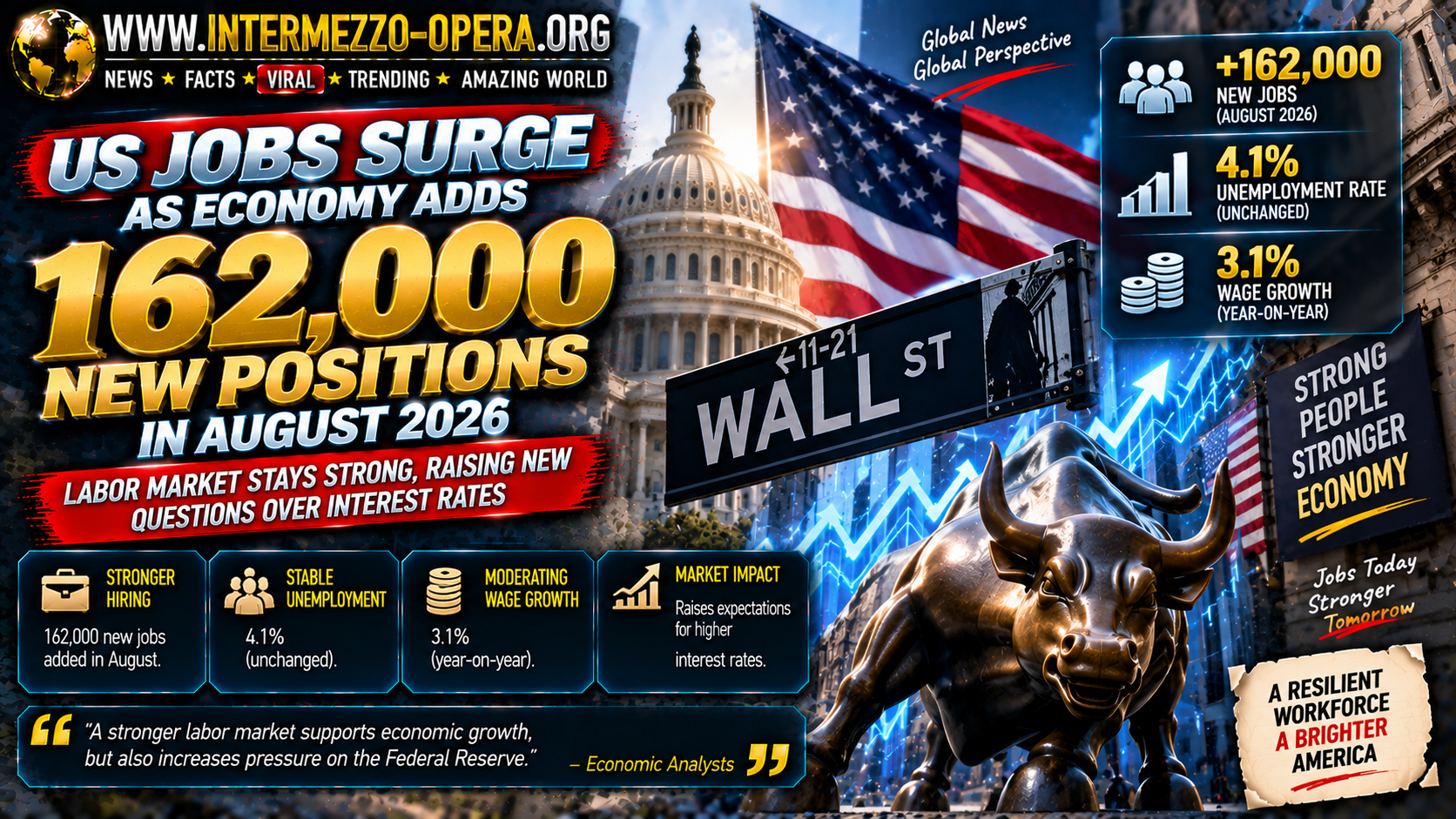
US Jobs Surge as Economy Adds 162,000 Positions, Raising New Questions Over Interest Rates
 0
0
 0
0
Read Time:7 Minute, 34 Second
The US jobs surge delivered a major surprise to financial markets after employers added 162,000 nonfarm jobs in August 2026, marking the strongest monthly increase in five months. The unemployment rate remained unchanged at 4.1%, suggesting that the American labor market continues to show resilience despite inflation, higher energy costs and broader economic uncertainty.
The stronger employment figures are important because the Federal Reserve closely watches labor-market conditions when determining monetary policy. A resilient jobs market can support consumer spending and economic growth, but it can also reduce the urgency for policymakers to lower interest rates.
US Jobs Surge Beats Market Expectations
The August employment report was considerably stronger than economists had anticipated.
Nonfarm payrolls increased by 162,000 jobs, representing the largest monthly employment gain in five months. The improvement provides evidence that hiring regained momentum following a period of weaker labor-market growth.
The unemployment rate, meanwhile, remained at 4.1%.
Together, the figures present an economy that continues to generate jobs even as businesses and households operate in a challenging environment shaped by inflation, expensive energy and elevated borrowing costs.
Leisure and Hospitality Led Hiring
A substantial portion of August’s employment growth came from the leisure and hospitality industry.
The sector added approximately 62,000 jobs, making it one of the largest contributors to the monthly increase.
Hotels, restaurants, entertainment businesses and other service-oriented companies are closely connected to consumer demand. Strong hiring in these industries can therefore provide an indication that Americans are continuing to spend on services despite higher living costs.
Local government education also recorded a notable increase, adding approximately 42,000 positions.
Other areas, including manufacturing, construction and healthcare, contributed to employment growth as well.
Unemployment Remains at 4.1%
Despite the stronger hiring numbers, the unemployment rate remained steady at 4.1%.
This happened even as more people entered the labor force.
The labor force expanded by approximately 683,000 people, while the participation rate increased to 61.6%.
An expanding labor force can be an encouraging economic signal because it indicates that more people are either working or actively seeking employment.
It also means employers have access to a larger pool of potential workers.
Wage Growth Is Showing Moderation
Another important part of the report involves wages.
Average hourly earnings increased approximately 3.1% from a year earlier, slightly below the 3.2% annual increase recorded in July.
That moderation matters for inflation.
Rapid wage growth can increase household purchasing power, but when labor costs rise much faster than productivity, companies may respond by increasing prices.
The latest numbers suggest that employment remains relatively strong without an obvious acceleration in wage-driven inflation.
That combination could complicate the Federal Reserve’s next decision.
Federal Reserve Faces a New Puzzle
The US jobs surge creates an interesting situation for monetary policymakers.
Normally, strong employment growth is good economic news.
However, the Federal Reserve is responsible for balancing maximum employment with price stability.
If the economy remains strong while inflation continues to pose a problem, policymakers may determine that interest rates need to remain elevated.
Financial markets therefore reacted to the employment report not simply as evidence of economic strength, but as another clue about what the Federal Reserve might do next.
Rate-Hike Expectations Return
Following the stronger employment figures, financial markets increased expectations that the Federal Reserve could raise interest rates at an upcoming policy meeting.
Market pricing indicated roughly a 62% probability of a rate increase following the report.
That does not mean an increase is guaranteed.
Expectations can change quickly as investors receive additional inflation, consumer spending and economic growth data.
However, the shift demonstrates how dramatically one major economic report can change assumptions about monetary policy.
Why Strong Jobs Can Mean Higher Rates
At first glance, it may seem strange that good employment numbers could make financial markets nervous.
The explanation lies in inflation.
A strong labor market generally supports household incomes and consumer spending. If demand remains strong while supplies are constrained or energy costs are elevated, businesses may have greater ability to raise prices.
Central banks sometimes respond by maintaining higher interest rates to prevent inflation from becoming entrenched.
Therefore, investors must balance two interpretations.
Strong employment reduces the probability of an immediate recession, but it can also increase the possibility that borrowing costs stay higher for longer.
Higher Rates Affect the Entire Economy
Federal Reserve policy extends far beyond Wall Street.
Interest rates influence the cost of mortgages, auto loans, credit cards and business financing.
Companies considering a new factory, office or expansion project may reconsider those plans when financing becomes significantly more expensive.
Households can make similar decisions.
A family may postpone purchasing a home when mortgage payments become too expensive, while consumers carrying variable-rate debt can face larger monthly payments.
That is why expectations surrounding Federal Reserve policy can influence economic activity even before the central bank actually changes rates.
The Labor Market Is Not Strong Everywhere
The headline employment figure does not mean every part of the US labor market is performing equally well.
Some sectors continued to struggle.
Employment in information and financial industries declined, with automation and artificial intelligence increasingly influencing staffing decisions in certain occupations.
Long-term unemployment also remains a concern.
The median duration of unemployment climbed to approximately 11.4 weeks, approaching its highest level in roughly four and a half years.
This suggests that while many companies are hiring, some unemployed workers are taking longer to find new positions.
Artificial Intelligence Is Changing Employment
Technology is becoming an increasingly important part of the employment story.
Companies across multiple industries are investing heavily in artificial intelligence and automation.
The impact does not necessarily mean that machines simply replace workers across the economy.
Instead, businesses can reorganize operations, automate specific tasks, reduce hiring for certain roles and simultaneously create demand for workers with different technical skills.
This transition can produce an unusual labor market where total employment remains relatively strong while individual occupations experience substantial disruption.
Consumer Spending Remains Critical
Employment is one of the foundations of consumer spending.
When Americans have jobs and receive regular income, they are generally more willing and able to purchase goods and services.
Consumer spending represents a major component of the US economy, meaning employment conditions can strongly influence overall growth.
The August hiring rebound therefore offers some reassurance that consumer demand may remain supported.
However, households are simultaneously facing expensive energy, elevated borrowing costs and lingering inflation pressures.
The durability of consumer spending will consequently remain an important economic indicator.
Energy Prices Complicate the Outlook
The employment report arrives during a difficult period for the broader global economy.
Energy costs have risen amid geopolitical tensions, adding pressure to transportation and production expenses.
Higher energy prices can eventually influence the prices of a wide range of goods because fuel is required to manufacture and transport products throughout the economy.
The OECD has warned that the global economy faces significant risks from energy shocks and inflationary pressures.
Under its time-limited disruption scenario, the organization projects global economic growth of 2.8% in 2026, compared with 3.4% in 2025.
A prolonged disruption could produce a considerably weaker outcome.
The US Economy Is Sending Mixed Signals
Economic data increasingly tell a complicated story.
The labor market has just produced a surprisingly strong month.
At the same time, overall economic growth has been relatively modest.
The US economy expanded at an annualized rate of approximately 1.5% during the second quarter, according to recently released government data.
Consumer spending remained comparatively resilient, but the slower headline growth demonstrates that strong employment does not necessarily mean every part of the economy is booming.
This combination makes forecasting particularly difficult.
Investors Now Turn to Inflation Data
After the employment surprise, attention will shift toward inflation.
Upcoming consumer and producer price reports will provide additional evidence about whether price pressures are accelerating or beginning to moderate.
If inflation remains elevated while employment continues to expand strongly, the argument for tighter monetary policy could strengthen.
If inflation cools substantially, policymakers may have more flexibility.
Markets will therefore examine upcoming data for clues about the direction of interest rates.
US Jobs Surge Shows Economic Resilience
The US jobs surge offers evidence that the world’s largest economy retains considerable resilience.
Employers added 162,000 jobs in August, the strongest monthly increase in five months, while unemployment remained at 4.1%. The labor force also expanded significantly, indicating that more Americans entered the job market.
However, strong employment brings a new challenge.
Financial markets must now consider whether resilient hiring will encourage the Federal Reserve to maintain restrictive monetary policy—or potentially tighten it further.
For households and businesses, that distinction matters enormously.
A stronger economy can protect employment and support incomes, but persistently high interest rates increase the cost of borrowing.
The August jobs report therefore represents more than a positive employment headline.
It has become another important piece of evidence in the debate over whether the United States can maintain economic growth while bringing inflation under control.


Happy
0 %

Sad
0 %

Excited
0 %

Sleepy
0 %

Angry
0 %

Surprise
0 %
Related Post

Beyond Wind Power: Uruguay Opens the Door to a New Decade of Solar Investment
MONTEVIDEO – After becoming one of Latin America’s most prominent renewable-energy success stories through wind…