
Spain’s Power Grid Crunch Pits Housing Projects Against Data Centers
 0
0
 0
0
Read Time:3 Minute, 7 Second
Madrid – A growing Spain power grid capacity shortage is creating competition between property developers and data center operators. Both sectors need access to electricity. However, limited grid capacity is making new connections increasingly difficult.
The problem is becoming a bottleneck for investment. Housing projects need reliable electricity before thousands of new homes can become operational. At the same time, data centers require enormous amounts of power to support cloud computing and artificial intelligence.
As a result, access to suitable grid connection points has become increasingly valuable.
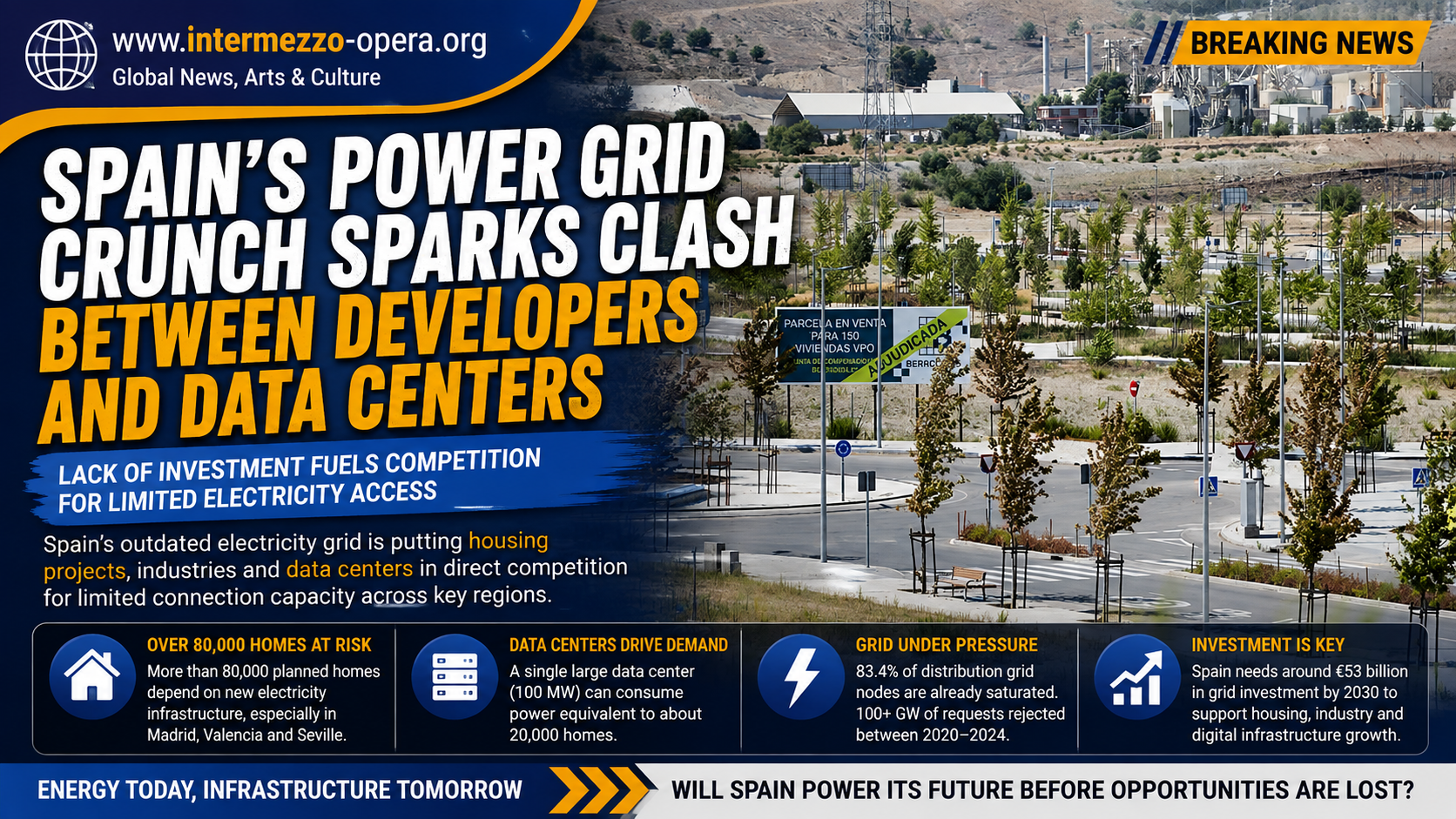
More Than 80,000 Homes Depend on Grid Expansion
According to a recent BBVA Research analysis cited by Spanish media, more than 80,000 planned homes currently depend on new electricity infrastructure.
Madrid, Valencia, Alicante, Seville and Murcia are among the areas where existing grid capacity could affect residential development.
Electricity is not the only obstacle facing Spain’s housing sector. Land availability, construction costs and administrative procedures also influence supply.
However, insufficient grid infrastructure can delay projects that have already progressed through other stages of development.
Therefore, expanding housing supply also requires adequate electricity infrastructure.
Data Centers Add Massive Electricity Demand
Meanwhile, Spain is attracting major investments in data centers. The growth of artificial intelligence and cloud services has increased demand for these facilities.
Yet, data centers consume large amounts of electricity.
For comparison, a large data center with around 100 megawatts of technological capacity can require power comparable to a development containing roughly 20,000 homes, according to the BBVA Research figures cited in the report.
Consequently, areas attracting major data centers can experience additional pressure on available grid capacity.
The data center industry expects significant growth in Spain. Sector estimates indicate potential investment of around €66.9 billion through 2030. However, energy access and regulation will determine how much of that investment ultimately materializes.
Housing and Data Centers Compete for Connections
The problem becomes particularly visible around strategic electricity nodes.
Large residential developments need power for thousands of homes. Meanwhile, industrial companies require additional electricity as they replace fossil-fuel processes with electric technologies.
Data centers are entering the same competition.
Therefore, available electricity capacity may need to serve several major projects at the same time.
Madrid provides a clear example. Large residential developments such as Los Berrocales, Los Cerros and Los Ahijones require substantial electricity infrastructure. Barcelona’s La Sagrera development also faces similar considerations.
Spain’s Electricity Network Faces Heavy Pressure
The wider challenge is not simply electricity generation. Instead, delivering that electricity through transmission and distribution networks has become a critical issue.
Recent assessments have shown that a large share of Spain’s distribution nodes have little or no capacity available for new demand. PwC cited data indicating that 83.4% of distribution-grid nodes were already saturated.
Between 2020 and 2024, more than 100 GW of consumer connection requests were rejected because of insufficient capacity, according to the same assessment.
Meanwhile, delays in developing electricity infrastructure are affecting industrial projects and urban developments across the country.
Investment in the Grid Becomes Critical
Spain now faces the challenge of expanding its electricity network quickly enough to support economic growth.
New homes require electricity. Moreover, factories are becoming increasingly electrified. Data centers also need reliable connections to operate around the clock.
Therefore, investment and better coordination between energy and urban planning are becoming increasingly important.
PwC estimates that meeting Spain’s energy and climate objectives could require around €53 billion in electricity-grid investment through 2030.
Without sufficient expansion, the Spain power grid capacity shortage could continue delaying housing, industrial and digital infrastructure projects.
However, stronger grid investment could turn the challenge into an opportunity. More connection capacity would allow Spain to develop new housing while also attracting technology and industrial investment.


Happy
0 %

Sad
0 %

Excited
0 %

Sleepy
0 %

Angry
0 %

Surprise
0 %
Related Post
Latin America Faces a Growth Puzzle as Low Productivity and Informal Jobs Hold Back the Economy
MONTEVIDEO – The economic outlook for Latin America and the Caribbean remains challenging. Although the…