
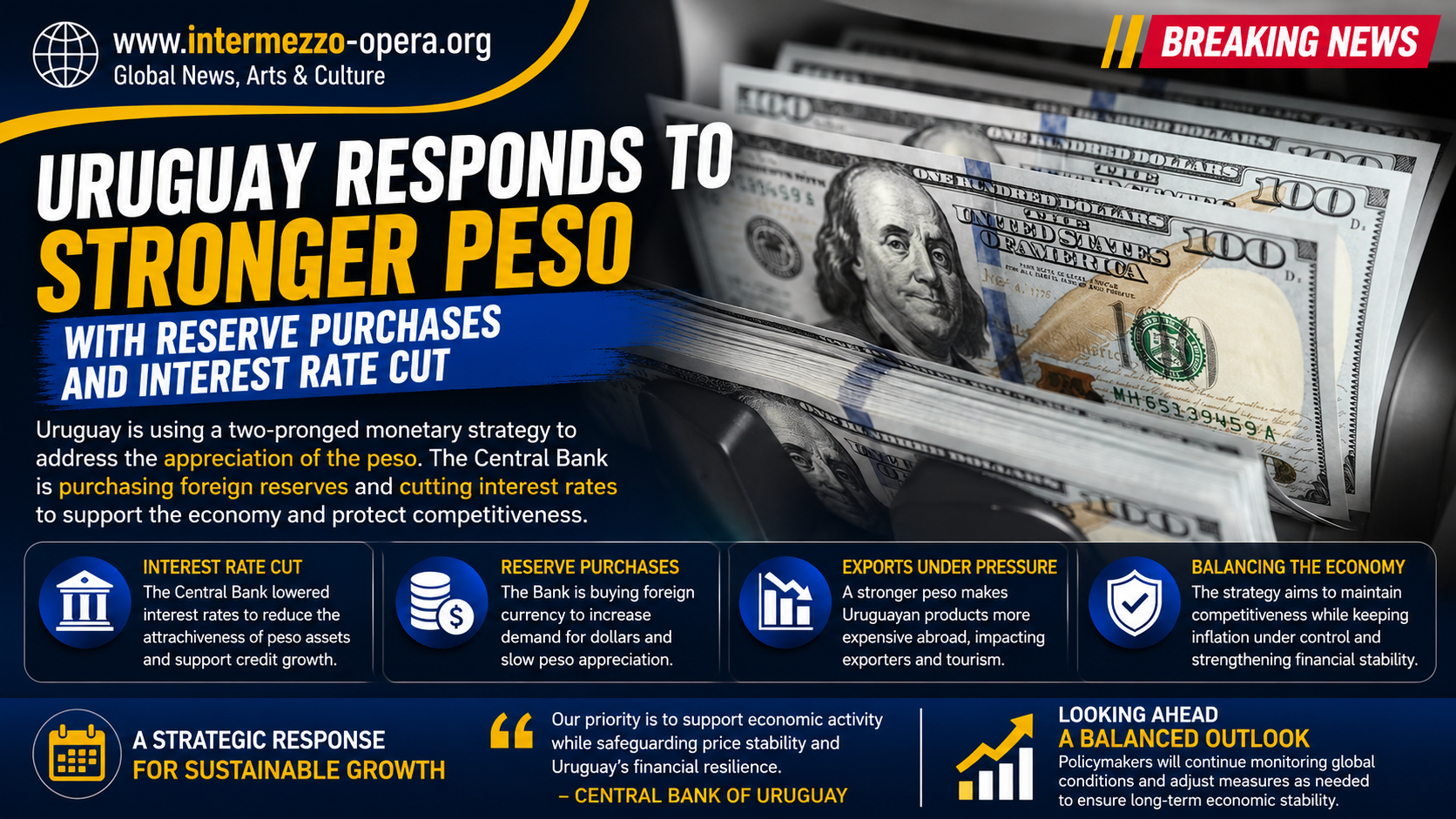
Uruguay Responds to Stronger Peso With Reserve Purchases and Interest Rate Cut
 0
0
 0
0
Read Time:2 Minute, 50 Second
Montevideo – Uruguay is adjusting its monetary policy as the Uruguayan peso appreciation creates new challenges for the economy. Authorities are combining foreign reserve purchases with lower interest rates to ease pressure on the currency and support economic activity.
The stronger peso has become an important issue for exporters. When the local currency appreciates, Uruguayan products can become more expensive for foreign buyers. Therefore, policymakers are looking for ways to limit the economic impact.
At the same time, authorities must keep inflation under control. This balance has made monetary policy increasingly important.
Central Bank Cuts Interest Rates
The Central Bank of Uruguay has moved to lower interest rates as inflation remains relatively contained.
Lower rates can reduce the attractiveness of peso-denominated assets. As a result, the measure may help moderate upward pressure on the local currency.
In addition, cheaper borrowing can support households and businesses. Companies may find it easier to finance investment, while consumers can gain better access to credit.
However, policymakers must proceed carefully. A rapid reduction in rates could create new inflationary pressure.
Reserve Purchases Target Peso Appreciation
Foreign reserve purchases are another tool available to authorities.
When the central bank purchases foreign currency, it increases demand for dollars in the domestic market. Consequently, the operation can help reduce excessive appreciation of the peso.
At the same time, these purchases strengthen international reserves. Those reserves can provide additional protection during periods of global financial volatility.
Therefore, the strategy can serve two purposes. It may moderate currency movements while also strengthening Uruguay’s external financial position.
Strong Peso Creates Pressure for Exporters
A stronger currency can benefit consumers because imported products may become cheaper. However, the situation is more complicated for exporters.
Uruguay depends on exports from sectors such as agriculture, livestock, forestry and manufacturing. These industries compete directly in international markets.
When the peso rises significantly against the dollar, exporters receive fewer pesos for revenue earned abroad. Therefore, their margins can come under pressure.
Tourism can also feel the effects. Uruguay may become relatively more expensive for international visitors when its currency strengthens.
For that reason, business groups often monitor the exchange rate closely.
Inflation Gives Policymakers More Room
Inflation is another key part of the equation.
When price growth remains under control, the central bank has more flexibility to reduce borrowing costs. However, maintaining credibility remains essential.
Policymakers must ensure that lower interest rates do not push inflation away from the target range.
Moreover, global conditions can change quickly. Commodity prices, US interest rates and movements in neighboring Argentina and Brazil can all influence Uruguay’s economy.
As a result, monetary decisions must consider both domestic and international conditions.
Uruguay Seeks a Balanced Monetary Strategy
The government and central bank face a difficult task. They want to protect competitiveness without abandoning price stability.
Therefore, reserve purchases and interest rate reductions can complement each other. One measure addresses pressure in the foreign exchange market. Meanwhile, the other can stimulate domestic economic activity.
Still, authorities are not simply targeting a specific exchange rate. Instead, the broader objective is to prevent financial conditions from becoming unnecessarily restrictive.
The response to Uruguayan peso appreciation will remain an important economic issue. If the currency continues to strengthen, policymakers may need to reassess the scale and timing of their measures.
For now, Uruguay is seeking a balance between a competitive currency, controlled inflation and sustainable economic growth.


Happy
0 %

Sad
0 %

Excited
0 %

Sleepy
0 %

Angry
0 %

Surprise
0 %
Related Post

Argentina’s Capital Market Enters a New Era as Regulators Target More Investors
Buenos Aires – Argentina’s capital market is entering a new phase after years of financial…