
Ceuta’s Economy Takes Heavy Hit as Migration Crisis Disrupts Tourism and Local Businesses
 0
0
 0
0
Read Time:7 Minute, 11 Second
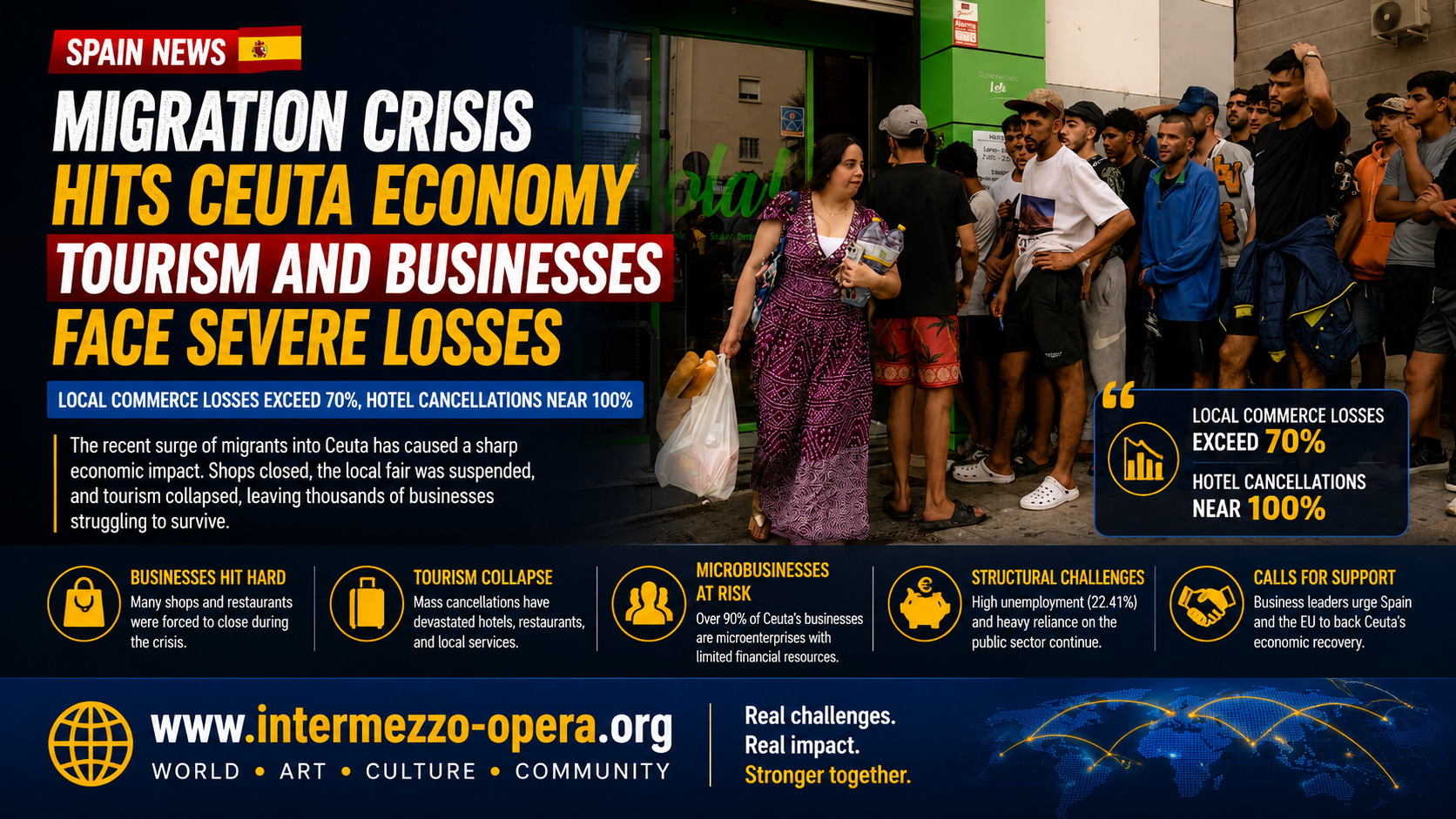
Ceuta’s economy faces mounting pressure after the recent migration crisis disrupted commerce, tourism, hospitality, and everyday business activity across the Spanish autonomous city in North Africa. Local business groups estimate that commercial losses have exceeded 70%, while hotel cancellations have reached almost 100% in some cases.
The economic shock followed the mass arrival of migrants from neighboring Morocco at the end of July. More than 50,000 people crossed during the initial surge, according to Reuters, although most subsequently returned to Morocco.
However, the consequences for Ceuta did not disappear when the immediate border pressure eased.
Businesses closed temporarily, the city’s annual fair was suspended, tourists cancelled reservations, and concerns about Ceuta’s economic future increased.
Therefore, business leaders are now calling for stronger support from Spain and greater European involvement.
Ceuta’s Economy Hit by Migration Crisis
The latest crisis arrived at a particularly difficult moment for Ceuta.
When large numbers of migrants reached the city’s streets, many shops, pharmacies, restaurants, and other establishments temporarily closed as a precaution. Some remained shut for several days.
As a result, local businesses immediately lost revenue.
The cancellation of the Ceuta Fair created another economic blow. Moreover, tourism suffered as visitors changed their plans.
According to figures cited by the Confederation of Business Owners of Ceuta, or CECE, local commerce recorded losses exceeding 70% following the crisis.
Meanwhile, hotel cancellations reached virtually 100%.
Those figures are particularly important because more than 90% of Ceuta’s local productive structure consists of microbusinesses.
Therefore, even a relatively short disruption can create significant financial pressure.
Tourism Suffers From Massive Cancellations
Tourism is among the sectors experiencing the strongest immediate impact.
Ceuta has spent years promoting itself as an attractive destination between Europe and Africa.
However, images of the border crisis spread rapidly around the world.
Consequently, many travelers reconsidered their plans.
Hotels experienced widespread cancellations. Restaurants also lost customers, while the suspension of the local fair eliminated another source of seasonal activity.
For small businesses, the timing was especially damaging.
Summer normally provides opportunities to attract visitors and generate additional revenue. Instead, many businesses faced empty tables, cancelled rooms, and reduced customer traffic.
Local Commerce Reports Losses Above 70%
Retail businesses have also suffered.
The CECE estimates that the immediate losses for local commerce exceeded 70%.
Moreover, uncertainty remains a major concern.
Businesses can reopen after a temporary closure. However, restoring consumer confidence and tourism demand can take much longer.
This distinction is important.
The physical disruption lasted several days. Nevertheless, its economic consequences could continue for weeks or months.
Therefore, local entrepreneurs are increasingly focused on what happens next.
Ceuta Already Faced Economic Challenges
The migration crisis did not create all of Ceuta’s economic problems.
Instead, it intensified weaknesses that were already present.
According to the figures reported by La Razón, approximately 44.3% of Ceuta’s economic output comes directly from public administration and essential services such as healthcare and education.
Unemployment is another major challenge.
The city’s unemployment rate stands at approximately 22.41%, according to the same report. That is more than twice Spain’s national average.
Consequently, local business leaders have repeatedly argued that Ceuta needs a stronger private sector.
More investment could diversify the economy. In addition, new businesses could create employment outside the public sector.
Border Trade Has Changed Dramatically
Ceuta’s economy has historically been closely connected with neighboring Morocco.
However, that relationship has changed significantly.
For decades, informal cross-border commerce generated considerable economic activity.
That model began to disappear when Morocco moved to end tolerated informal trade in 2019.
According to La Razón, this activity had previously represented between €600 million and €700 million annually for Ceuta’s economy.
Then came another major disruption.
The COVID-19 pandemic led to the closure of the Tarajal border for more than two years. It finally reopened in May 2022.
Therefore, the city’s businesses had already experienced several years of uncertainty before the latest migration crisis.
Geographic Position Is Both an Advantage and a Risk
Ceuta occupies an unusual geographic position.
It is Spanish territory located on the North African coast. Moreover, it sits directly beside Morocco while remaining politically and economically connected to Spain and the European Union.
That position creates advantages.
Ceuta has a special tax regime. It also has a strategically located port and acts as a connection point between continents.
However, geography also creates vulnerability.
A major border disruption can quickly affect tourism, trade, transport, and business confidence.
The latest crisis demonstrated that problem clearly.
Therefore, local business leaders fear that the damage could extend beyond immediate financial losses.
Businesses Fear Reputational Damage
One of the biggest concerns now involves Ceuta’s international image.
The city has worked to promote itself as a safe and attractive location for tourism and investment.
However, global coverage of the migration crisis may complicate that effort.
Karim Bulaix, president of Ceuta’s Chamber of Commerce, told La Razón that the reputational damage was particularly serious after years of efforts to promote Ceuta as an open and secure destination for investment.
That concern matters because investment decisions often depend on perceptions of stability.
Businesses want predictable conditions.
Tourists also prefer destinations where they expect transportation, accommodation, and public services to operate normally.
Therefore, rebuilding confidence may become one of Ceuta’s most important economic challenges.
Business Leaders Call for Spanish Government Action
Local business representatives are asking Spain’s central government to respond.
They argue that returning to normal cannot simply mean reopening shops and restoring traffic.
Instead, businesses want measures that address Ceuta’s deeper economic vulnerabilities.
Arantxa Campos, president of CECE-CEOE, called for measures that would allow Ceuta to compete under better economic conditions. She also argued that the city should gradually reduce its dependence on the public sector by encouraging private enterprise and job creation.
Furthermore, local representatives want greater European involvement.
Ceuta is not only Spain’s border with Morocco.
It is also part of the European Union’s southern external frontier.
Therefore, local businesses argue that the EU has a direct interest in the city’s stability.
Most Migrants Have Returned to Morocco
The migration situation itself has changed considerably since the initial surge.
Spain’s Interior Minister said that around 72,000 migrants had entered Ceuta, with approximately 70,000 subsequently returning to Morocco, according to reports published earlier this week.
Reuters had earlier reported that more than 50,000 people crossed during the deadly initial rush.
Therefore, the number of migrants remaining in Ceuta is far lower than during the peak of the crisis.
However, the city continues to face significant challenges.
In particular, authorities have warned about pressure involving unaccompanied minors who remained in the territory after the mass crossing.
Consequently, the humanitarian and administrative consequences have not completely disappeared.
Small Businesses Face the Greatest Pressure
The structure of Ceuta’s economy makes recovery particularly important.
More than 90% of the productive network consists of microenterprises, according to CECE figures reported by La Razón.
These businesses usually have fewer financial resources than large corporations.
Therefore, they may find it more difficult to absorb several days of lost revenue.
A restaurant may lose income when tourists cancel reservations.
Likewise, a small retailer can suffer when residents avoid commercial areas.
Hotels face another problem when rooms remain empty.
Together, these losses spread across the local economy.
Ceuta Looks Beyond the Immediate Crisis
Business leaders now want the discussion to move beyond the events at the border.
They argue that Ceuta needs a long-term economic strategy.
That strategy could involve improving connections with European markets. Moreover, it could encourage investment and strengthen private enterprise.
The city also wants to capitalize on its special tax status and strategic location.
However, those advantages depend heavily on stability.
Without confidence, investors may hesitate.
Similarly, tourists may choose alternative destinations if they remain concerned about disruption.
Therefore, restoring Ceuta’s reputation will be just as important as restoring normal business hours.
Economic Recovery Could Take Time
Ceuta’s economy faces mounting pressure even as the immediate migration emergency begins to ease.
Local businesses estimate commercial losses above 70%. Meanwhile, hotel cancellations reached almost 100%, and the cancellation of the Ceuta Fair further affected tourism and hospitality.
The crisis also exposed structural problems.
Ceuta has high unemployment, heavy dependence on the public sector, and an economy that remains vulnerable to changes along its border with Morocco.
For that reason, business leaders are demanding action from Spain and greater recognition from the European Union.
The immediate border emergency may eventually fade. However, recovering lost business activity, restoring tourism confidence, and attracting new investment could take considerably longer.
For Ceuta, the next challenge is therefore economic as much as migratory.


Happy
0 %

Sad
0 %

Excited
0 %

Sleepy
0 %

Angry
0 %

Surprise
0 %
Related Post

China’s “Unfinished Kids” Phenomenon Exposes Growing Pressure on Young Graduates
BEIJING – China’s unfinished kids phenomenon has become a widely discussed symbol of the growing…