
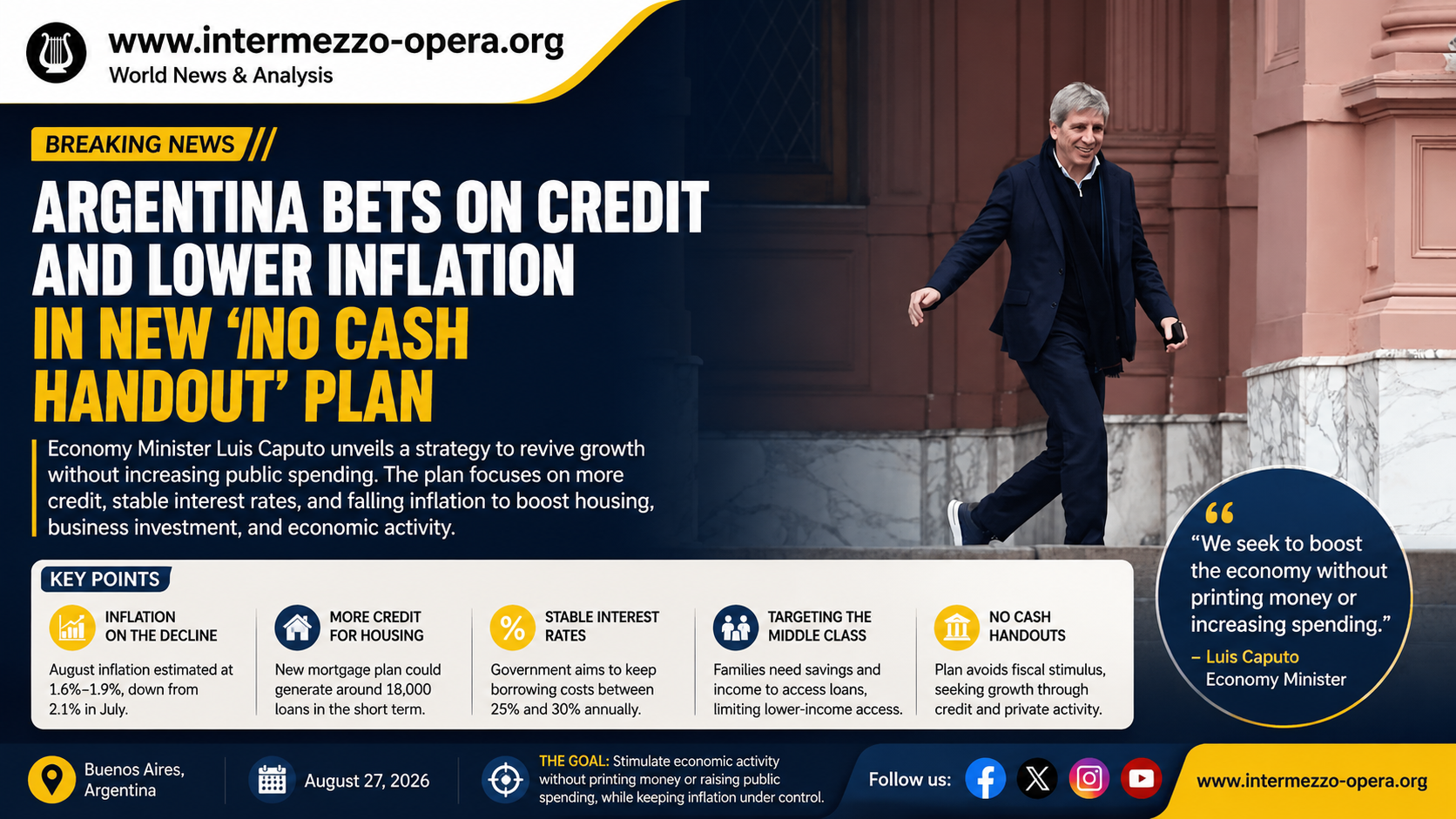
Argentina Turns to Credit and Lower Inflation in New “No Cash Handout” Recovery Plan
 0
0
 0
0
Read Time:3 Minute, 54 Second
BUENOS AIRES – Argentina’s government is looking for new ways to revive economic activity without increasing public spending. The strategy relies on lower inflation, stable interest rates and more credit for households and businesses.
The government wants to stimulate sectors that have struggled in recent months. However, President Javier Milei’s administration still intends to maintain strict fiscal and monetary policies.
Economy Minister Luis Caputo has placed credit at the center of this strategy. Mortgage lending is one of the main areas targeted by the government.
The approach has been described as a “no cash handout” economic plan because it avoids a traditional fiscal stimulus.
Argentina Seeks Growth Without More Public Spending
The government has limited room to stimulate economic activity.
Milei wants to maintain fiscal discipline. His administration also rejects monetary expansion as a tool to boost consumption.
Therefore, officials are turning to other options.
More affordable credit could encourage households to buy homes and durable goods. Businesses could also use financing to expand their operations.
The government hopes this approach can support economic growth without creating fresh inflationary pressure.
Mortgage Credit Becomes a Key Tool
Mortgage lending forms an important part of the new strategy.
Caputo recently announced measures designed to increase funding for housing loans. The government expects the initiative to generate about 18,000 mortgages within a relatively short period.
Officials believe stronger mortgage lending could help several sectors at once.
More home purchases could stimulate the real estate market. In turn, higher housing demand could support construction.
That activity could also create jobs.
Government Wants Interest Rates to Remain Stable
Interest rates represent another important part of the plan.
The government wants borrowing costs to remain at levels that allow credit to expand. A sharp rise in rates could weaken investment and consumption.
Recent financial decisions show this approach.
When short-term market rates approached 30% annually, the Treasury injected liquidity by purchasing bonds. Officials also avoided validating higher rates on longer-term government securities.
Small and medium-sized businesses can currently access some financing at annual rates of around 25% to 30%, according to the report.
However, weak sales remain a major problem for many companies.
Lower Inflation Could Support Recovery
Falling inflation gives the government more room to pursue its strategy.
Private estimates cited in the report put Argentina’s August inflation between 1.6% and 1.9%. If confirmed, inflation would fall below 2% again after reaching 2.1% in July.
Food prices also appear to have increased at a slower pace.
That matters because food inflation directly affects household budgets and the basic consumption basket.
Lower inflation could gradually improve purchasing power. It could also make credit conditions more predictable.
Construction Could Benefit From More Loans
The construction sector could become one of the main beneficiaries.
Mortgage lending creates demand for property transactions. It can also encourage new housing projects when demand strengthens.
Argentina’s construction industry has faced pressure during periods of weak economic activity.
The government hopes additional financing can help reverse that trend.
Caputo has highlighted the wider economic effect that mortgage lending could produce.
Middle-Class Families Are a Main Target
The mortgage initiative mainly targets middle-income households.
However, access will still require significant savings and income.
In an example presented by the government, a family seeking a USD 100,000 home would first need around USD 25,000 in savings. The household would also need monthly income above ARS 3.4 million to meet the loan requirements.
These conditions could limit access for lower-income families.
Even so, officials hope greater mortgage availability will revive a market that has struggled with limited bank funding.
Employment Remains a Major Challenge
Economic recovery will ultimately depend on more than credit.
Formal employment and household income remain important tests for Milei’s economic program.
More lending will have limited impact if consumers remain cautious or businesses continue to face weak demand.
For that reason, the government needs economic activity to improve while inflation continues to fall.
The challenge is to achieve both goals without abandoning fiscal discipline.
Argentina Tests a Different Recovery Strategy
The Argentina economic recovery plan represents an attempt to stimulate activity without a major increase in government spending.
Instead of direct fiscal stimulus, the administration is betting on credit, stable rates and lower inflation.
The strategy carries risks. Credit demand may remain weak if household income does not improve. Businesses may also avoid new investment when sales remain low.
Still, the government believes greater access to financing can support housing, construction and other sectors.
The coming months will show whether Argentina can turn lower inflation into stronger economic activity while maintaining its fiscal strategy.


Happy
0 %

Sad
0 %

Excited
0 %

Sleepy
0 %

Angry
0 %

Surprise
0 %
Related Post

BNF Core Banking Tender Faces Scrutiny Over Procurement Transparency
The procurement process for BNF's core banking system has come under increased public attention following…