Global Economy Holds Up in 2026, but Rising Energy Costs Put Inflation Back in Focus
 0
0
 0
0
Read Time:4 Minute, 11 Second
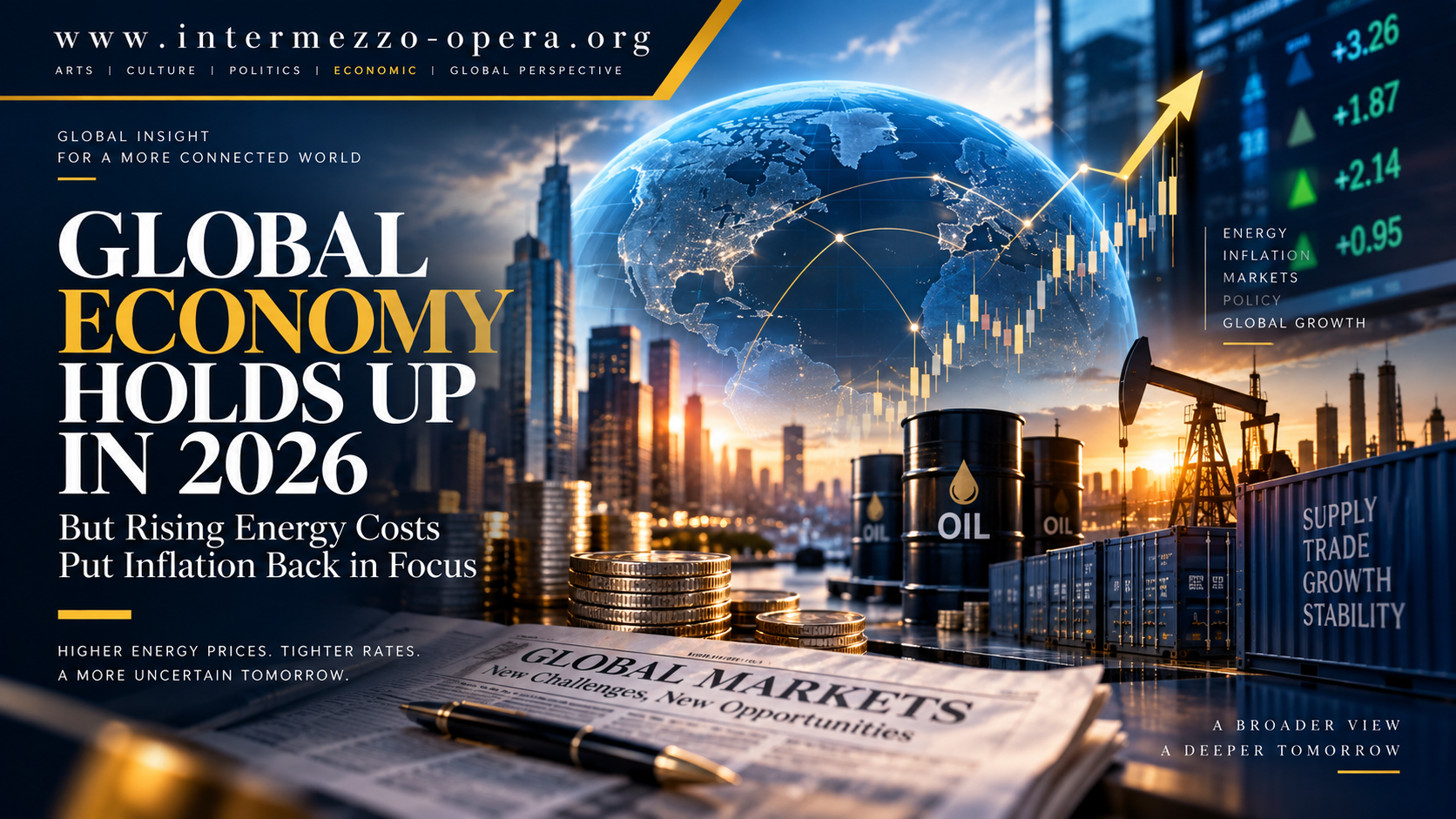
The global economy in 2026 continues to show surprising resilience despite higher energy prices, geopolitical uncertainty, and renewed inflation pressure. The International Monetary Fund expects world economic output to expand by around 3% this year. However, the outlook remains fragile as governments, businesses, and consumers face higher borrowing and energy costs.
The latest economic signals reveal two opposing forces. On one side, expensive oil and gas are pushing production and transportation costs higher. On the other, investment linked to artificial intelligence and technology continues to support economic activity. This unusual combination has made the direction of the global economy harder to predict.
Global Economy in 2026 Remains Resilient
The IMF said the world economy has handled the recent energy shock better than initially feared. Countries have used energy reserves, developed alternative supplies, and reduced demand where necessary.
According to the IMF’s July outlook, global growth is projected at 3.0% in 2026, followed by a stronger 3.4% expansion in 2027. Still, growth remains uneven across different regions. Energy-importing economies face greater pressure, while countries connected to technology and AI supply chains may receive additional support.
However, inflation has become a concern again. The IMF previously estimated global headline inflation at 4.7% for 2026. The decline in inflation seen during earlier years has therefore lost momentum.
Oil Prices Create New Inflation Pressure
Energy is now one of the biggest risks for the global economy in 2026.
Brent crude moved above $100 per barrel this week as disruptions affected international energy flows. Higher oil prices can quickly spread through the economy because transportation, manufacturing, agriculture, and logistics all depend heavily on energy.
The impact is already visible in the United States. U.S. wholesale prices increased 5.4% year over year in August, up from 4.8% in July. Diesel prices also recorded a sharp increase, adding pressure to transportation and production expenses.
As a result, businesses could face higher operating costs. Consumers may eventually feel those increases through more expensive goods and services.
Central Banks Turn More Cautious
Higher inflation is also changing expectations for interest rates.
The European Central Bank raised its benchmark deposit rate by 25 basis points to 2.50% on September 10. It was the ECB’s second increase this year. Eurozone inflation reached 3.3% in August, remaining above the central bank’s 2% target.
Meanwhile, several other major central banks are taking a more cautious approach.
Australia’s central bank has already raised rates several times this year. Markets are also watching upcoming decisions from the U.S. Federal Reserve and the Bank of Japan. Reuters reported that persistent inflation and resilient economic activity have increased expectations that monetary policy could remain tighter for longer.
Higher interest rates can reduce inflation by slowing demand. However, they also make mortgages, business loans, and government borrowing more expensive.
Europe Shows Signs of Economic Resilience
Despite higher energy costs, Europe’s economy has performed better than some economists expected.
The ECB increased its eurozone GDP growth projection for 2026 to 0.9%, compared with its previous estimate of 0.8%. Growth for 2027 is now projected at 1.4%, up from the earlier 1.2% forecast.
Consumption, investment, and industrial production have remained relatively stable. This suggests that businesses and households have adapted to changing economic conditions.
However, the ECB also raised its inflation projection. It now expects inflation to average 2.5% in 2027. Therefore, policymakers cannot assume that price pressure will disappear quickly.
AI Investment Provides a Different Economic Force
Technology investment offers a brighter part of the outlook.
The IMF describes the current economy as being pulled in opposite directions. The energy shock creates higher costs, while the AI-driven technology cycle provides additional demand and investment.
Companies continue to spend heavily on data centers, semiconductors, cloud infrastructure, and artificial intelligence systems. Countries that participate in these supply chains could benefit from stronger investment.
However, technology alone cannot eliminate wider economic risks.
Global public debt is approaching 100% of world GDP, according to the IMF. Developing economies with limited access to financing face particular challenges. High interest rates could make those debt burdens even harder to manage.
What Comes Next for the Global Economy?
The next few months will be important for the global economy in 2026.
First, investors will closely watch oil and gas prices. A sustained decline could ease inflation pressure. However, another energy shock could force central banks to keep interest rates high.
Next, policymakers will monitor consumer prices, employment, and economic growth. Central banks must balance inflation control against the risk of slowing their economies too aggressively.
Finally, governments face another challenge: managing large public debts while continuing to invest in infrastructure, energy security, and technology.
For now, the global economy in 2026 remains stronger than many feared. Yet resilience does not mean stability. Rising energy costs, stubborn inflation, high debt, and tighter monetary policy continue to create significant risks. At the same time, strong technology investment offers an important source of growth in an increasingly uncertain economic environment.


Happy
0 %

Sad
0 %

Excited
0 %

Sleepy
0 %

Angry
0 %

Surprise
0 %
Related Post

France’s E-Invoicing Reform Raises Cybersecurity Questions: Are Businesses Really More Exposed to Hackers?
Paris – The upcoming France e-invoicing reform is changing how millions of businesses exchange invoices.…