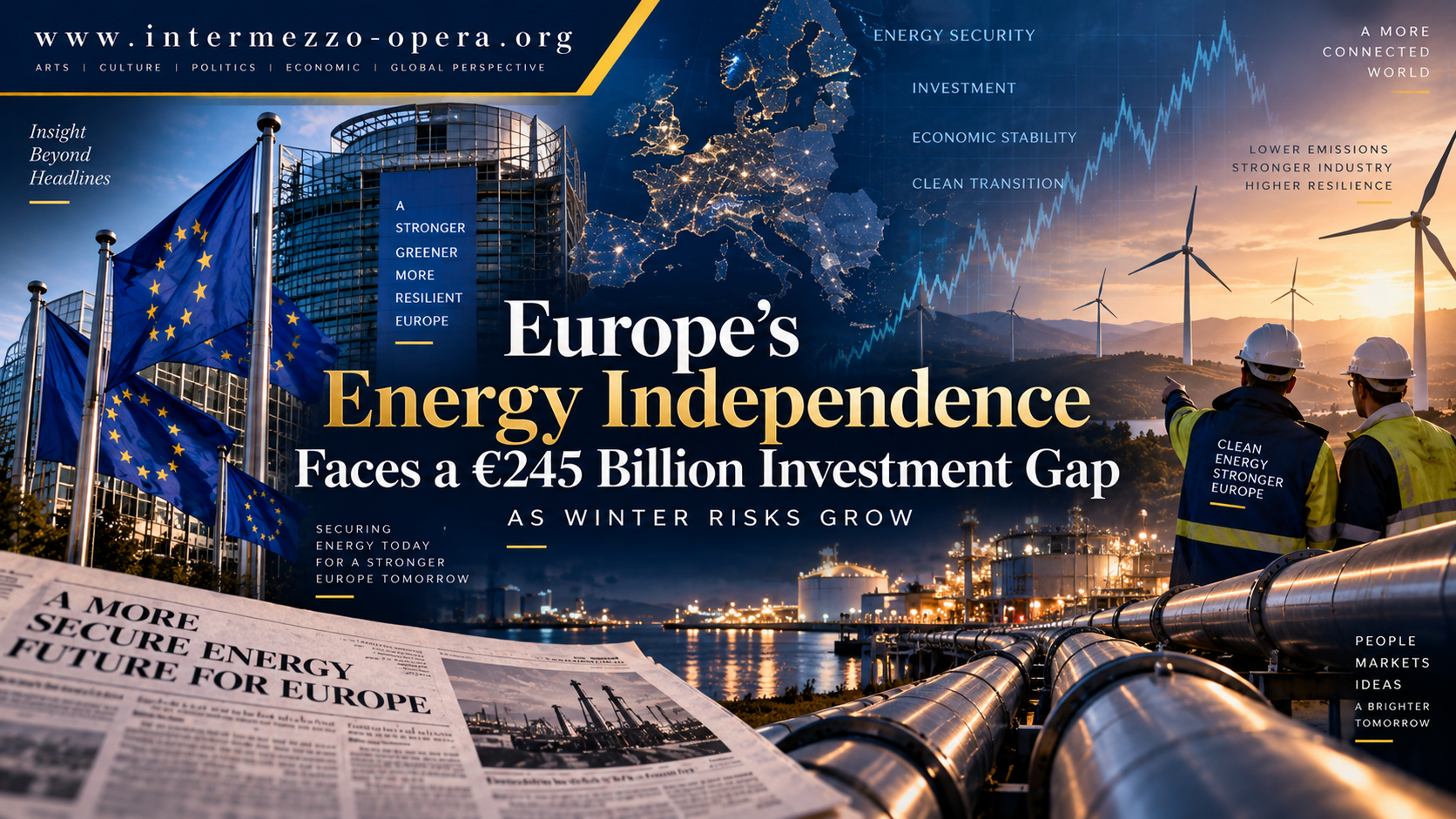
Europe’s Energy Independence Faces a €245 Billion Investment Gap as Winter Risks Grow
 0
0
 0
0
Read Time:5 Minute, 38 Second
Europe’s energy independence is facing a major economic test as the European Union struggles to turn its plan to eliminate Russian energy dependence into sufficient infrastructure investment. A new assessment from the European Court of Auditors warns that progress is faltering just as Europe approaches another winter with lower gas reserves and renewed pressure on global energy markets.
The challenge is no longer simply about replacing Russian oil and gas. Europe must simultaneously expand renewable energy, strengthen electricity grids, diversify fuel supplies and protect businesses from another period of expensive energy. The scale of investment required makes the issue increasingly important for the broader European economy.
Europe’s Energy Independence Requires Massive Investment
The European Commission initially estimated that ending Russian energy dependence would require approximately €300 billion in investment.
However, EU countries have so far committed only about €54.3 billion, according to figures cited by the European Court of Auditors. That leaves a difference of roughly €245.7 billion between the original estimated requirement and currently committed funding.
The gap highlights the financial challenge surrounding Europe’s energy independence.
Investment is needed not only for renewable generation but also for transmission networks, energy storage, cross-border connections and infrastructure capable of moving electricity and gas between European countries.
Without sufficient infrastructure, Europe may remain vulnerable to sudden disruptions even as its direct dependence on Russia declines.
Russian Gas Dependence Has Fallen Sharply
Europe has already made significant progress in reducing Russian energy imports.
Before Russia’s full-scale invasion of Ukraine in 2022, Russia supplied approximately 45% of EU gas imports. That share has now fallen to around 12%. The bloc has also eliminated nearly all imports of Russian crude oil transported by sea through sanctions.
These changes represent a substantial transformation of Europe’s energy system.
But auditors argue that part of the reduction in Russian gas dependence resulted from relatively mild weather and high energy prices suppressing demand rather than permanent structural improvements alone.
That distinction matters economically.
Lower consumption caused by efficiency improvements can strengthen an economy. Lower consumption because households and factories cannot afford energy can instead weaken industrial production and purchasing power.
Gas Storage Creates Another Economic Risk
The timing of the warning is particularly important.
EU gas storage facilities were around 67% full, compared with approximately 80% at the same point last year, according to Gas Infrastructure Europe data cited by Reuters.
Lower reserves do not automatically mean Europe will face an energy shortage.
However, they provide less protection if winter temperatures become unusually cold or international supplies experience additional disruption.
Europe is also preparing for a complete prohibition on Russian LNG imports beginning January 1, 2027.
The transition therefore leaves policymakers with a difficult balance: achieving Europe’s energy independence without producing another energy-price shock for households and industry.
Higher Energy Costs Threaten European Competitiveness
Energy security has become closely connected with Europe’s competitiveness problem.
Manufacturers require reliable electricity and fuel at prices that allow them to compete internationally. Chemicals, steel, transportation, glass, fertilizers and other energy-intensive industries are particularly sensitive to sustained increases in energy costs.
The problem becomes more significant when European businesses compete against companies operating in economies with cheaper energy.
Recent assessments of European competitiveness also suggest that major structural reforms remain unfinished. A tracker cited by the Financial Times found that only 15.7% of the 383 recommendations contained in Mario Draghi’s competitiveness report had been fully implemented by July 2026.
Energy investment is therefore only one component of a much broader economic challenge.
Inflation Complicates Europe’s Energy Transition
The latest energy uncertainty arrives when inflation has already returned as a major concern.
Euro-area inflation reached 3.3% in August, above the European Central Bank’s 2% target. Reuters reported that the increase has largely been driven by energy costs.
Expensive energy can spread throughout an economy.
Businesses pay more for transportation and production. Those expenses can eventually appear in consumer prices, while households face higher fuel and utility bills.
The European Central Bank must then determine whether the shock is temporary or whether higher energy prices are beginning to influence wages and broader inflation.
That makes Europe’s energy independence not merely an environmental or geopolitical objective, but an important part of monetary and economic stability.
Interest Rates Add Another Layer of Pressure
Higher inflation can also influence borrowing costs.
A Reuters poll of 65 economists published September 3 found unanimous expectations that the ECB would raise its deposit rate by 25 basis points to 2.50% at its September 10 meeting. Most economists nevertheless expected the central bank to stop tightening after that move.
Other institutions have become more cautious.
Deutsche Bank recently changed its forecast and now expects another quarter-point increase in December, which would take its projected terminal rate to 2.75%, primarily because persistent energy risks could keep inflation elevated.
For businesses, this creates a double challenge.
Companies may need to finance expensive energy-transition projects precisely when interest rates make borrowing more costly.
Renewable Energy and Power Grids Become Economic Assets
Accelerating renewable investment could reduce some of these vulnerabilities over the longer term.
Solar, wind, storage and stronger electricity networks can reduce exposure to imported fossil fuels while creating additional domestic investment.
The European Commission says its policies and funding have already accelerated renewable-energy projects and contributed to the sharp reduction in Russian gas dependence. It has also said it will respond to recommendations from the European Court of Auditors.
Yet building generation capacity alone will not solve the problem.
Electricity grids must be capable of transporting power from areas with abundant renewable production to major cities and industrial centers.
Cross-border infrastructure therefore becomes an economic asset rather than merely an engineering project.
Europe’s Energy Independence Enters a Critical Phase
The next stage of Europe’s energy independence could be more difficult than the first.
Reducing direct purchases from Russia was a clear political objective. Building a resilient replacement system requires years of investment, coordination and infrastructure development.
The approximately €245.7 billion difference between the Commission’s original investment estimate and funding committed so far illustrates the scale of the challenge. At the same time, lower gas inventories, elevated energy prices and approaching restrictions on Russian LNG increase the urgency.
Europe has already demonstrated that it can dramatically change where its energy comes from. The economic question for the coming years is whether it can build a system that is not only independent, but also affordable enough to support households and globally competitive industries.
For Europe’s energy independence, success will ultimately depend less on political declarations and more on whether investment in grids, renewable energy and diversified supplies arrives quickly enough to turn energy security into lasting economic resilience.


Happy
0 %

Sad
0 %

Excited
0 %

Sleepy
0 %

Angry
0 %

Surprise
0 %
Related Post

China’s “Unfinished Kids” Phenomenon Exposes Growing Pressure on Young Graduates
BEIJING – China’s unfinished kids phenomenon has become a widely discussed symbol of the growing…