
AfD Saxony-Anhalt Election Could Reshape German Politics as Party Eyes Historic Victory
 0
0
 0
0
Read Time:7 Minute, 49 Second
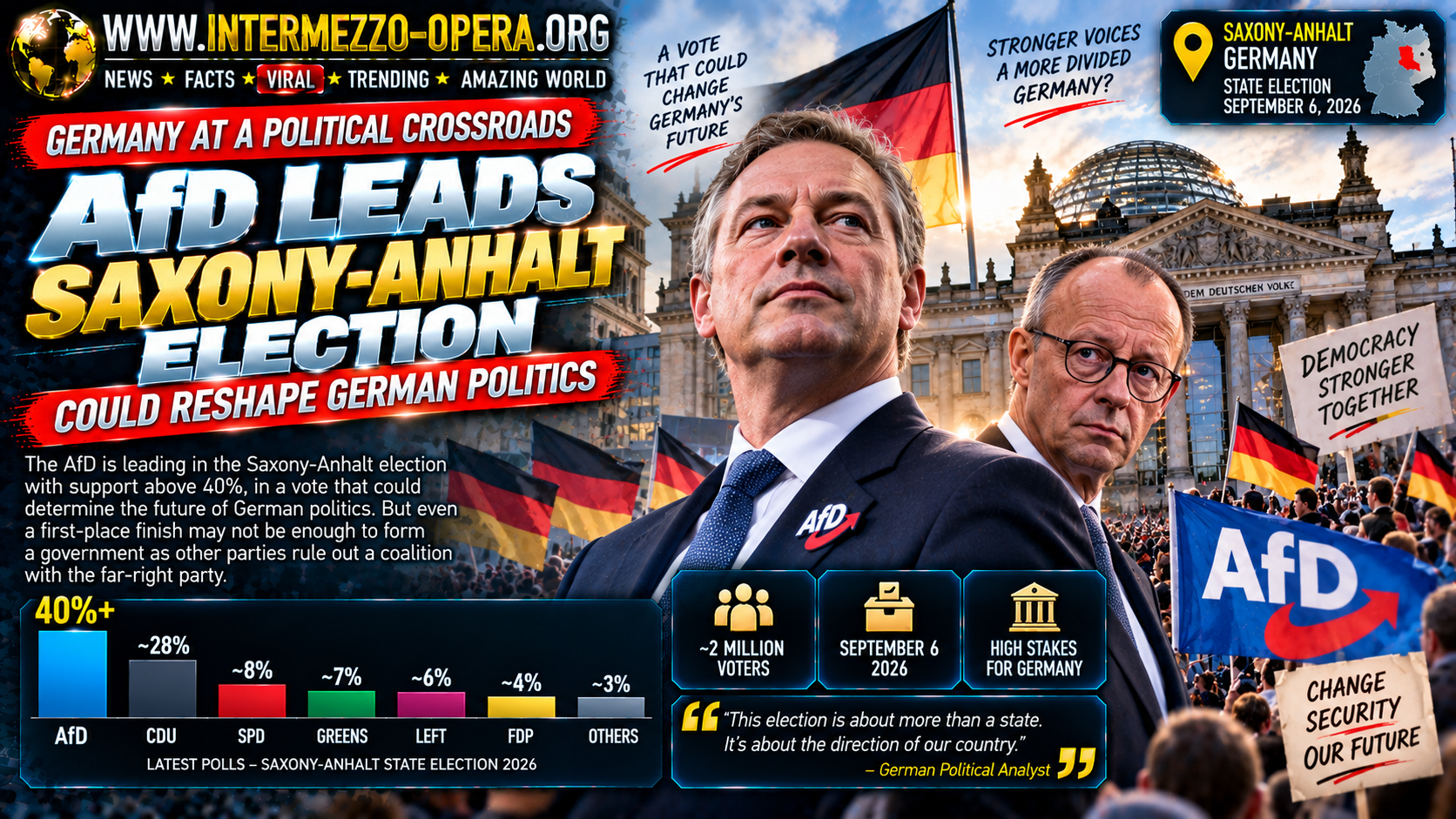
The AfD Saxony-Anhalt election has emerged as one of Germany’s most consequential political contests of 2026. Voters in the eastern German state will head to the polls on September 6, with the Alternative for Germany entering the election ahead in opinion polls and seeking to lead a state government for the first time.
Recent polling has placed the AfD above 40%, ahead of Chancellor Friedrich Merz’s Christian Democratic Union, or CDU. Yet even a first-place finish would not automatically give the AfD control of the state government because most other parties have ruled out governing with it.
The result could therefore create an extraordinary situation: the party receiving the largest share of votes could still find itself outside government.
AfD Saxony-Anhalt Election Becomes a National Test
Although approximately two million people live in Saxony-Anhalt, the significance of the election extends far beyond the state’s borders.
The vote is increasingly being viewed as a test of Germany’s national political direction and of Chancellor Friedrich Merz’s government in Berlin.
Saxony-Anhalt has traditionally been governed by mainstream parties. The CDU currently leads the state government under Premier Sven Schulze.
A strong AfD result would demonstrate how dramatically the political landscape in eastern Germany has shifted.
For the AfD, victory would also provide momentum as it attempts to transform strong polling numbers into direct governing power.
Polls Put AfD Above 40%
The most striking feature of the campaign has been the AfD’s level of support.
Polling ahead of the election has placed the party above 40%, giving it a substantial lead over the CDU.
That would represent a remarkable result for a party founded only in 2013.
The AfD initially emerged primarily as a Eurosceptic movement but gradually shifted its political focus toward immigration, national identity, security and opposition to Germany’s political establishment.
Support has become particularly strong in eastern Germany.
If polling translates into votes, Saxony-Anhalt could produce one of the AfD’s strongest election results ever.
Ulrich Siegmund Leads the AfD Campaign
The AfD’s candidate for state premier is Ulrich Siegmund.
Siegmund has attempted to present a more approachable public image while campaigning on themes including migration, energy costs, economic frustration and dissatisfaction with the federal government.
He rejects descriptions of himself and his party as far-right.
However, Saxony-Anhalt’s domestic intelligence agency has classified the state AfD organization as right-wing extremist.
That classification remains central to the political controversy surrounding the party and helps explain why mainstream rivals continue to reject coalition agreements with it.
Winning the Election May Not Be Enough
Germany’s parliamentary system means becoming the largest party does not automatically guarantee control of government.
A state premier must command sufficient support in the state parliament.
If the AfD wins the most seats but falls short of a majority, it would normally need coalition partners.
That is where the political arithmetic becomes complicated.
Most major parties have rejected cooperation with the AfD.
As a result, the CDU could potentially remain at the centre of government even if it finishes second, provided enough other parties enter parliament and can construct an alternative majority.
The Five Percent Threshold Could Decide Everything
Smaller parties may ultimately determine the outcome of the AfD Saxony-Anhalt election.
German elections generally require parties to receive at least 5% of the vote to enter parliament through the party-list system.
Several parties are polling close to that threshold.
If parties such as the Social Democrats or Greens fail to reach 5%, a larger proportion of parliamentary seats could effectively go to parties that clear the threshold.
That could make it easier for the AfD to approach a parliamentary majority.
Conversely, if several smaller parties enter the legislature, opponents may have more options for constructing a government without the AfD.
A movement of only one or two percentage points could therefore dramatically change the final balance of power.
CDU Faces an Extremely Difficult Choice
The CDU’s Sven Schulze is trying to prevent the AfD from taking control of the state.
Interestingly, surveys indicate Schulze remains personally competitive as voters consider who should serve as premier, even though his party trails the AfD.
The CDU has rejected forming a coalition with the AfD.
It also maintains restrictions against formal cooperation with the Left Party.
Those positions could make forming a majority government extremely difficult.
One possibility discussed by political observers is a CDU-led minority government that receives outside support or tolerance from another party without establishing a formal coalition.
Germany has already seen versions of such arrangements at the regional level.
Friedrich Merz Warns About Investment
Chancellor Friedrich Merz has personally entered the debate.
Merz warned that an AfD victory could damage Saxony-Anhalt’s attractiveness to international investors.
He argued that foreign companies considering factories or other major investments could become reluctant to commit capital if the AfD controlled the state government.
The AfD rejects that argument.
Its supporters contend that changes in migration, energy and economic policy could instead improve conditions for residents and businesses.
The disagreement demonstrates how the election has expanded beyond cultural politics into a debate over Saxony-Anhalt’s economic future.
Immigration Is a Central Issue
Immigration remains one of the strongest political issues benefiting the AfD.
Germany accepted large numbers of refugees during the European migration crisis beginning in 2015, and immigration has remained a highly divisive issue ever since.
The AfD advocates significantly tougher restrictions.
Supporters argue that existing policies have placed excessive pressure on housing, public services, schools and social systems.
Opponents argue that the AfD’s approach risks damaging social cohesion and making Germany less attractive to foreign workers.
The economic dimension is especially important for Saxony-Anhalt.
Saxony-Anhalt Needs Workers
Saxony-Anhalt faces a demographic challenge.
Its population has declined significantly since German reunification, while the remaining population is ageing.
Businesses in sectors including healthcare, tourism and the chemical industry need workers.
Economists have therefore warned that restricting immigration too aggressively could deepen existing labour shortages.
This creates a difficult political contradiction.
Many voters support tighter migration policies, while important parts of the economy may require additional workers from outside the region.
How policymakers balance those pressures could shape Saxony-Anhalt’s economy for years.
Eastern Germany Has Become an AfD Stronghold
The AfD’s rise is particularly pronounced in Germany’s eastern states.
Economic and political differences between eastern and western Germany have persisted more than three decades after reunification.
Many communities in the east experienced population decline, industrial restructuring and the loss of traditional employment after the collapse of East Germany.
Although enormous investment has transformed infrastructure and living standards, feelings of political alienation remain strong in some areas.
The AfD has successfully converted part of that dissatisfaction into electoral support.
Russia Is Also Part of the Campaign
Foreign policy has entered the Saxony-Anhalt campaign as well.
The AfD has frequently criticized Germany’s confrontational approach toward Russia and has advocated restoring closer economic relations.
That position resonates with some eastern German voters, where historical, economic and cultural attitudes toward Russia can differ from those in western Germany.
Critics argue that such policies underestimate security concerns created by Russia’s actions in Europe.
Supporters of the AfD counter that renewed dialogue and trade could reduce tensions and economic costs.
The debate illustrates how a regional election has become connected to much larger questions about Germany’s role in Europe.
The Intelligence Classification Remains Controversial
Another major issue surrounding the AfD is scrutiny from Germany’s domestic intelligence authorities.
The Saxony-Anhalt branch of the party has been designated as right-wing extremist by the state’s intelligence office.
The AfD strongly disputes characterizations that portray it as extremist and says establishment institutions unfairly target the party.
Opponents argue that the designation reinforces concerns about whether an AfD-led government would respect Germany’s post-war democratic norms.
That dispute is likely to become even more important if the party wins enough votes to claim a mandate to govern.
Could AfD Lead a German State for the First Time?
This is the central question.
The AfD has already achieved major electoral successes and become a powerful force in German politics.
But leading an actual state government would represent a different milestone.
Government would give the party direct responsibility for administration, budgets, education, policing and regional economic policy.
It would also challenge the longstanding strategy used by Germany’s mainstream parties to prevent the AfD from entering governing coalitions.
If that political barrier breaks in Saxony-Anhalt, similar debates could emerge elsewhere.
Germany Watches September 6
The AfD Saxony-Anhalt election could therefore become far more significant than an ordinary regional vote.
The AfD enters election weekend leading opinion polls with support above 40%, while the CDU is attempting to assemble enough support to prevent the party from taking control of government.
Yet the final outcome will depend on more than which party finishes first.
The 5% parliamentary threshold, the performance of smaller parties and the willingness of rival parties to cooperate could all determine who ultimately governs.
For Chancellor Friedrich Merz, the election represents an important test of whether Germany’s traditional centre-right can contain the AfD’s rapid growth.
For Ulrich Siegmund and the AfD, it offers something the party has pursued for years: the possibility of moving from opposition into executive power.
And for Germany, September 6 could reveal whether the country’s increasingly fragmented political landscape has reached another historic turning point.


Happy
0 %

Sad
0 %

Excited
0 %

Sleepy
0 %

Angry
0 %

Surprise
0 %
Related Post

Smotrich Pushes for Israeli Control of Gaza and New Jewish Settlements
JERUSALEM – Bezalel Smotrich’s Gaza settlement plan has drawn renewed attention after the Israeli finance…