
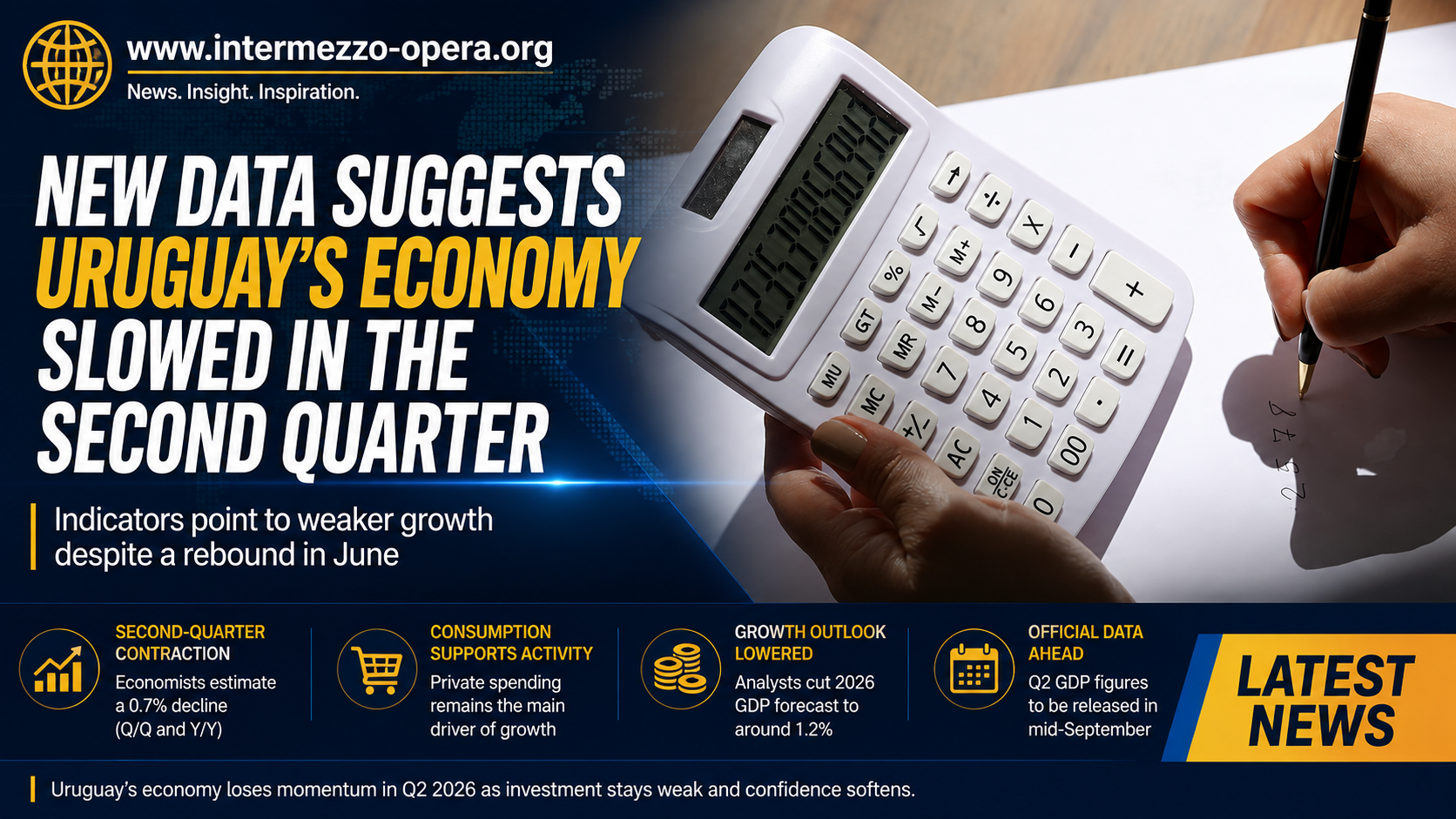
Uruguay’s Economy Shows Signs of Slowing in Second Quarter as Growth Momentum Weakens
 0
0
 0
0
Read Time:1 Minute, 58 Second
Uruguay’s economy appears to have lost momentum during the second quarter of 2026, according to new activity data released by the Central Bank of Uruguay (BCU). Although economic activity rebounded in June, figures for the April-to-June period point to a weaker performance overall.
The BCU’s Monthly Economic Activity Indicator (IMAE), which provides an early indication of GDP trends, increased 0.7% year-on-year in June. Meanwhile, seasonally adjusted activity rose 1.4% compared with May.
However, the trend-cycle measurement showed growth of just 0.1%, suggesting that underlying economic momentum remained limited.
Second-Quarter Data Point to Contraction
The June rebound followed declines recorded during April and May. When the three months are considered together, economists say Uruguay may have experienced a contraction during the second quarter.
Economist Aldo Lema estimated that GDP contracted by approximately 0.7% both quarter-on-quarter and year-on-year during the April-June period. He described June’s improvement as a predictable rebound partly influenced by calendar effects and a greater number of working days.
However, that figure remains an estimate rather than the official second-quarter GDP result. Uruguay’s national accounts covering April through June are expected to be released in mid-September.
The BCU has also noted that private consumption has been an important source of economic activity, supported by employment and real wages. Investment, by comparison, has remained relatively weak.
Growth Forecasts Remain Modest
The slowdown comes as economists have already lowered their expectations for Uruguay’s economic performance in 2026.
The Ministry of Economy currently projects GDP growth of 1.6% for the full year. However, the median forecast among analysts participating in the BCU’s August Economic Expectations Survey stands at a more cautious 1.2%.
Economist Javier de Haedo has argued that economic activity has remained broadly flat since early 2025. In his assessment, annual average growth could struggle to exceed 1% in 2026.
Consumption has so far performed better than exports and investment. Higher real wages, helped by relatively low inflation, have supported household spending.
Employment has also remained resilient despite the weaker growth environment. Nevertheless, weaker consumer and business confidence could create additional pressure in the coming months.
Official second-quarter GDP figures will provide a clearer picture of whether the slowdown indicated by monthly data translated into an outright contraction.


Happy
0 %

Sad
0 %

Excited
0 %

Sleepy
0 %

Angry
0 %

Surprise
0 %
Related Post

UTE Confirms Baygorria Solar Park After Reaching Agreement With Durazno Authorities
DURAZNO, Uruguay — Uruguay’s state-owned electricity company UTE has confirmed plans to build a photovoltaic…