
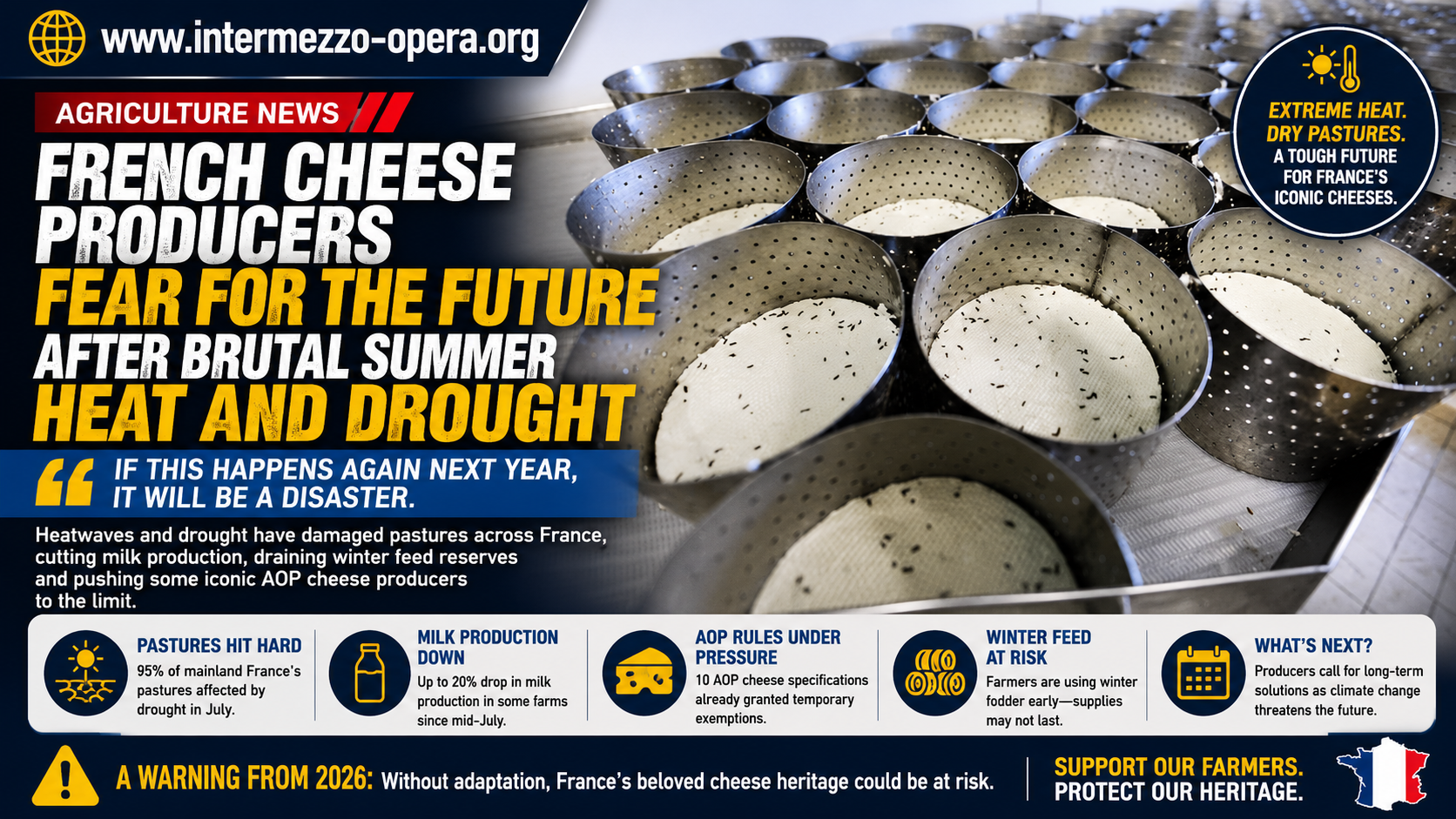
French Cheese Producers Fear for the Future After Brutal Summer Heat and Drought
 0
0
 0
0
Read Time:5 Minute, 18 Second
PARIS, France — French cheese producers are raising concerns about the future of their industry after an exceptionally difficult summer of heatwaves and drought damaged pastures, reduced milk production and forced farmers to tap into winter feed reserves months earlier than usual.
The impact has been particularly serious for producers of France’s protected AOP cheeses, whose strict production rules often require livestock to graze locally and consume feed produced within designated geographical areas.
For some farmers, the summer of 2026 has become a warning of what could happen if extreme heat becomes increasingly common.
“If this happens again next year, it will be a disaster,” Bleu d’Auvergne producer Nicolas Cussac told Le Monde.
Heatwaves Leave French Pastures Severely Damaged
Successive heatwaves and prolonged dry conditions transformed many French pastures during the summer.
Grass stopped growing normally in several regions. In some areas, fields became so dry that livestock could no longer obtain enough food from grazing.
As a result, farmers began distributing stored fodder much earlier than usual.
Some producers started using supplementary feed around July 10, according to industry representatives cited by Le Monde. Others began drawing directly from hay reserves originally intended for winter.
The problem has affected a large part of France.
According to reporting by The Guardian, around 95% of mainland France’s pastures were affected by drought conditions in July, while grassland growth was about one-third below historical norms.
Cheese Production Falls as Animals Struggle With Heat
The heat has affected more than grass.
Dairy cows and goats also experience physiological stress during extreme temperatures. Consequently, animals may eat less while using more energy to regulate their body temperature.
That combination can reduce milk production.
Moreover, changes in milk composition can make cheese production less efficient.
One goat farmer told Le Monde that producing one kilogram of tomme normally required approximately 10 liters of milk. During this summer’s heat, he needed almost two additional liters.
The impact can be even greater among dairy cattle.
Saint-Nectaire producer Sébastien Ramade estimated that milk volume on his farm had fallen by around 20% since mid-July. He said some other farmers had experienced even greater losses.
Therefore, farmers face a double challenge: producing less milk while spending more money feeding their animals.
AOP Cheese Rules Become Difficult to Follow
France’s famous AOP system presents another complication.
The Appellation d’Origine Protégée, or Protected Designation of Origin, protects products associated with specific geographical areas and traditional production methods.
However, those protections come with detailed requirements.
For example, some cheese specifications determine where animal feed must originate. Others establish minimum grazing periods or restrictions on how much feed can come from outside the designated production area.
Normally, those rules help protect the identity and quality of traditional French cheeses.
This summer, however, drought made some requirements extremely difficult to meet.
By August 20, temporary modification requests had already been approved for 10 AOP cheese specifications, according to France’s National Institute of Origin and Quality, or INAO.
They included Rocamadour, Fourme de Montbrison, Abondance, Cantal, Beaufort, Reblochon, Bleu du Vercors-Sassenage, Comté, Fourme d’Ambert and Bleu d’Auvergne.
Four additional applications had also been formally submitted and were awaiting consideration.
Comté, Beaufort and Abondance Receive Temporary Relief
French authorities have already relaxed some production requirements.
For cheeses including Comté, Beaufort and Abondance, temporary exemptions allow farmers greater flexibility to bring in fodder or grain from outside their traditional production areas.
The measures are intended to prevent farmers from losing AOP compliance simply because drought has made local feed unavailable.
Nevertheless, temporary exemptions cannot solve the underlying climate problem.
Other producers are considering similar requests.
Saint-Nectaire, for instance, normally requires a minimum of 160 grazing days per year. After this summer’s conditions, some farmers may struggle to meet that requirement.
Winter Feed Supplies Are Now a Major Concern
Another problem may emerge after summer ends.
Farmers normally produce and store hay during warmer months so livestock have sufficient food during winter.
However, many farms have already begun using those reserves.
Consequently, even if temperatures improve during autumn, farmers could enter winter with significantly smaller fodder stocks.
The situation has also attracted attention from major dairy companies.
Groupe Bel said its current requirements, including at least 150 days of pasture access, remained compatible with conditions experienced so far. However, the company warned that summer heat could have a delayed impact on winter fodder supplies.
This means the full economic consequences of the 2026 drought may not become clear for several months.
Roquefort Escapes Immediate Damage, but Risks Remain
Not every cheese-producing region experienced the same immediate impact.
Roquefort producers entered the summer in a relatively stronger position because milk production had been unusually high during winter 2025-2026.
Production volumes for that campaign were expected to finish approximately 5% above the previous year.
However, producers are already concerned about the 2026-2027 season.
Roquefort rules require 75% of sheep feed to originate within the AOP geographical area. Furthermore, outside feed brought onto individual farms is limited.
Therefore, depleted local fodder supplies could create difficulties during the next production cycle.
Industry representatives are expected to examine whether a temporary exemption will also become necessary.
Climate Change Forces Producers to Consider Long-Term Adaptation
The French government has recognized the severity of the situation.
Agriculture Minister Annie Genevard announced emergency and anticipatory measures earlier this summer as unusually early and intense heat affected the agricultural sector.
Still, cheese producers increasingly argue that emergency exemptions alone will not be enough.
The industry may need structural changes if severe droughts and heatwaves become more frequent.
For example, producers could reconsider grazing systems, fodder reserves and herd sizes.
Roquefort industry representatives have called for climate change to be incorporated more directly into future production planning. Meetings are expected to begin in September to discuss possible solutions.
Reducing herd sizes is also emerging as a possibility.
Such a move would represent a significant cultural shift for farms that have traditionally expanded production from one generation to the next. However, fewer animals could reduce pressure on limited pasture and feed supplies during extreme summers.
For France’s cheese industry, the summer of 2026 has therefore become more than a temporary production problem.
It has raised a larger question about how some of the country’s most traditional agricultural products can preserve their identity while adapting to a hotter and less predictable climate.


Happy
0 %

Sad
0 %

Excited
0 %

Sleepy
0 %

Angry
0 %

Surprise
0 %
Related Post

Gold and Bitcoin Surge as Dollar Weakens and U.S. Debt Hits Record $40 Trillion
Gold and Bitcoin surge as the U.S. dollar weakens and national debt reaches a record…