Paraguay’s Falling Dollar Raises Alarm in Real Estate Sector as Developers Warn of Investment Risks
 0
0
 0
0
Read Time:4 Minute, 7 Second
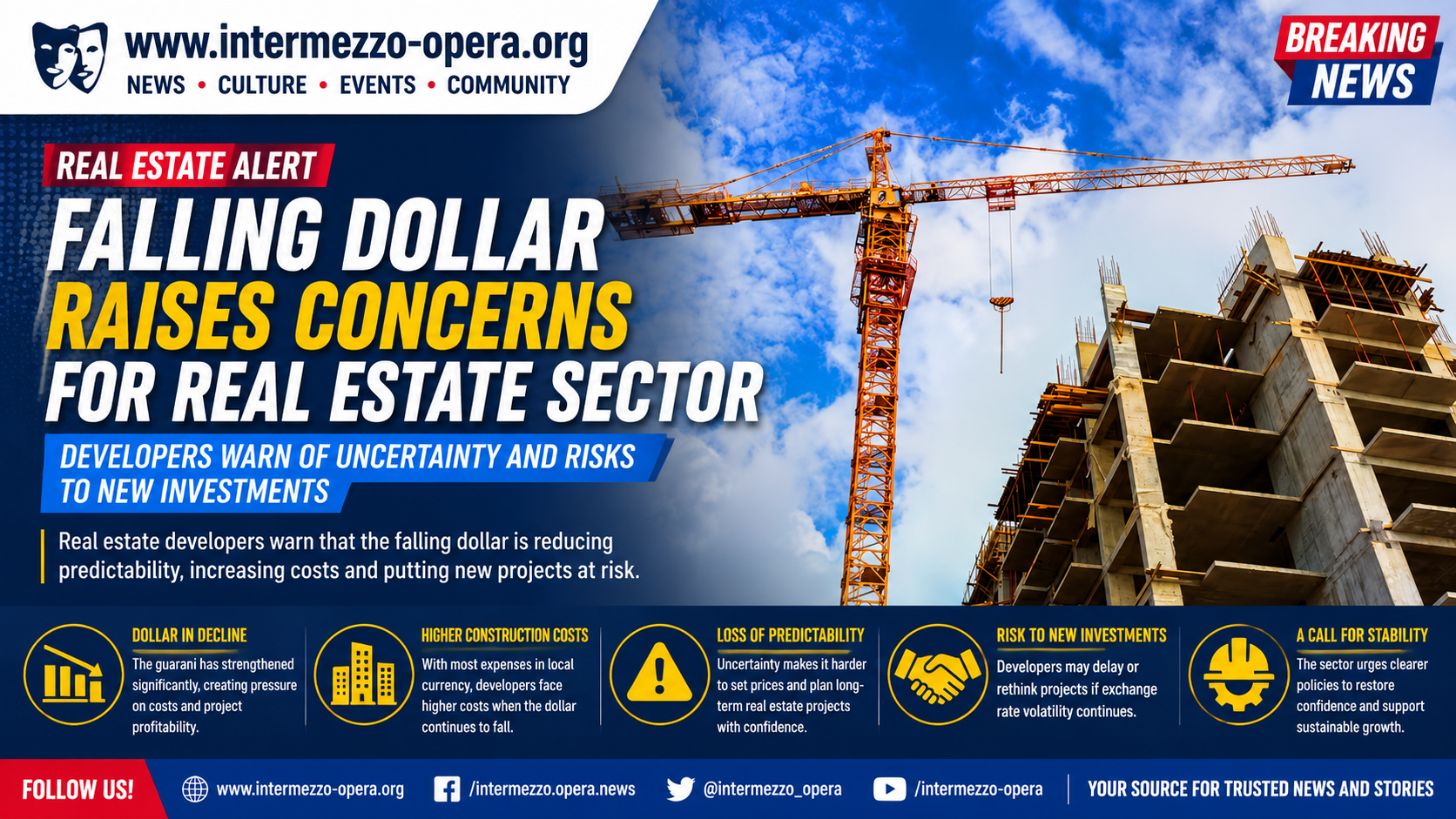
ASUNCIÓN, Paraguay — Paraguay’s real estate industry is raising concerns over the continued decline of the U.S. dollar, warning that exchange-rate volatility is making long-term projects harder to price and could eventually delay new investments.
Representatives of the Paraguayan Chamber of Real Estate Developers, known as Capadei, said the main concern is not simply whether the dollar rises or falls. Instead, developers are worried about losing the exchange-rate predictability that has supported Paraguay’s investment environment for years.
The warning comes as the Paraguayan guaraní has strengthened significantly against the U.S. currency.
After approaching G.8,000 per dollar in 2025, the exchange rate moved close to G.6,000 in August 2026. Market expectations for the end of 2026 have also shifted downward.
Falling Dollar Creates a New Challenge for Developers
The falling dollar in Paraguay has an unusual impact on real estate because much of the sector operates in two currencies.
Capadei council member Gonzalo Faccas told ABC Color that virtually all revenue in the industry is denominated in U.S. dollars. Meanwhile, he estimated that around 80% of costs are paid in Paraguayan guaraníes.
That difference becomes increasingly important when the dollar weakens.
Labor, professional services, construction materials and other domestic expenses continue to be paid in guaraníes. However, those expenses become more expensive when converted into dollars.
This can quickly change the financial calculations behind a development.
Property Prices Face Upward Pressure
Faccas said developers previously had the opportunity to continue selling properties at an average price of around US$1,500 per square meter.
Under current conditions, he said the average has moved closer to US$2,000 per square meter.
The industry argues that this does not necessarily mean developers are simply increasing their profit margins.
Instead, the change reflects a more expensive cost structure when expenses paid in guaraníes are converted into a weaker U.S. dollar.
This situation is particularly important because property developments are long-term investments.
A project may require two, three or even four years from planning and construction to final commercialization.
Capadei Calls for Greater Exchange-Rate Predictability
Capadei representatives have also questioned the response of the Central Bank of Paraguay (BCP).
According to Faccas, the industry does not want an artificially managed exchange rate. However, developers want greater predictability and clearer communication about the central bank’s approach.
He argued that the BCP previously intervened when the dollar climbed sharply.
The sector is therefore questioning why the central bank has taken a different approach while the dollar has fallen significantly.
Exporters have raised similar concerns. They reported that the dollar had fallen around 20% against the guaraní over the 12 months through July 2026, while Paraguay’s real exchange rate contracted by approximately 17%.
New Real Estate Investments Could Be Delayed
Capadei President Raúl Constantino said exchange-rate uncertainty makes it increasingly difficult to establish prices for new developments.
Previously, developers could launch a project with a dollar-denominated selling price and keep that price relatively stable during much of the sales period.
The current environment makes that strategy more difficult.
If the exchange rate continues changing significantly, the original selling price may no longer cover the actual replacement and construction costs when the building is completed.
This creates another problem: investment decisions.
Developers may include larger safety margins when calculating future costs. In more uncertain circumstances, some companies could postpone projects entirely.
For an industry that requires years of planning, exchange-rate stability therefore plays a major role in determining whether new developments remain financially viable.
Strong Guaraní Changes Paraguay’s Property Market
The exchange-rate movement has been one of the most significant economic developments affecting Paraguay’s real estate market in 2026.
Industry analysis shows that the dollar fell from levels approaching G.8,000 in 2025 to roughly G.6,000 by August 2026.
Several factors may be contributing to the stronger guaraní. These include Paraguay’s record soybean harvest, international dollar weakness, lower country risk and greater capital flows toward guaraní-denominated assets.
For consumers, a stronger local currency can bring certain benefits.
For developers whose sales are priced in dollars but expenses remain largely in guaraníes, however, the equation is more complicated.
Real Estate Boom Depends on Stability
Capadei argues that Paraguay’s macroeconomic stability has been one of the foundations of the country’s recent real estate expansion.
That stability has helped attract both domestic and foreign investors.
Developers now fear that prolonged currency uncertainty could weaken one of those advantages.
The industry is therefore asking for greater clarity rather than demanding a specific dollar price.
For developers, the ability to estimate construction costs several years ahead is crucial when deciding whether a new apartment building or other property development can proceed.
If that predictability deteriorates, Capadei warns that the consequences could extend beyond property prices and eventually affect the pace of new real estate investment in Paraguay.


Happy
0 %

Sad
0 %

Excited
0 %

Sleepy
0 %

Angry
0 %

Surprise
0 %
Related Post
Spain’s Power Grid Crunch Pits Housing Projects Against Data Centers
Madrid – A growing Spain power grid capacity shortage is creating competition between property developers…