Wall Street Turns More Cautious on Argentina as Political Support Becomes a Key Investor Risk
 0
0
 0
0
Read Time:4 Minute, 42 Second
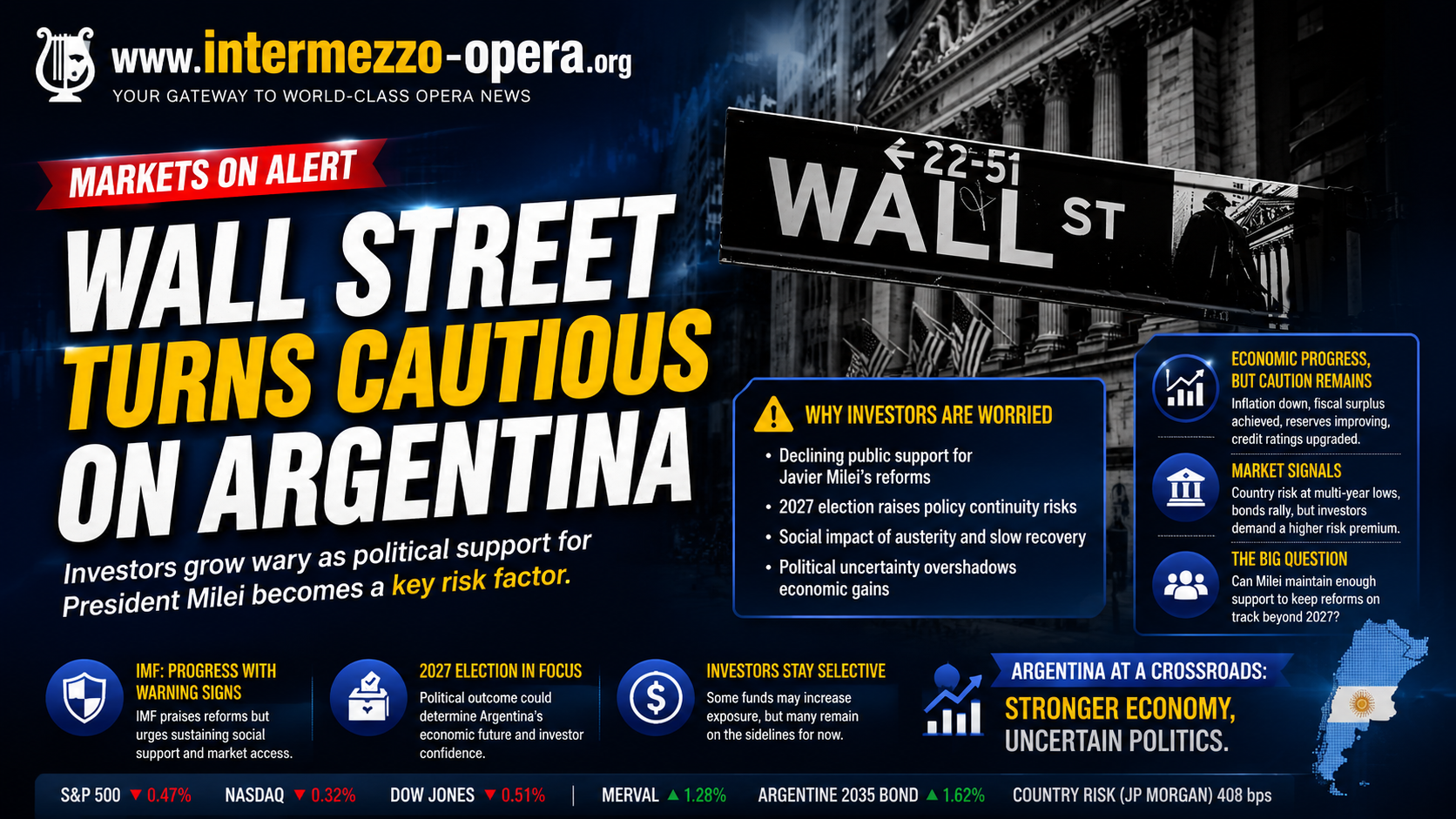
BUENOS AIRES – International investors are becoming more cautious about Argentina’s financial outlook, with Wall Street increasingly focused on political risk and whether President Javier Milei can maintain enough public support to preserve his market-oriented economic reforms through the 2027 presidential election.
The shift does not amount to a wholesale retreat from Argentine assets. Instead, major investment banks and institutional funds are increasingly weighing improved economic fundamentals against uncertainty over the political durability of the government’s reform agenda.
After meetings with large investment funds in London, Morgan Stanley found that investors’ main concern was no longer simply Argentina’s short-term economic program. Attention has increasingly shifted toward whether the current policy direction can survive the next electoral cycle.
Political Risk Moves to the Center of Wall Street’s Argentina Debate
Argentina has achieved several developments welcomed by financial markets during 2026.
Inflation has eased, fiscal discipline has strengthened, international reserves have improved and major credit-rating agencies have upgraded the country.
In July, Moody’s upgraded Argentina’s long-term issuer rating from Caa1 to B3 and changed its outlook from stable to positive. The agency cited stronger macroeconomic stability, fiscal surpluses, economic liberalization and improved access to financing.
Yet these improvements have not eliminated investor concerns.
Wall Street is increasingly asking whether Argentina’s economic transformation can maintain sufficient political and social support to continue beyond the current phase.
Citi reached a similar conclusion after meetings with investment funds in New York and Boston. Investors raised concerns about the social impact of Milei’s economic program and the possibility that declining political support could eventually threaten policy continuity.
Investors Remain Cautious Despite Economic Progress
The changing mood illustrates an unusual situation.
Argentina’s economic fundamentals have improved in several areas while investors remain reluctant to substantially increase their exposure.
Morgan Stanley reported that some international funds would consider increasing their positions in Argentine assets if they had greater confidence that the country’s economic recovery would translate into sustainable political support.
The bank itself has suggested that international investors may actually be too cautious toward Argentina.
Morgan Stanley believes stronger economic activity, improved financial conditions and continued reserve accumulation could gradually reduce investor concerns and encourage greater exposure to Argentine assets.
This distinction is important.
Rather than Wall Street uniformly abandoning Argentina, investors appear to be demanding a larger political-risk premium before committing additional capital.
Milei’s Public Support Becomes a Market Variable
For investors, the approaching 2027 presidential election is becoming increasingly important.
The concern is not simply whether Milei wins or loses. Markets are assessing whether Argentina’s population will continue supporting fiscal discipline, deregulation and other reforms if economic recovery remains uneven.
Recent market commentary has highlighted declining government polling numbers, political controversies and an economy whose recovery has not been equally visible across society as reasons for caution.
That makes public sentiment increasingly relevant to asset prices.
Investors typically value predictability. If they believe economic policy could change substantially following an election, they may demand higher returns or limit their exposure until the political outlook becomes clearer.
Argentina Has Also Sent Positive Signals to Markets
The cautious mood should be viewed alongside several positive developments.
In June, Argentina’s sovereign risk indicator fell sharply following a sovereign-rating upgrade from S&P. The JPMorgan country-risk index dropped to 443 basis points, its lowest level since May 2018 at that point, while Argentine sovereign bonds and US-listed shares rallied strongly.
In early July, the country-risk measure fell further to approximately 408 basis points after Economy Minister Luis Caputo presented the government’s financing strategy through 2027.
The government has said its longer-term objective is to move Argentina toward investment-grade status, although Caputo has stressed that returning to international capital markets is an option rather than an immediate objective.
These developments complicate any simple narrative of investors abandoning the country.
Argentina continues to attract market interest, but investors are becoming more selective about how much political risk they are willing to assume.
IMF Sees Progress but Warns of Remaining Vulnerabilities
The International Monetary Fund has also acknowledged significant progress while emphasizing that important vulnerabilities remain.
Following its 2026 Article IV consultation and second review of Argentina’s Extended Fund Facility, the IMF praised continued adherence to a strong fiscal anchor and supported efforts to rebuild foreign-exchange reserves.
At the same time, the Fund stressed the importance of achieving durable access to international capital markets and maintaining adequate social support as reforms continue.
Argentina will face substantial foreign-currency debt obligations in 2027, adding another layer of importance to market confidence.
IMF Managing Director Kristalina Georgieva praised the country’s economic reforms during her July visit, while the Fund continued to highlight political uncertainty and the need to sustain the reform process.
Wall Street Is Watching 2027
For Wall Street, the central question surrounding Argentina is gradually changing.
Investors spent much of Milei’s early presidency asking whether the government could stabilize an economy suffering from severe inflation, fiscal imbalances and depleted reserves.
Now the debate increasingly concerns political sustainability.
Can improving macroeconomic indicators translate into better living conditions? Can Milei preserve enough public support to continue his reforms? And will Argentina maintain its economic direction beyond the 2027 election?
Those questions could determine whether international funds increase their exposure or remain on the sidelines.
The current picture is therefore more nuanced than a simple Wall Street withdrawal. Investors remain interested in Argentina, but political uncertainty and concerns about the durability of Milei’s public support are making them more cautious about taking additional risk.


Happy
0 %

Sad
0 %

Excited
0 %

Sleepy
0 %

Angry
0 %

Surprise
0 %
Related Post

Uruguay Moves to Repopulate Ciudad Vieja by Turning Underused Properties Into New Housing
Uruguay’s Ciudad Vieja housing plan is moving forward as the government seeks to bring more…