
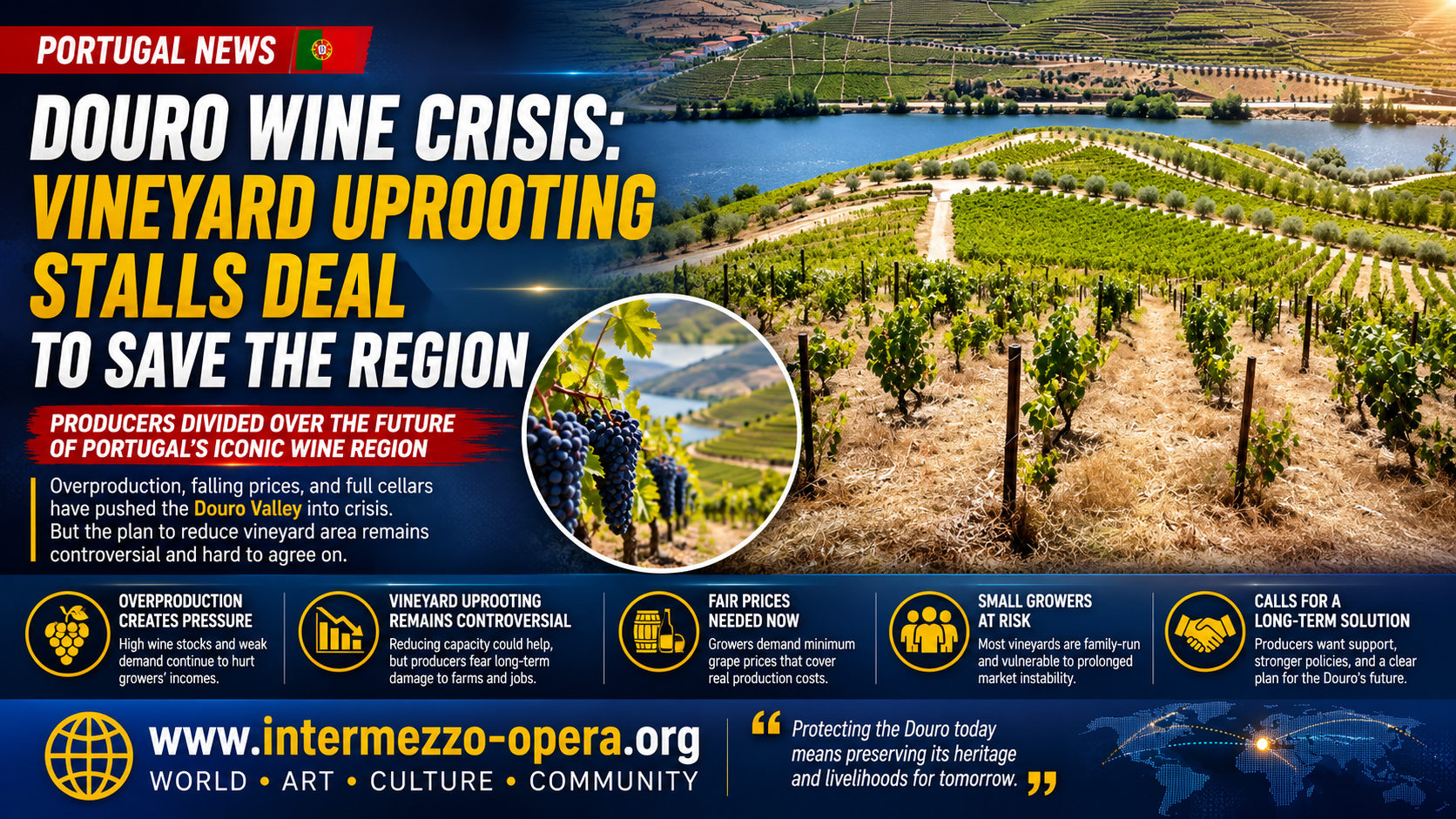
Vineyard Uprooting Divides Douro Wine Sector as Producers Seek Deal to End Crisis
 0
0
 0
0
Read Time:7 Minute, 6 Second
The Douro wine crisis is entering another difficult phase as disagreements over vineyard uprooting complicate efforts to build a common strategy for one of Portugal’s most important wine-producing regions.
Winegrowers, industry representatives, cooperatives, and authorities broadly agree that the Douro faces a serious structural problem. However, finding agreement on how production capacity should be adjusted remains much more difficult.
At the center of the debate is vineyard removal.
Reducing vineyard area could help rebalance supply and demand. Nevertheless, many growers fear that poorly designed measures could permanently damage family farms, traditional vineyards, and the social fabric of the Douro.
Therefore, the discussion is no longer simply about reducing wine stocks. It is also about deciding what kind of Douro wine sector should survive the crisis.
Douro Wine Crisis Driven by Excess Supply
The current problems did not emerge overnight.
Portugal’s official Action Plan for the Sustainable Management and Valorization of the Douro Demarcated Region identifies historically high wine surpluses as a major structural challenge.
According to the government, these stocks developed through a combination of declining demand and increasing production.
Consequently, producers have struggled to sell grapes and wine under sustainable economic conditions.
Smaller growers are particularly exposed.
They often depend heavily on a single annual harvest. Therefore, even relatively small reductions in grape prices can have a major effect on household income.
Vineyard Uprooting Becomes a Difficult Question
One potential response involves adjusting the region’s productive capacity.
The Portuguese government’s Douro plan already includes measures for the voluntary adjustment of production potential.
In practical terms, reducing vineyard area could decrease future grape production.
However, the proposal creates several problems.
Douro vineyards are not simply agricultural production units. Many are family properties with generations of history behind them.
Moreover, vineyards form an essential part of the region’s internationally recognized landscape.
Therefore, growers want guarantees that any vineyard-reduction program will be carefully designed.
Growers Demand Fair Grape Prices
Price remains one of the biggest concerns.
Douro winegrowers organized a demonstration in Peso da Régua on August 7, 2026, demanding urgent government action.
Among their demands was a prohibition on purchasing grapes below production costs. They also called for adequately funded crisis distillation and stronger intervention by Casa do Douro in managing stocks.
This issue explains why vineyard removal alone cannot solve the problem.
A smaller vineyard area could theoretically reduce future production.
However, growers argue that the sector must also provide economically sustainable prices.
Otherwise, farmers could leave vineyards simply because producing grapes is no longer financially viable.
Crisis Distillation Provides Short-Term Relief
Portugal has already used crisis distillation as an emergency measure.
Under the government’s Douro action plan, growers received support of €0.50 per kilogram of grapes delivered for distillation.
The measure originally had a budget of €15 million.
Its objective was straightforward.
Instead of allowing excess grapes to become additional commercial wine stocks, part of the harvest could be redirected to distillation.
As a result, authorities hoped to reduce immediate pressure on producers and wineries.
However, crisis distillation is primarily a short-term intervention.
It removes excess product from the market. Nevertheless, it does not automatically correct the underlying imbalance between production and demand.
Government Continued Payments in 2026
The government subsequently authorized additional spending to settle eligible applications that remained unpaid.
A May 2026 resolution allowed up to €250,000 to be used for applications from the 2025-2026 campaign that had not been paid because of operational and administrative issues.
Therefore, authorities continued implementing the emergency program into 2026.
Nevertheless, growers have continued demanding broader structural measures.
Their concern is understandable.
If excess wine production continues every year, repeated emergency distillation would treat the consequence rather than the cause.
Douro Needs a Long-Term Solution
The Portuguese government has acknowledged this problem.
Its official plan was designed not only to respond to the immediate crisis but also to prevent similar situations from repeatedly affecting the region.
Several approaches are being considered.
Cooperatives could receive stronger support. Storage capacity could improve. Moreover, investments in energy efficiency and technical modernization could help producers become more competitive.
Production capacity is another part of that discussion.
However, reducing vineyards is particularly sensitive because the consequences can be permanent.
Once a vineyard disappears, restoring the same productive and cultural landscape is not necessarily easy.
Small Winegrowers Fear Being Hit Hardest
The social structure of the Douro makes the debate even more complicated.
Many vineyards are divided among relatively small producers.
These growers do not necessarily have the financial reserves available to larger wine companies.
Therefore, a prolonged period of low grape prices can quickly become unsustainable.
The government itself has recognized the need to protect smaller growers in other vineyard-support measures.
For example, after storms damaged vineyards earlier in 2026, Portugal introduced measures intended particularly to protect small producers. The package safeguarded €22 million associated with vineyard recovery and included a new €5 million VITIS funding round.
This experience reinforces demands that structural changes in the Douro should also consider differences between large and small operators.
Douro Landscape Is Part of the Debate
Economic calculations are only one dimension of the issue.
The Douro is also a cultural landscape.
Terraced vineyards along the Douro River have become one of Portugal’s most recognizable images.
Therefore, large-scale vineyard abandonment could have consequences beyond wine production.
The landscape depends on continuous agricultural management.
Moreover, vineyards support employment and economic activity across rural communities.
For that reason, any vineyard reduction strategy must balance supply management with territorial preservation.
Cooperatives Could Play a Bigger Role
The government’s action plan also proposes strengthening wine cooperatives.
This could be important for smaller producers.
Cooperatives can provide storage, technical resources, processing capacity, and stronger negotiating power.
Moreover, they can help coordinate production decisions across many growers.
Portugal’s official Douro plan specifically includes modernization, greater storage capacity, improved energy efficiency, and technical support for cooperatives.
Therefore, policymakers are looking beyond vineyard removal alone.
A sustainable solution could require several measures operating simultaneously.
Demand Is Another Part of the Equation
Reducing production addresses only one side of the market.
Increasing demand is equally important.
Douro wines compete in international markets with producers from Spain, France, Italy, Chile, Argentina, Australia, and many other regions.
Meanwhile, consumer habits continue to evolve.
Consequently, producers need stronger commercial strategies as well as production controls.
Premium positioning could help.
Wine tourism could also generate additional revenue. Furthermore, stronger export strategies could create opportunities outside Portugal.
The challenge is to increase the economic value generated by each hectare rather than relying solely on production volume.
Producers Want Structural Change
The August protest demonstrated that growers remain dissatisfied with the current situation.
Their demands included fair grape prices, regional brandy for Port production, adequately funded crisis distillation, and a stronger role for Casa do Douro.
These demands reflect a broader concern.
Winegrowers want greater predictability.
They need to know whether grapes can be sold at economically viable prices before investing another year of labor and money into their vineyards.
Therefore, uncertainty itself has become part of the crisis.
Vineyard Uprooting Could Complicate an Agreement
This is why the vineyard-removal debate is so sensitive.
In theory, voluntary vineyard reduction can help correct structural oversupply.
However, producers want to know which vineyards would be eligible, what compensation would be available, and how the measure would affect future production rights.
They also want assurances that small growers will not carry a disproportionate share of the adjustment.
Consequently, vineyard uprooting can become an obstacle to a broader agreement even when most parties recognize that production and demand need to become better aligned.
Douro Faces a Critical Moment
The Douro wine crisis is ultimately about much more than this year’s grape harvest.
Portugal must decide how to protect growers while reducing structural oversupply.
Emergency measures have already provided some relief. Crisis distillation received €15 million under the government’s action plan, while additional payments were authorized in 2026.
However, producers continue to demand deeper reforms.
Vineyard reduction may form part of that solution. Nevertheless, it remains one of the most controversial elements because it directly affects growers, production capacity, and the Douro landscape.
Therefore, reaching an agreement will require more than simply removing vines.
The long-term solution must combine sustainable grape prices, better stock management, stronger cooperatives, market development, and carefully targeted production adjustments.
If those elements can be balanced, the current crisis could become an opportunity to reshape the Douro wine sector.
If not, pressure on small growers could continue well beyond the 2026 harvest.


Happy
0 %

Sad
0 %

Excited
0 %

Sleepy
0 %

Angry
0 %

Surprise
0 %
Related Post

The Economy in Plain English with Arun Advani
In today’s complex world, understanding economics can feel overwhelming. However, Arun Advani offers a refreshing…