
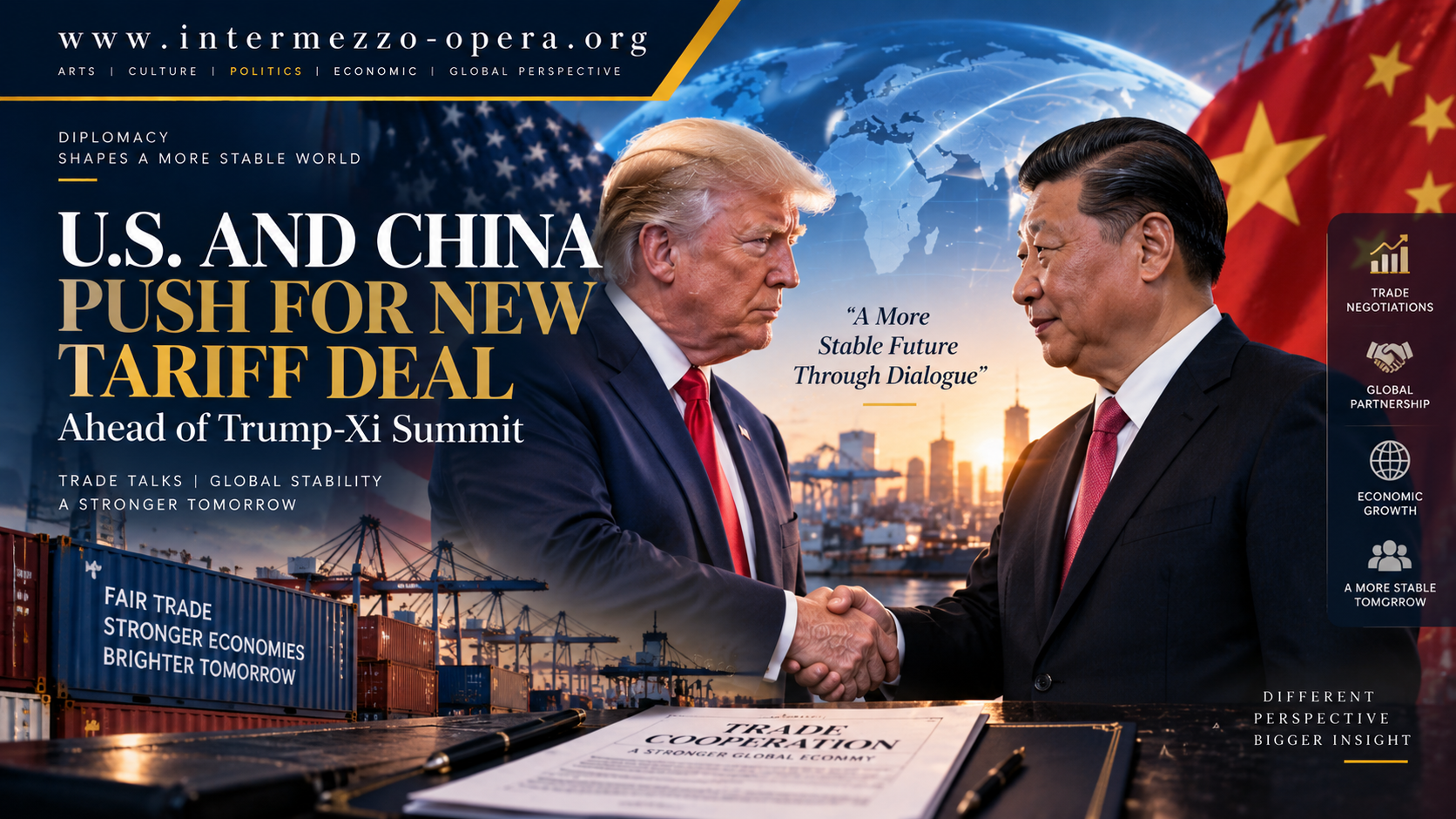
U.S. and China Push for New Tariff Deal Ahead of Trump-Xi Summit
 0
0
 0
0
Read Time:4 Minute, 26 Second
The U.S.-China tariff talks are moving back into the global political spotlight as Washington and Beijing work toward reciprocal tariff reductions before a planned meeting between U.S. President Donald Trump and Chinese President Xi Jinping. The negotiations could provide a new test of whether the world’s two largest economies can stabilize their relationship after years of trade disputes and strategic rivalry.
Chinese officials said negotiators are trying to reach an agreement on tariff reductions covering $30 billion worth of goods from each country. Both governments hope to make progress before Trump and Xi meet in Washington on September 24, 2026. The meeting would be their third face-to-face discussion within a year.
U.S.-China Tariff Talks Return to Center Stage
Trade remains one of the most sensitive political issues between Washington and Beijing.
The latest negotiations focus mainly on goods that both governments consider relatively nonsensitive. Therefore, the discussions may avoid some of the more difficult disputes involving technology, national security, and strategic industries.
China’s Commerce Ministry said both sides want to implement reciprocal tariff reductions at an early date. According to China’s official Xinhua News Agency, the proposed reductions would cover an equal $30 billion in goods from each side.
The negotiations also connect to a broader effort to create a U.S.-China Board of Trade. Trump and Xi agreed to pursue that mechanism during their previous meeting in Beijing in May.
In addition, the two governments discussed creating a Board of Investment. These institutions could provide more structured channels for handling future economic disagreements.
Trump-Xi Meeting Could Shape the Next Political Phase
The September 24 summit carries significance beyond tariffs.
Washington and Beijing continue to compete across technology, manufacturing, investment, security, and global influence. However, both sides also have strong reasons to prevent their rivalry from becoming uncontrollable.
Chinese Foreign Ministry spokesperson Guo Jiakun described leader-level diplomacy as an important strategic force in managing bilateral relations.
Meanwhile, the current tariff truce is scheduled to expire on November 10. That deadline adds pressure to the upcoming summit.
A successful meeting could extend the period of relative stability. However, failure to reach common ground could bring trade tensions back to the forefront.
A Broad Trade Agreement Remains Difficult
Despite renewed diplomacy, a comprehensive settlement still appears difficult.
Barclays analysts said trade would likely remain a central issue at the Trump-Xi summit. However, they also suggested that targeted tariff reductions appear more achievable than a sweeping trade agreement.
The economic relationship has also changed.
American and Chinese companies have spent years adjusting supply chains and reducing some forms of dependence on each other’s markets. Chinese exports to the United States fell sharply last year after Washington introduced higher tariffs.
As a result, even successful U.S.-China tariff talks may not have the same economic impact that a similar agreement would have produced several years ago.
Still, the political message could be significant. Limited cooperation would show that Washington and Beijing can negotiate even while competing in other areas.
Tariff Cuts Could Benefit Both Countries Differently
The proposed $30 billion arrangement may have an uneven impact.
Economist Gary Ng of Natixis estimated that $30 billion represents roughly 28% of U.S. exports to China, while the same amount represents only around 10% of Chinese exports in the opposite direction. Therefore, the United States could receive a larger proportional benefit from the proposed reductions.
However, tariffs are only one part of the relationship.
Technology restrictions, investment rules, manufacturing competition, and national security remain major sources of disagreement. Both governments also want to protect industries they consider strategically important.
Consequently, negotiators must find areas where cooperation remains politically possible without forcing either government to abandon its broader priorities.
Economic Diplomacy Becomes a Political Tool
The renewed negotiations demonstrate how closely economics and politics now interact.
Tariffs affect manufacturers and consumers. At the same time, governments increasingly use them to pursue strategic goals.
For Washington, negotiations offer an opportunity to improve access for American exporters while maintaining pressure in sensitive sectors.
For Beijing, lower tariffs could support trade and demonstrate that China remains willing to negotiate with the United States.
However, domestic politics matter as well. Both governments need to present any agreement as a victory rather than a concession.
That makes smaller agreements particularly useful. They allow leaders to show progress without resolving every major dispute.
U.S.-China Relations Face Another Important Test
The coming weeks will determine whether the latest U.S.-China tariff talks can produce a concrete agreement.
First, negotiators must settle the details of the reciprocal reductions. Next, Trump and Xi will have an opportunity to address broader issues during their Washington meeting.
Finally, both governments must decide what happens before the existing tariff truce expires in November.
A limited tariff agreement would not end the strategic competition between the United States and China. However, it could create additional space for diplomacy and reduce the risk of another rapid escalation.
For global politics, that alone would matter. The relationship between Washington and Beijing influences international trade, investment, technology, and diplomacy far beyond their borders.
The September summit will therefore offer an important signal. The U.S.-China tariff talks may begin with $30 billion in goods, but their political significance could extend much further.


Happy
0 %

Sad
0 %

Excited
0 %

Sleepy
0 %

Angry
0 %

Surprise
0 %
Related Post

Spain Tightens Border Checks on Flights and Ships From Italy Until September 7
MADRID – Spain has temporarily restored border checks for travelers arriving from Italy by air…