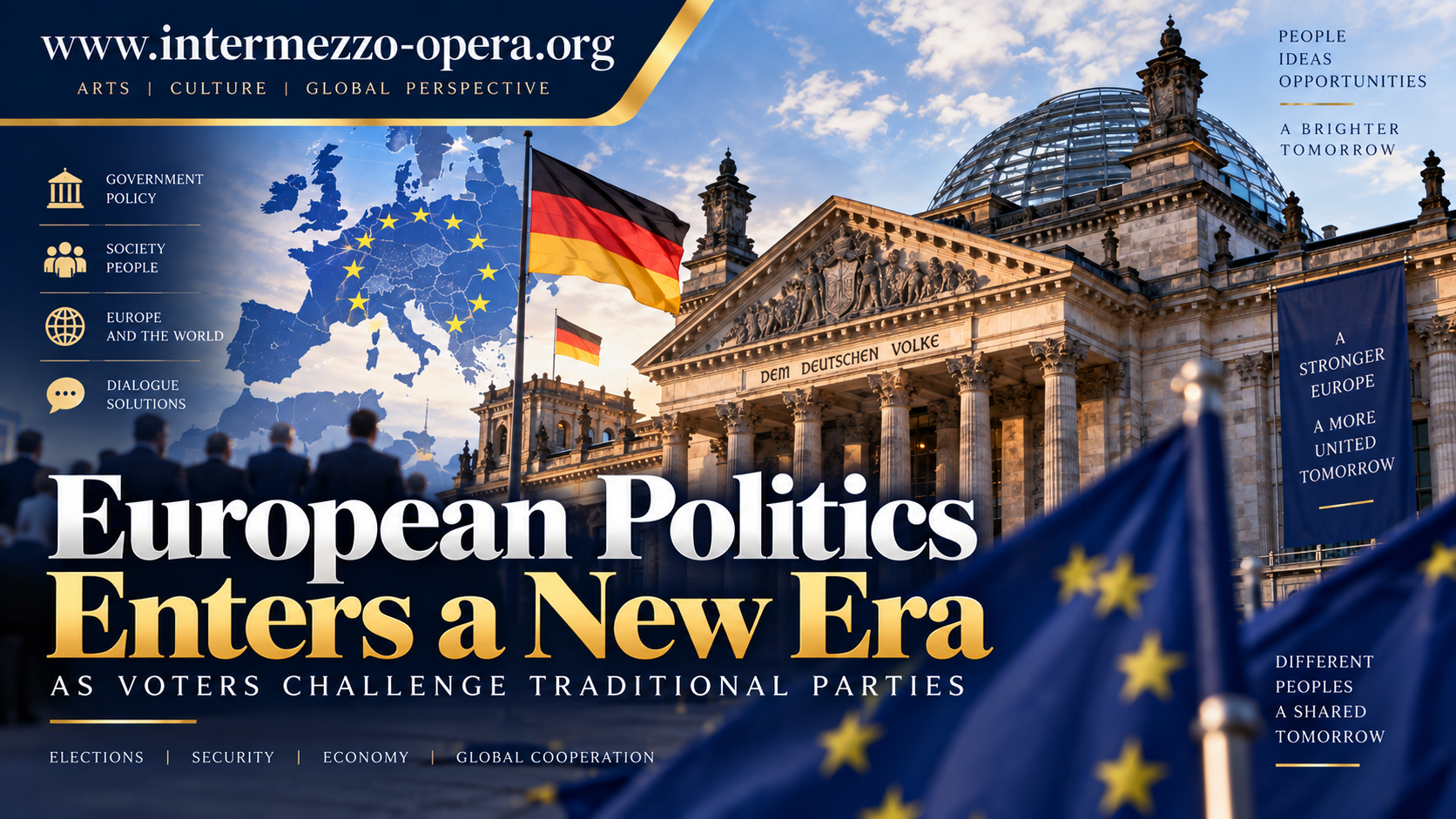
European Politics Enters a New Era as Voters Challenge Traditional Parties
 0
0
 0
0
Read Time:6 Minute, 14 Second
European politics is entering a period of significant change as voters across the continent increasingly challenge established political parties. One of the clearest signals came from Germany, where the Alternative for Germany (AfD) achieved a historic victory in the eastern state of Saxony-Anhalt.
The AfD secured nearly 44% of the vote in the September 6, 2026 state election and won 39 of the legislature’s 83 seats. Although that was not enough for an outright majority, the result placed the party far ahead of Chancellor Friedrich Merz’s Christian Democratic Union (CDU).
The result has implications beyond one German state. It reflects wider debates taking place throughout Europe over immigration, economic security, national identity, foreign policy and public confidence in traditional political institutions.
European Politics Faces a Major Shift
The transformation of European politics has developed over several years.
Traditional centre-left and centre-right parties that dominated European governments for decades now face competition from populist, nationalist, environmentalist and other political movements.
Germany’s Saxony-Anhalt election provides a striking example.
Reuters reported that dissatisfaction with Chancellor Merz’s government was extremely high among voters in the state. An Infratest dimap survey for ARD found that 87% of respondents were unhappy with the federal government.
Economic insecurity, pensions and the cost of living were among the issues influencing voter dissatisfaction.
AfD Victory Shakes German Politics
The scale of the AfD victory was particularly significant because Germany has traditionally maintained strong political barriers against cooperation with the far right.
Chancellor Merz acknowledged that the result had shaken his CDU while continuing to rule out cooperation with the AfD. Germany’s mainstream parties have long followed a political “firewall” designed to prevent governing partnerships with the party.
That firewall could now face greater political pressure.
With 39 of 83 seats, the AfD does not control the Saxony-Anhalt parliament by itself. Forming a stable government could therefore require complicated negotiations among parties that have significant ideological differences.
The situation illustrates an increasingly common characteristic of European politics: electoral fragmentation can make coalition building much more difficult.
Economic Concerns Influence Political Choices
Political change cannot be separated from economics.
Germany remains Europe’s largest economy, but voters have faced concerns about growth, employment, pensions and living costs.
These pressures can significantly influence political behavior.
When households feel economically insecure, voters may become more willing to consider parties that promise major changes to existing policies.
Reuters’ analysis of the Saxony-Anhalt result described economic insecurity as an important source of voter frustration with the federal government.
This connection between economics and politics is increasingly visible across Europe.
Governments are under pressure to maintain public services while controlling debt, supporting economic growth and responding to higher household expenses.
Immigration Remains a Powerful Political Issue
Immigration continues to play a major role in European politics.
The AfD has built substantial support around a restrictive approach toward immigration. However, debates surrounding migration extend well beyond Germany.
European governments continue to discuss border security, asylum policy, integration and the distribution of responsibility among EU member states.
The political challenge is complicated because migration involves humanitarian, economic and security considerations simultaneously.
Different countries also experience migration pressures differently, making it difficult to establish policies that satisfy every member of the European Union.
As a result, immigration is likely to remain one of Europe’s most politically sensitive issues.
Ukraine and Russia Divide Political Movements
Foreign policy is another important dividing line.
The AfD advocates ending German support for Ukraine and restoring relations with Moscow, positions that differ sharply from Chancellor Merz’s government. Merz has reiterated his support for Ukraine and argued that Germany should continue defending its existing security commitments.
These disagreements extend beyond Germany.
European governments continue to debate defense spending, sanctions, military assistance and the continent’s future security architecture.
For voters, these policies also have domestic consequences because defense expenditure and international commitments compete with other priorities for government resources.
Foreign policy has therefore become increasingly connected with domestic political debates.
Sweden Shows How Competitive European Politics Has Become
Germany is not the only country experiencing intense political competition.
Sweden is preparing for its September 13 parliamentary election, where polling indicates an increasingly close contest between the governing right-wing bloc and the centre-left opposition.
A Novus poll reported by Reuters on September 7 showed the governing bloc narrowing the gap considerably. The Liberals also reached the 4% parliamentary threshold in the survey, potentially improving the government’s electoral prospects.
Major campaign issues include healthcare, schools, the cost of living, security, immigration and energy.
The Swedish race illustrates how quickly political momentum can change.
Traditional Parties Must Reconnect With Voters
One of the largest challenges facing established political parties is rebuilding public trust.
Many voters believe governments are not responding quickly enough to economic insecurity, housing shortages, immigration concerns or declining public services.
Traditional parties therefore face a difficult choice.
They can maintain existing policies and argue for stability, or adjust their positions to respond to voters moving toward newer political movements.
Moving too far in either direction carries risks.
Adopting policies associated with populist competitors could alienate moderate supporters, while ignoring voter concerns could strengthen political alternatives.
The challenge will shape European politics well beyond individual elections.
Coalition Governments Could Become More Complicated
Political fragmentation also creates practical problems for governing.
European parliamentary systems frequently require parties to build coalitions. When votes are distributed among more parties, forming a majority becomes increasingly difficult.
Parties that disagree on immigration may nevertheless agree on economic policy. Others may share similar positions on social policy but disagree sharply over Ukraine, Russia or European integration.
This can produce lengthy coalition negotiations.
Minority governments may also become more common if parties cannot establish conventional parliamentary majorities.
Saxony-Anhalt provides a particularly important test because most established German parties continue to reject cooperation with the AfD despite its electoral victory.
European Union Faces Its Own Political Debate
The future of the European Union is another central issue.
Some political movements want deeper European integration, while others argue that national governments should regain greater control over legislation, borders and economic policy.
This disagreement is increasingly visible in national elections.
Italy’s Roberto Vannacci, for example, recently used an appearance at a major business conference to criticize deeper EU political integration and advocate greater national sovereignty. His emerging Futuro Nazionale movement is another indication of the changing political landscape on the continent.
At the same time, pro-European parties argue that cooperation is essential for trade, defense, energy security and global competitiveness.
The future balance between national sovereignty and European integration is therefore likely to remain a defining political debate.
European Politics Moves Into an Uncertain Future
The latest elections and opinion polls suggest that European politics is becoming more competitive, fragmented and unpredictable.
Germany’s Saxony-Anhalt result is particularly important because it demonstrates how dramatically voter preferences can change when economic dissatisfaction, immigration concerns and distrust of established institutions converge.
The AfD’s nearly 44% result does not automatically mean it will govern the state. It does, however, force Germany’s traditional parties to confront a political reality that has become increasingly difficult to ignore.
Sweden’s close election race provides another indication that political competition is intensifying elsewhere in Europe.
For governments, the challenge will be larger than winning elections. Political leaders will need to address economic concerns, maintain public trust and navigate increasingly divided electorates.
The result could determine not only who governs individual European countries, but also the future direction of the European Union itself.


Happy
0 %

Sad
0 %

Excited
0 %

Sleepy
0 %

Angry
0 %

Surprise
0 %
Related Post

Milei and Cristina Face Off as Political Tensions Draw Global Attention
Argentina's political landscape remains under intense international scrutiny as President Javier Milei and former President…