Glucksmann Draws Red Line on France’s 2027 Budget, Warns Government Over Social and Green Cuts
 0
0
 0
0
Read Time:6 Minute, 47 Second
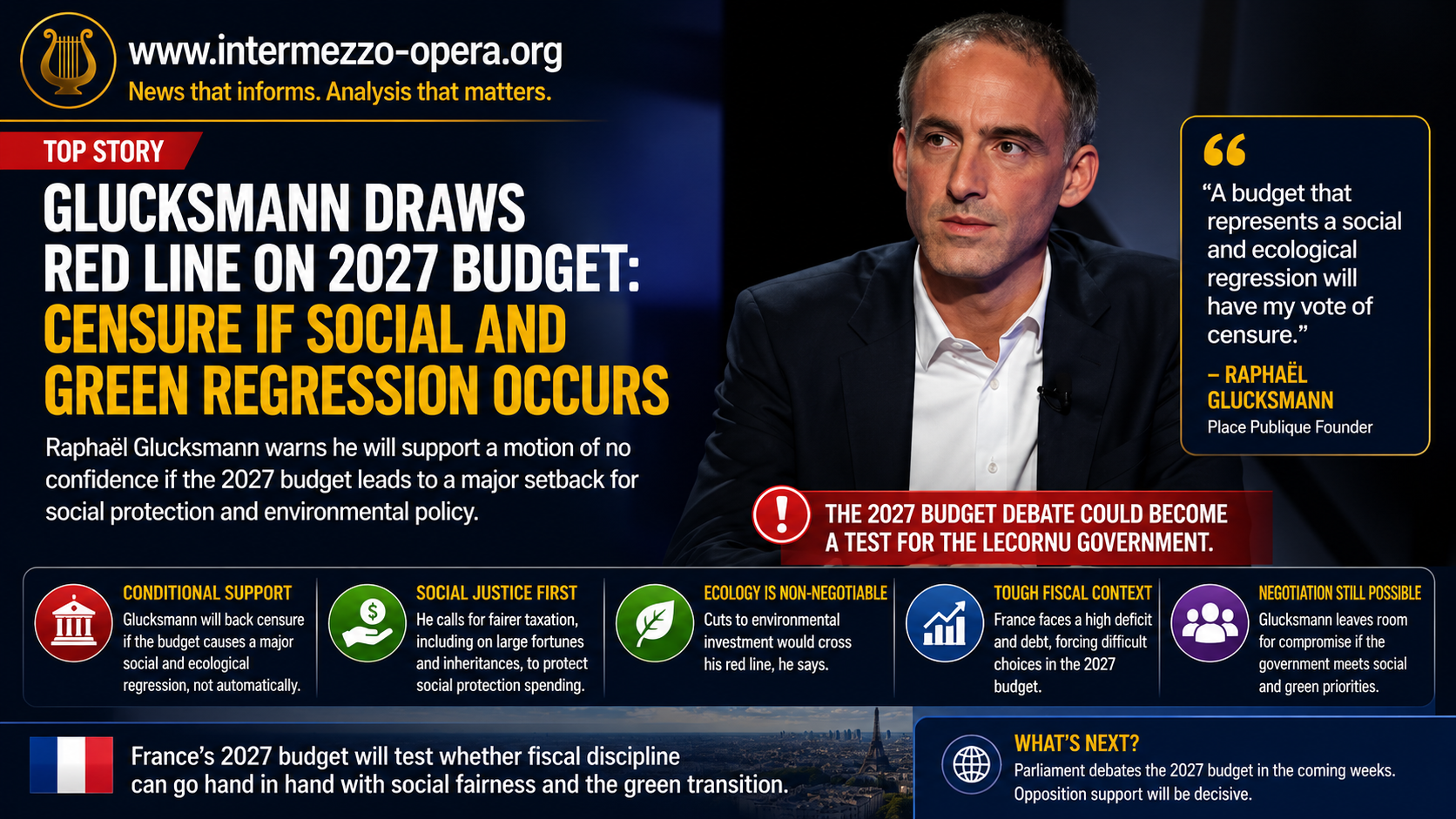
PARIS — French presidential candidate Raphaël Glucksmann has warned that he would support a motion of no confidence against the government if the 2027 state budget results in a major setback for social protection and environmental policy. His warning adds pressure on Prime Minister Sébastien Lecornu as the government searches for parliamentary compromises ahead of a difficult budget battle.
Speaking during the Socialist Party’s summer gathering in Blois on August 29, Glucksmann made clear that his position would depend on the substance of the final budget.
Rather than promising to bring down the government immediately, he presented social and ecological policy as decisive conditions.
The distinction is important. France’s fragmented parliament means the government will need either compromises with opposition parties or another mechanism to secure passage of the 2027 budget.
Glucksmann Sets Conditions for the 2027 Budget
Glucksmann’s intervention came as debate over France’s public finances intensified.
The Place Publique founder indicated that a budget leading to social and environmental regression would cross his political red line. In that scenario, he said he would support censure of the government.
However, his position differs from an unconditional threat.
Glucksmann has consistently argued that censure should be treated seriously rather than used simply as a political weapon.
That approach leaves the door open for negotiations if the government presents proposals that his political camp considers credible.
Therefore, the coming budget debate could become a test of whether Lecornu can find enough common ground with moderate opposition forces.
Government Calls for Compromise
The government has already warned about the consequences of failing to approve a budget for 2027.
Public Accounts Minister David Amiel said France could face serious economic consequences if lawmakers fail to reach an agreement.
Meanwhile, government spokesperson Maud Bregeon has argued that political parties cannot afford to reject compromise altogether.
The government has also not ruled out using Article 49.3 of the French Constitution.
That mechanism allows a government to pass legislation without a conventional parliamentary vote. However, its use exposes the government to a motion of no confidence.
Consequently, the budget debate could quickly become a battle over the survival of Lecornu’s government.
Social Justice Becomes a Key Red Line
Glucksmann wants the budget debate to focus not only on reducing France’s deficit but also on who carries the burden of fiscal consolidation.
His political platform emphasizes a new balance between taxation of labor, capital and large inheritances.
In particular, he has advocated stronger taxation of very large fortunes and inheritances.
The goal, according to his broader programme, is to finance policies that benefit workers and strengthen social protection.
This approach places him at odds with fiscal strategies that rely heavily on reducing public services or household support.
For Glucksmann, controlling public finances remains necessary. However, he argues that deficit reduction must also meet standards of fairness.
Ecology Is Another Non-Negotiable Issue
Environmental policy forms the second major pillar of Glucksmann’s warning.
The presidential candidate has placed the green transition at the center of his campaign for the 2027 election.
His proposals include expanding renewable energy, improving building insulation, developing rail transport and accelerating the electrification of the economy.
He has also argued that Europe must play a central role in financing the transition.
Therefore, significant reductions in environmental investment under the 2027 budget could trigger opposition from his camp.
For Glucksmann, ecological spending is not simply an additional government expense.
He presents it as long-term investment in energy independence, employment and France’s economic resilience.
France Faces a Difficult Fiscal Equation
The confrontation comes as France continues to face pressure over its public finances.
The government needs to reduce its deficit while avoiding measures that could trigger another parliamentary crisis.
That creates a difficult equation.
Large spending reductions could improve the fiscal outlook. However, cuts affecting pensions, public services, healthcare or environmental programmes could provoke strong opposition.
At the same time, increasing taxes carries its own political risks.
As a result, Lecornu’s government is seeking compromises before the parliamentary examination of the budget begins.
Glucksmann Rejects Automatic Censure
Glucksmann’s approach is notably different from that of Jean-Luc Mélenchon and La France Insoumise.
Mélenchon has already promised to support censure over the 2027 budget, prompting criticism from Lecornu.
Glucksmann has taken a more conditional position.
He argues that opposition parties should examine concrete proposals before deciding whether to bring down a government.
Earlier comments from Glucksmann also show that he views motions of no confidence as serious institutional tools.
He has previously said that politicians cannot simply “play with censure,” particularly when France faces difficult social, economic and political conditions.
That position places him between unconditional opposition and automatic support for government stability.
Budget Battle Becomes Part of the 2027 Presidential Race
The debate also has an electoral dimension.
Glucksmann officially announced his candidacy for the 2027 French presidential election on August 23. He is expected to compete in a primary involving Place Publique and the Socialist Party.
As a result, every major economic position now forms part of his presidential campaign.
The 2027 budget gives him an opportunity to distinguish his political project from both Macron’s governing camp and Jean-Luc Mélenchon’s harder-left strategy.
Glucksmann is trying to build a pro-European, social-democratic and environmentally focused alternative.
His challenge will be maintaining that position while convincing left-wing voters that he can deliver meaningful policy changes.
Green Transition Central to Glucksmann’s Campaign
Climate policy has become particularly important in that strategy.
Glucksmann has proposed an ambitious environmental programme that includes a rapid expansion of renewable energy and improvements in energy efficiency.
Together with Green senator Yannick Jadot, he has promoted the idea of an environmental transformation during the first 100 days of a future presidency.
The plan also includes measures involving electric vehicles, building renovation, agriculture and rail transport.
Therefore, his warning about “ecological regression” in the budget is consistent with the wider programme he is taking into the presidential race.
Mega-Inheritances Also Enter the Debate
Glucksmann has also placed taxation of large inheritances at the center of his economic message.
He argues that France needs greater fiscal fairness rather than relying disproportionately on workers and middle-income households.
During his recent political appearances, he has defended higher taxation of extremely large inheritances as part of a broader social and fiscal contract.
This issue could become particularly contentious during negotiations over the budget.
The government needs additional fiscal room.
Meanwhile, Glucksmann wants that effort to involve wealthy households rather than relying primarily on cuts.
The disagreement is therefore about more than the overall size of the budget.
It also concerns how France distributes the cost of repairing its public finances.
Lecornu Faces a Parliamentary Test
For Prime Minister Sébastien Lecornu, the challenge will be assembling enough political support to prevent the budget from triggering another institutional crisis.
France’s fragmented political landscape makes that difficult.
The government cannot assume that opposition parties will support its proposals.
At the same time, some opposition leaders remain willing to negotiate rather than immediately seek the government’s removal.
Glucksmann falls into this second category.
His position can essentially be summarized as conditional cooperation: negotiations remain possible, but a budget viewed as socially unfair or environmentally regressive could lead him to back censure.
A Major Test Before France’s Presidential Election
The budget battle will consequently serve as an early test of the competing political strategies ahead of the 2027 presidential election.
Glucksmann wants to demonstrate that the moderate left can negotiate while maintaining firm policy boundaries.
Meanwhile, the government needs to show that it can control public finances without losing parliamentary support.
The debate will also test whether social spending, ecological investment and deficit reduction can coexist in a compromise package.
For now, Glucksmann has stopped short of announcing automatic opposition.
His message is more conditional: if the 2027 budget produces a significant social and ecological setback, he is prepared to support censure of the government.
That warning ensures that France’s coming budget negotiations will be closely linked to the political battle already taking shape for 2027.


Happy
0 %

Sad
0 %

Excited
0 %

Sleepy
0 %

Angry
0 %

Surprise
0 %
Related Post

Colombia Elects New CNE: Nine Magistrates Take Office After Last-Minute Political Deals
Bogotá – Colombia’s Congress has elected the nine magistrates who will form the new National…