Europe’s Historic Recovery Fund Reaches Its Final Deadline, Leaving a New Playbook for Future Crises
 0
0
 0
0
Read Time:6 Minute, 36 Second
BRUSSELS — The European Union is reaching a decisive moment in its post-pandemic recovery programme. On 31 August 2026, the deadline arrives for member states to complete the reforms and investments linked to the Recovery and Resilience Facility, or RRF, a programme that changed Europe’s approach to managing a major economic crisis.
Instead of relying mainly on spending cuts, the EU responded to the COVID-19 shock with large-scale public investment, grants and loans.
The programme also linked financial support to specific reforms. As a result, governments could receive payments only after meeting previously agreed milestones and targets.
This model marked an important shift in European economic policy.
EU Recovery Fund Reaches Key Deadline
The Recovery and Resilience Facility entered into force in February 2021 as the central component of NextGenerationEU.
It was designed as a temporary instrument to help European economies recover from the pandemic while improving their long-term resilience.
Under the programme, every participating government prepared a national Recovery and Resilience Plan.
Those plans combined investment with structural reforms.
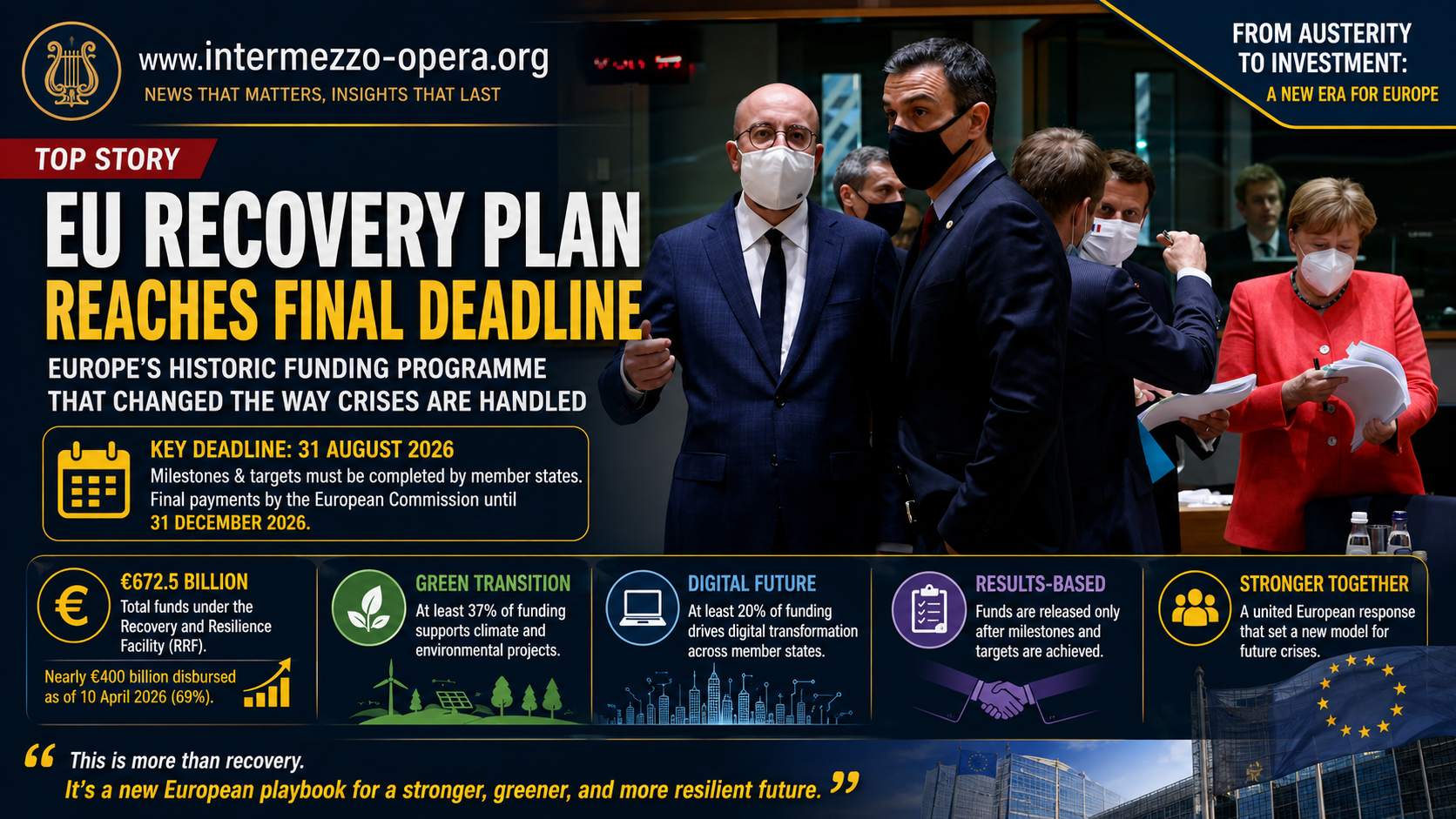
Moreover, at least 37% of planned spending had to support green measures. Another 20% had to contribute to digital transformation.
However, the programme was never intended to become permanent.
All agreed milestones and targets must be completed by 31 August 2026. Member states then submit their final payment requests, while the European Commission has until 31 December 2026 to make the remaining payments.
Europe Chose Investment Instead of Another Austerity-First Response
The political significance of the recovery fund goes beyond its size.
Europe entered the pandemic with memories of the sovereign debt crisis that followed the 2008 global financial crash.
During that earlier period, fiscal consolidation and austerity became central parts of the response in several countries.
The pandemic produced a different strategy.
EU governments agreed to raise large amounts of money collectively through European borrowing. The funds were then used to support national investments and reforms.
Therefore, the recovery programme represented more than emergency financial assistance.
It created a different model for responding to an extraordinary economic shock.
Brussels Linked Money to Reforms
Another important feature was the way governments received the money.
The RRF is a performance-based programme.
A country does not receive its full allocation simply because a project has been announced or included in a national budget.
Instead, the European Commission evaluates whether the government has completed specific milestones and targets. Payments are released after those requirements are considered fulfilled.
Consequently, investment and reform became closely connected.
The model gave Brussels greater oversight while giving national governments access to significant European financing.
It also created a demanding administrative process.
Governments had to design projects, implement reforms, document progress and demonstrate that targets had been achieved.
Race Against Time Intensifies
The final months have created intense pressure across Europe.
Because the legal deadline cannot simply be extended for unfinished projects, countries have been simplifying and revising their recovery plans.
The European Commission began working with member states on this process to accelerate implementation before the 2026 deadline.
Some projects were scaled back or modified.
Others may continue after 2026 using national budgets or different European funding programmes.
Therefore, 31 August does not mean every construction project financed through the recovery strategy must physically disappear or stop immediately.
Instead, it is the deadline for meeting the RRF milestones and targets required under the programme.
Hundreds of Billions Have Already Reached Member States
The scale of the programme has been extraordinary.
By 10 April 2026, almost €400 billion, representing about 69% of committed funds, had already been disbursed. At that point, another 22 payment requests from EU countries were still under assessment.
Large amounts were directed toward energy, transport, digital infrastructure, public administration and other investments.
Energy measures alone accounted for about €153.8 billion of allocated RRF resources.
Those projects included energy efficiency, hydrogen, skills development and measures connected to reducing Europe’s dependence on Russian fossil fuels.
Thus, a programme originally created in response to COVID-19 eventually became connected to other European priorities.
Spain Became One of the Biggest Test Cases
Spain provides one of the clearest examples of the programme’s scale.
The country was allocated roughly €140 billion, including around €80 billion in grants, according to reporting on the final phase of the recovery programme.
Managing that amount required an enormous administrative effort.
Spain directed recovery resources toward digitalisation, green investment, technology and economic modernisation.
At the same time, implementation faced difficulties.
Bureaucracy complicated some projects, while demand for certain loan programmes was weaker than expected. Questions also remain about how deeply the programme has transformed Spain’s productive economy.
Still, most of the grant allocation has been deployed as the deadline approaches.
Portugal Secures €16.3 Billion in Grants
Portugal has also reached an important milestone during the final days of the programme.
The country completed all 44 reforms required under its post-pandemic recovery plan, making it eligible for €16.3 billion in EU grants.
The funding supports more than 100 projects across the Portuguese economy.
Portugal’s case demonstrates one of the defining principles of the RRF.
European financing was directly connected to completing agreed reforms rather than simply distributing funds according to traditional budget rules.
Green and Digital Transformation at the Center
From the beginning, Brussels wanted the recovery programme to do more than restore economic activity lost during COVID-19.
The EU also wanted to accelerate structural changes.
For that reason, national plans were required to devote substantial resources to climate and digital projects.
Investments have supported areas such as renewable energy, energy efficiency, public transport and digital public services.
Meanwhile, the programme later became an important financing mechanism for REPowerEU, which was created after Russia’s invasion of Ukraine disrupted European energy markets.
This broadened the recovery fund’s role.
A mechanism created during one crisis was adapted to help Europe respond to another.
Not Every Project Ends on August 31
The deadline requires an important distinction.
The RRF’s implementation deadline arrives on 31 August, but the financial process does not immediately finish.
Countries can still submit final payment requests afterward. The Commission must complete final payments by the end of December 2026.
Furthermore, some projects can continue beyond 2026 if governments finance the remaining work through national resources or other EU programmes.
Auditing and monitoring obligations will also continue.
Therefore, Europe will still be measuring the programme’s results long after its formal funding phase closes.
The Experiment Could Influence Future EU Policy
Perhaps the biggest legacy of NextGenerationEU is political.
Before the pandemic, large-scale common EU borrowing was highly controversial.
The recovery programme demonstrated that member states could jointly raise funds when faced with an extraordinary economic emergency.
That experience is now influencing debates over how Europe should finance new priorities.
However, there is no agreement that joint borrowing should become routine.
The debate remains visible in negotiations over the EU’s next long-term budget. Germany, Denmark, the Netherlands, Austria, Finland and Sweden have recently opposed new joint EU borrowing while demanding tighter overall spending.
Therefore, the recovery fund created a precedent without resolving the political argument surrounding common European debt.
Europe Leaves the Pandemic Era with a Different Crisis Model
The RRF was born from an exceptional emergency.
Its response combined European borrowing, national investment and reforms under common targets.
That combination represented a significant departure from the austerity-heavy response associated with earlier European crises.
Nevertheless, the final assessment will depend on more than how much money was spent.
Europe will also have to examine whether projects increased productivity, strengthened infrastructure and accelerated green and digital transformation.
The 31 August 2026 deadline therefore closes one stage of an unprecedented economic experiment.
Its longer-term impact may become clearer only after the spending ends.
What is already evident is that NextGenerationEU expanded the range of tools Europe is willing to consider when confronting a severe economic crisis.


Happy
0 %

Sad
0 %

Excited
0 %

Sleepy
0 %

Angry
0 %

Surprise
0 %
Related Post

Uruguay’s Private Banks Call for Fairer Competition With State-Owned BROU
Private banks compete with BROU in Uruguay but are calling for equal conditions, clearer rules…