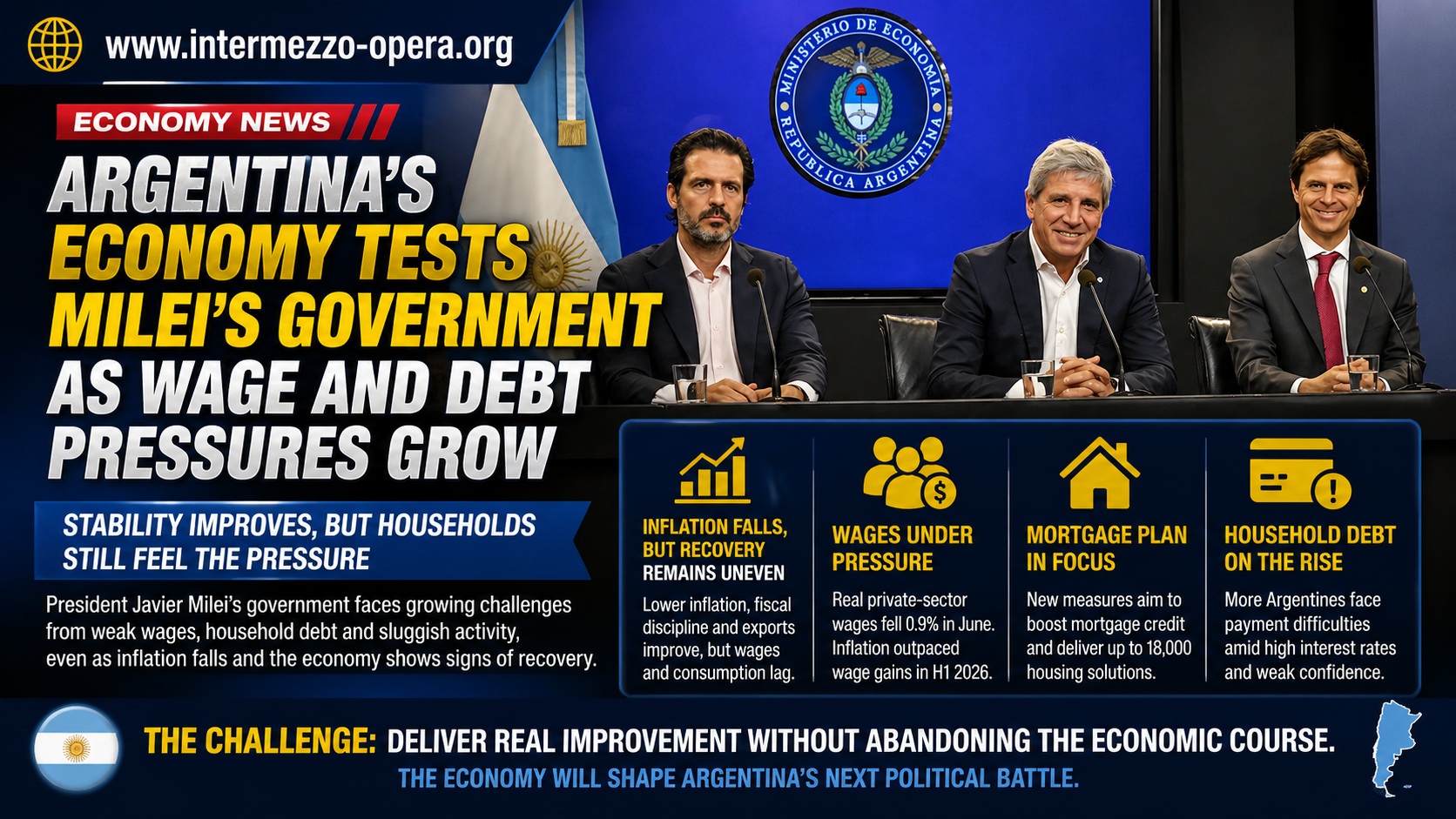
Argentina’s Economy Tests Milei’s Government as Wage and Debt Pressures Grow
 0
0
 0
0
Read Time:5 Minute, 38 Second
BUENOS AIRES, Argentina — President **Javier Milei’s government is facing growing pressure from Argentina’s uneven economic recovery, as weak wages, household debt and sluggish activity complicate its effort to maintain a strict free-market message.
The administration insists that it will not abandon its economic program. However, several recent measures suggest that the government is increasingly responding to financial difficulties affecting Argentine households.
Among those measures are efforts to revive mortgage lending and discussions aimed at establishing a guaranteed income floor in some of the country’s lowest-paying collective bargaining agreements.
Therefore, the latest moves have opened a broader debate over how Milei can preserve his economic principles while addressing mounting social concerns.
Milei Government Maintains Its Economic Course
Milei continues to defend the economic model implemented since he took office.
Speaking at the Council of the Americas on August 20, the president highlighted falling inflation and economic growth. He argued that private consumption, GDP and exports had reached historically high levels.
A day later, Milei again defended his economic strategy during an event at the Rosario Stock Exchange.
He also addressed concerns about credit and delinquency. At the same time, the president rejected proposals that would involve greater government intervention in the market.
Nevertheless, economic conditions remain uneven across different sectors.
Recent reporting indicates that Argentina’s industrial sector accumulated a 2.2% decline during the first half of 2026. In addition, around 47% of companies reported delays in at least one payment obligation.
These indicators are increasing pressure on the government to demonstrate that macroeconomic improvements can reach households and businesses.
Wages Remain a Major Challenge
Wages have become another sensitive issue.
According to figures cited from Argentina’s Labor Secretariat, the average registered private-sector salary declined 0.9% in real terms in June, following a 2.9% decrease in May.
Meanwhile, private registered wages increased 14.5% during the first half of 2026.
National public-sector wages rose 13.7%, while provincial public-sector wages increased 16.4%.
However, accumulated inflation reached 16.8% over the same period. Consequently, those wage categories failed to fully keep pace with rising prices.
The situation helps explain why household purchasing power remains an important political issue despite improvements in several macroeconomic indicators.
Government Considers a Guaranteed Wage Floor
Against this backdrop, the government has encouraged negotiations involving some of Argentina’s lowest collective bargaining agreements.
One proposal would establish a guaranteed salary floor of approximately 1.07 million Argentine pesos per month beginning in August.
After standard deductions, workers could receive roughly 860,000 pesos.
However, this proposal should not be confused with Argentina’s statutory minimum wage.
Instead, it would apply through collective bargaining negotiations involving sectors where negotiated wage floors have fallen significantly behind.
The move is noteworthy because Milei has traditionally emphasized limited government involvement in agreements between companies and workers.
Therefore, government participation in these discussions has fueled questions about whether economic realities are encouraging a more pragmatic approach.
Mortgage Credit Becomes Another Government Priority
Housing is also emerging as an area of concern.
Economy Minister Luis Caputo recently announced measures designed to encourage mortgage lending. According to current estimates, the initiative could potentially generate around 18,000 housing solutions.
The government intends to use resources linked to Argentina’s social security system, ANSES, as part of the initiative.
However, the program remains relatively limited compared with the size of Argentina’s housing and credit markets.
Still, its political significance may be larger than its immediate economic impact.
The initiative signals that the administration recognizes the difficulty many Argentines face when attempting to access long-term housing finance.
Household Debt Moves Higher on the Political Agenda
Household indebtedness has also become increasingly important.
Recent reports indicate that millions of Argentines are experiencing payment difficulties. Consumer confidence has weakened, while high interest rates and constrained household finances continue to affect spending.
Opposition lawmakers have consequently pushed proposals addressing household delinquency.
However, Milei’s administration has resisted measures that it considers excessive state intervention.
The president has repeatedly argued that abandoning his current economic strategy would risk returning Argentina to policies that his government associates with populism.
Therefore, the administration faces a difficult balance.
It wants to address financial pressure without appearing to reverse the principles that underpin its economic program.
Inflation Has Fallen, but Recovery Remains Uneven
Inflation remains one of the strongest arguments used by Milei to defend his administration.
Argentina has achieved a substantial reduction in inflation compared with the extreme levels recorded earlier in his presidency. The government also points to fiscal discipline, deregulation and monetary restraint as central elements of that improvement.
However, lower inflation does not automatically produce an immediate recovery in wages, employment or consumption.
Recent private-sector analysis has highlighted difficulties in achieving sustained income and economic growth outside sectors such as agriculture and mining.
Meanwhile, consumer confidence and household finances continue to show signs of strain.
As a result, Argentina is experiencing a contrast between improving macroeconomic indicators and persistent pressure on parts of the population.
Political Communication Adds Another Layer of Tension
Economic challenges are unfolding alongside an increasingly confrontational political environment.
Milei has continued to strongly criticize journalists, economists and political opponents who challenge his interpretation of Argentina’s economic performance.
The president’s official speeches have also included sharp criticism of analysts whom he believes misrepresent economic data.
An Infobae analysis published on August 29 argued that this confrontational communication increasingly resembles tactics previously associated with Kirchnerism, particularly attacks on sections of the media. That comparison represents the columnist’s interpretation rather than an established economic fact.
Nevertheless, the intensity of the political rhetoric has become part of the broader debate surrounding the government.
Economy Could Shape Argentina’s Next Political Battle
Economic performance is becoming increasingly important as Argentina moves toward its next electoral cycle.
The government is betting that stronger economic conditions in 2027 will reinforce Milei’s political position. At the same time, officials are monitoring how electoral competition could affect alliances in Congress.
For the administration, maintaining lower inflation remains essential.
However, voters are also likely to judge the economy through their salaries, employment opportunities, access to credit and everyday purchasing power.
Consequently, improving macroeconomic figures may not be enough on their own.
The challenge for Milei’s government will be translating stabilization into tangible improvements for households without abandoning the fiscal and monetary framework it considers central to Argentina’s recovery.
Recent mortgage measures and wage negotiations suggest that this challenge is already influencing government decisions.
For now, Milei continues to reject a fundamental change in direction. Yet the growing focus on wages, credit and household debt shows how Argentina’s economic reality is increasingly shaping both the government’s policies and its political strategy.


Happy
0 %

Sad
0 %

Excited
0 %

Sleepy
0 %

Angry
0 %

Surprise
0 %
Related Post

Rubén Moreira Claims Morena Pressured INE to Review His Social Media Accounts
Rubén Moreira Accuses Morena of Targeting His Social Media Mexican lawmaker Rubén Moreira, who coordinates…