
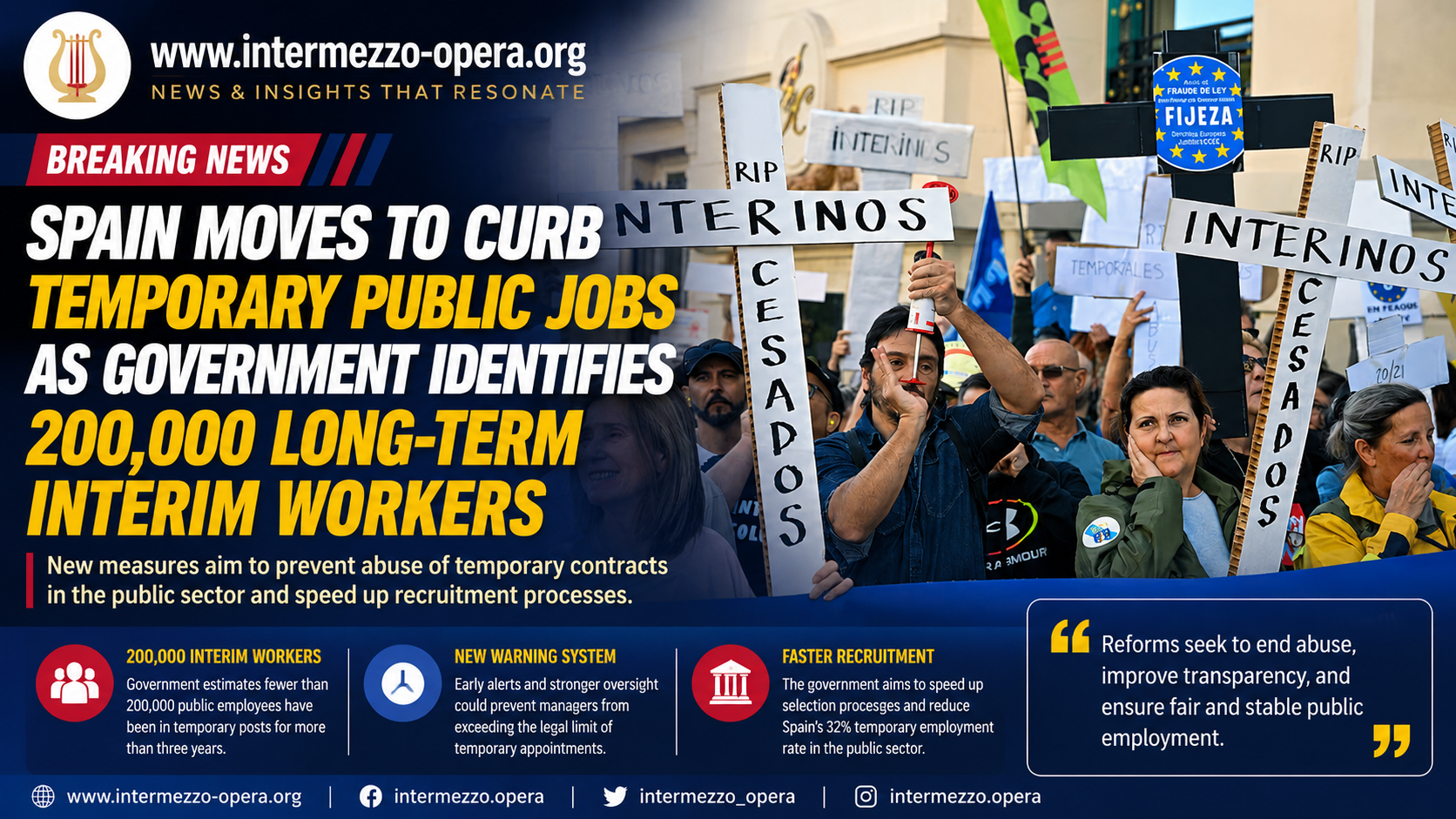
Spain Moves to Curb Temporary Public Jobs as Government Identifies 200,000 Long-Term Interim Workers
 0
0
 0
0
Read Time:3 Minute, 40 Second
MADRID – The Spanish government is preparing new measures to curb temporary public employment, as pressure grows to address the prolonged use of interim workers across public administrations.
The government estimates that fewer than 200,000 interim employees have remained in temporary positions for more than three years. Officials consider this group particularly relevant when assessing possible abuse of temporary employment.
However, the broader problem remains much larger. More than 900,000 public-sector employees currently work without permanent contracts, according to recent figures reported in Spain.
Spain Targets Abuse of Temporary Public Employment
Spain has struggled with high levels of temporary employment in public administration for years.
The temporary employment rate in the public sector remains around 32%, despite previous efforts to reduce it. The government now wants stronger mechanisms to prevent interim appointments from continuing beyond legal limits.
Under existing legislation, an interim civil servant appointed to fill a vacant position generally cannot remain in that post for more than three years.
After that period, the temporary appointment must normally end. However, there are exceptions when the corresponding recruitment process has already been formally launched.
Therefore, the government is focusing closely on workers who have exceeded the three-year threshold.
New Warning System Could Monitor Contracts
One of the measures under consideration involves an early-warning mechanism.
Public-sector managers could receive alerts when an interim employee approaches the maximum permitted period in a temporary position. This system would help administrations act before the legal limit is exceeded.
In addition, officials are considering stronger accountability for managers who allow abusive temporary employment practices to continue.
Possible sanctions are also being examined.
The government believes these measures could make existing limits more effective. Moreover, they could help prevent new cases rather than dealing only with workers who have already spent years in temporary positions.
Recruitment Procedures Could Be Accelerated
Another problem involves Spain’s lengthy public recruitment procedures.
Some selection processes can take more than two years to complete. As a result, temporary employees may remain in vacant positions while administrations wait for permanent recruitment procedures to conclude.
The government therefore wants to accelerate these processes.
Faster recruitment could reduce the need for long-term interim appointments. At the same time, it could make public workforce planning more predictable.
This issue is important because Spain’s 2021 reform established a goal of reducing structural temporary employment in public administration to below 8%.
More Than 440,000 Positions Stabilized
Spain has already carried out a major stabilization process.
According to the latest reporting, more than 440,000 public-sector positions have been stabilized since 2021. Nevertheless, temporary employment remains substantially above the target established by previous reforms.
The 2021 legislation introduced measures designed to prevent and sanction excessive temporary employment.
It also established stricter limits on interim appointments. Furthermore, public administrations were given responsibility for preventing irregularities involving temporary workers.
Despite those changes, the problem has not disappeared.
Consequently, Madrid is preparing another round of measures.
EU Pressure Adds Urgency
The issue has also become important in Spain’s relationship with the European Union.
The European Commission has pressed Spain to introduce effective measures against abusive temporary employment in the public sector. Madrid has requested additional time, until March 2027, to develop an action plan and avoid further legal escalation.
Spain’s Ministry for Digital Transformation and Public Administration has also been coordinating with regional governments.
In June, the ministry called a meeting with Spain’s autonomous communities and the Spanish Federation of Municipalities and Provinces to discuss measures aimed at reducing temporary public employment.
Therefore, the solution will require cooperation between different levels of government.
Government Seeks More Precise Data
Authorities are also working to establish exactly how many employees have experienced abusive temporary employment.
This distinction matters because the overall number of temporary public workers does not automatically represent the number of abuse cases.
While more than 900,000 employees lack permanent status, government estimates indicate that fewer than 200,000 have exceeded the three-year threshold.
Therefore, the government is trying to provide Brussels with more precise figures.
The next reforms are expected to focus on prevention, faster recruitment and greater responsibility for public managers.
For Spain, reducing temporary public employment remains both a domestic labor challenge and a European commitment. The government now faces the task of ensuring that interim appointments remain genuinely temporary while keeping essential public services adequately staffed.


Happy
0 %

Sad
0 %

Excited
0 %

Sleepy
0 %

Angry
0 %

Surprise
0 %
Related Post

Ceuta’s Economy Takes Heavy Hit as Migration Crisis Disrupts Tourism and Local Businesses
Ceuta’s economy faces mounting pressure after the recent migration crisis disrupted commerce, tourism, hospitality, and…