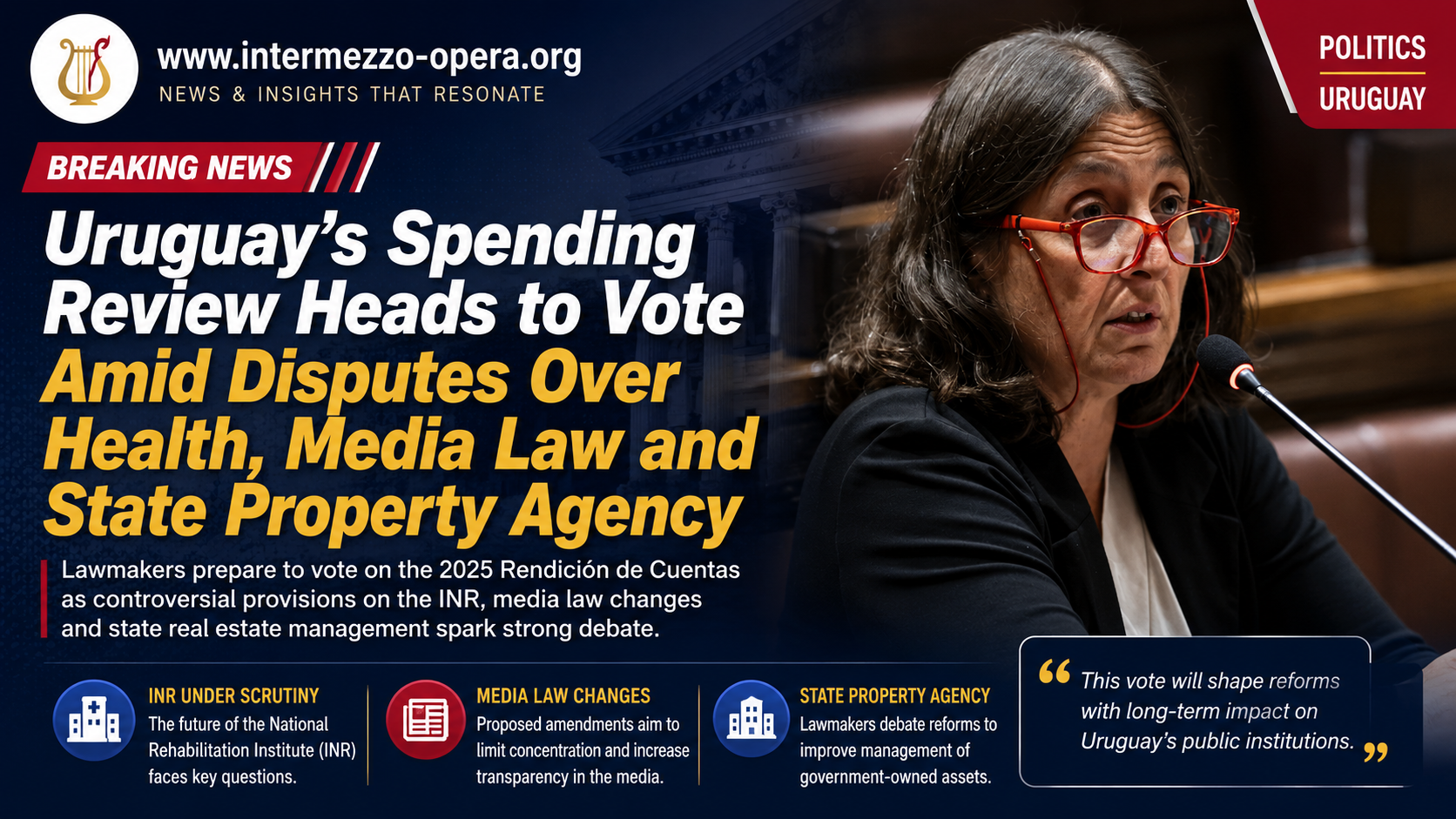
Uruguay’s Spending Review Heads to Vote Amid Disputes Over Health, Media Law and State Property Agency
 0
0
 0
0
Read Time:3 Minute, 38 Second
MONTEVIDEO – Uruguay’s Rendición de Cuentas debate is entering a decisive stage as lawmakers prepare to vote on the government’s spending review. However, several controversial provisions remain under discussion.
The debate goes beyond public spending. Lawmakers are also examining institutional reforms and regulatory changes that could affect health services, the media sector and the management of state-owned properties.
As a result, negotiations between the governing Frente Amplio and opposition parties remain important before the legislation completes its parliamentary journey.
Spending Review Moves Toward a Vote
Uruguay’s Rendición de Cuentas is an important part of the country’s budget process. It allows the government and Parliament to assess the execution of public finances and consider additional legal provisions.
The current process relates to the 2025 fiscal year. Meanwhile, several public institutions have submitted their own requests and priorities.
For example, Uruguay’s judiciary presented its 2025 spending review proposal in July. It requested resources for specialized courts, gender-based violence cases, child protection and improvements to access to justice.
However, the wider parliamentary discussion has become politically complex.
Opposition lawmakers have sought changes to parts of the government’s proposal. Therefore, negotiations have continued as the legislation approaches voting.
Media Law Changes Remain Under Debate
One of the most closely watched issues in the Rendición de Cuentas debate involves Uruguay’s media regulations.
The government included amendments related to Law 20.383. The proposed changes focus on media ownership, transfers and concentration.
In particular, the government wants stronger restrictions on foreign ownership. It also seeks greater transparency over the real owners of media companies and stronger safeguards against hidden licence transfers.
However, the issue has a complicated political history.
Uruguay has debated its audiovisual regulatory framework for years. Previous attempts to change the rules generated disagreements among political parties, media organizations and legal experts.
Consequently, the latest amendments are again attracting scrutiny.
Political Negotiations Could Shape the Final Text
Cabildo Abierto could also play an important role in the media provisions.
Recent reporting indicates that the party has been considering whether to support the new changes. This follows earlier disputes surrounding media legislation and a presidential veto during the previous administration.
Therefore, the final wording could still depend on negotiations.
The government argues that its proposals would improve transparency and reduce excessive concentration. Nevertheless, lawmakers must balance those objectives with concerns about freedom of expression and legal certainty.
This makes the media provisions one of the politically sensitive sections of the legislation.
Questions Over State Property Management
Another area of discussion concerns the management of government-owned real estate.
Uruguay already maintains mechanisms to register and manage state properties. The National Directorate of Cadastre took responsibility for the Registro Único de Inmuebles del Estado in 2021.
According to the Ministry of Economy and Finance, the change was intended to improve the rational use of government properties. Authorities have also worked on a technological management system designed to consolidate information about state-owned real estate.
Against that background, lawmakers are scrutinizing proposals that could change the institutional structure for managing those assets.
Questions include how a new agency would operate, what responsibilities it would receive and how it would interact with existing government bodies.
INR Also Draws Attention
The future of the Instituto Nacional de Rehabilitación (INR) is another point attracting political attention during the spending review.
The institution is responsible for Uruguay’s prison and rehabilitation system. Therefore, changes involving its structure, resources or institutional position have implications for both public security and rehabilitation policy.
Lawmakers are expected to examine those provisions closely before the final legislation emerges.
Meanwhile, the broader debate illustrates how the Rendición de Cuentas has become more than an accounting exercise.
It is also being used to discuss reforms affecting several areas of government.
Final Negotiations Ahead
The government still needs sufficient parliamentary support for the legislation.
Therefore, negotiations could determine whether disputed provisions remain unchanged, are modified or are removed from the final text.
The Rendición de Cuentas debate will consequently be closely watched in Montevideo. Decisions involving the INR, media regulation and state property management could have effects well beyond the government’s annual financial accounts.
For the administration, the challenge is to secure approval while maintaining the reforms it considers necessary. For opposition parties, meanwhile, the voting stage offers an opportunity to demand changes to provisions they consider problematic.


Happy
0 %

Sad
0 %

Excited
0 %

Sleepy
0 %

Angry
0 %

Surprise
0 %
Related Post
Spain’s Popular Party Confirms It Will Accept Unaccompanied Minors in Regional Governments
Popular Party Says It Will Comply With Law on Unaccompanied Migrant Minors Spain's Popular Party…