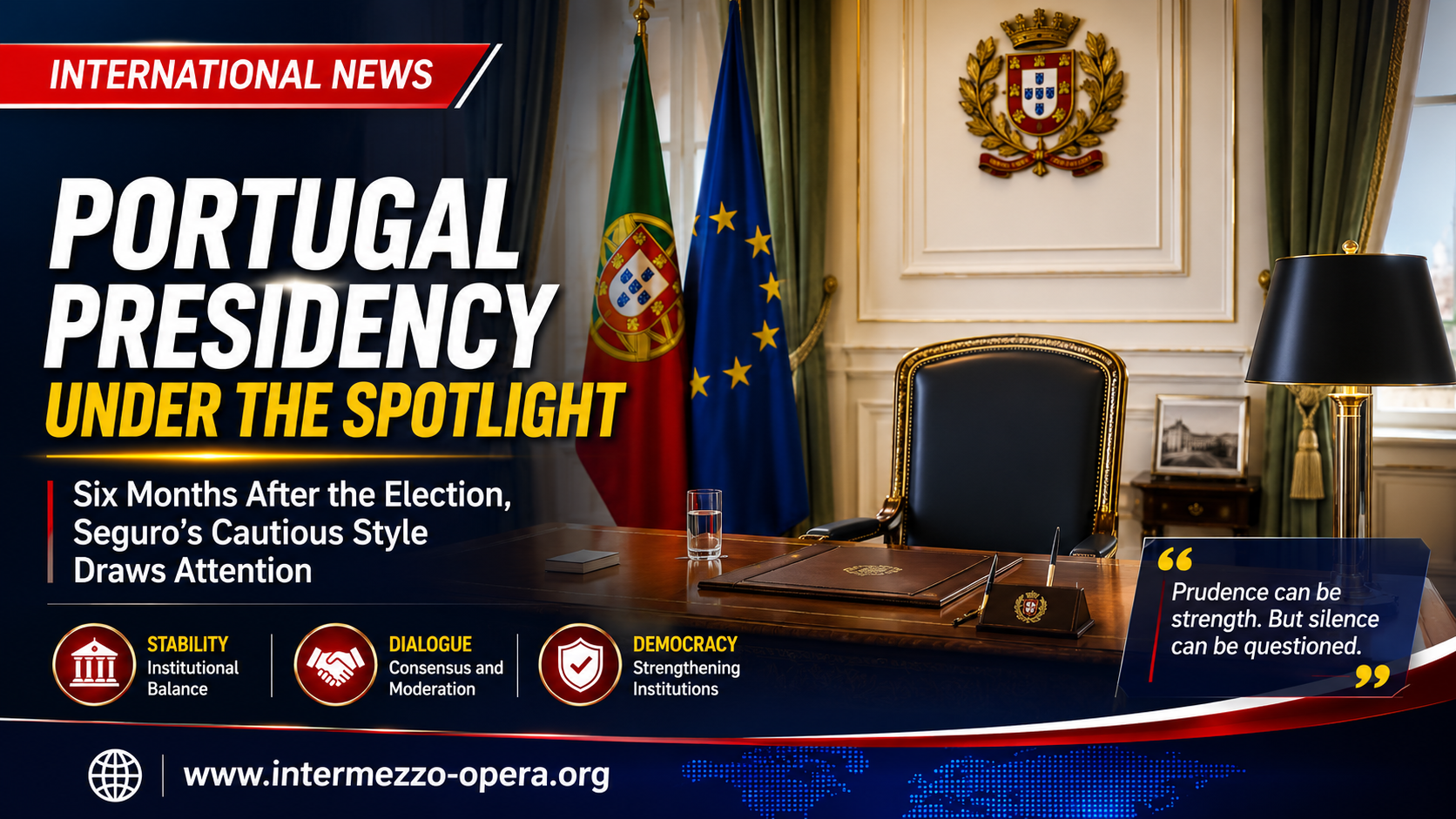
Six Months After Election, António José Seguro’s Cautious Presidency Faces Growing Scrutiny
 0
0
 0
0
Read Time:5 Minute, 37 Second
António José Seguro’s presidency entered Portugal’s political landscape with a promise of moderation, institutional stability and dialogue. Six months after his decisive presidential election victory, however, the same cautious approach that helped define his political identity is increasingly raising a broader question: when does presidential prudence begin to look like absence?
Seguro secured a commanding victory in Portugal’s 2026 presidential election after defeating André Ventura in the second round. His success represented a remarkable political comeback for the former Socialist Party leader, who had spent years away from the country’s political front line.
Early projections after the February 8 vote put Seguro above 67 percent, while official results subsequently confirmed a victory of roughly two-thirds of the vote. His mandate was therefore substantial and geographically broad.
Yet electoral strength does not automatically determine presidential style.
From the beginning, Seguro presented himself as a different kind of president: less interested in constant confrontation and more focused on institutional balance.
Seguro Arrived in Belém With a Strong Mandate
The scale of Seguro’s election victory gave the new president considerable political legitimacy.
He defeated Ventura by more than 30 percentage points and secured more than 3.4 million votes, according to official-election figures cited after the contest. Seguro also won the overwhelming majority of Portuguese municipalities.
His victory was particularly notable considering his political trajectory.
Seguro previously served as secretary-general of Portugal’s Socialist Party and as a member of the European Parliament. After years away from frontline politics, his presidential campaign brought him back into national prominence.
His campaign relied heavily on an image of moderation, democratic stability and political dialogue.
Those characteristics initially appeared well suited to a country emerging from a period of intense political competition.
A Presidency Built Around Moderation
António José Seguro’s presidency was never expected to resemble a highly confrontational political project.
Even before his election, analysis of his political profile highlighted sobriety, institutional restraint and a preference for democratic consensus as central features of his expected presidency.
That approach also contrasted with the style of his predecessor, Marcelo Rebelo de Sousa.
Marcelo became widely associated with an exceptionally visible presidency and frequent interaction with citizens and the media. Seguro entered Belém with expectations of a more restrained approach.
The difference does not necessarily indicate political inactivity. Portugal’s presidency has constitutional powers and institutional responsibilities that do not require the head of state to dominate everyday political debate.
Nevertheless, visibility inevitably shapes public perceptions of presidential leadership.
Prudence or Political Absence?
This is where the central debate surrounding Seguro becomes more complicated.
Presidential restraint can serve an important purpose. A head of state who avoids reacting to every political controversy may help reduce institutional tension and preserve the presidency’s role as a stabilizing force.
However, excessive caution carries its own political risks.
During periods of social, economic or governmental tension, citizens may expect the president to provide direction, communicate concerns or use the authority of the office to encourage political solutions.
The question is therefore not simply whether Seguro speaks frequently enough.
Instead, the more important issue is whether Portuguese voters can clearly identify his influence on the country’s political direction.
Seguro Promised to Be an Institutional Unifier
The cautious style should not come as a surprise.
During the presidential campaign, Seguro repeatedly presented himself as a candidate capable of bringing different sections of Portuguese society together.
During a debate with André Ventura, he explicitly contrasted that approach with a more interventionist interpretation of the presidency. Seguro described himself as someone who intended to act as an institutional unifier, while Ventura argued for a president prepared to intervene more aggressively.
The disagreement illustrated two fundamentally different concepts of presidential leadership.
Seguro’s model prioritised mediation and institutional stability. Ventura’s campaign argued for greater presidential intervention.
Portuguese voters ultimately delivered Seguro a decisive mandate.
The Comparison With Marcelo Is Difficult to Avoid
Any assessment of Seguro’s public presence is inevitably influenced by the presidency that came before him.
Marcelo Rebelo de Sousa developed an unusually visible political style during his years in Belém. His frequent media appearances and direct engagement with citizens made the presidency highly present in everyday Portuguese public life.
Seguro was never likely to reproduce that model.
Commentary surrounding his election already anticipated a presidency characterized by greater sobriety and less personalization.
Consequently, lower visibility should not automatically be interpreted as inactivity.
However, the contrast creates a political communication challenge. After years of an intensely visible presidency, institutional discretion can easily be perceived as silence.
Portugal’s President Has a Delicate Constitutional Role
Portugal is a semi-presidential democracy, meaning the president occupies an important but carefully balanced position within the political system.
The government manages day-to-day executive policy, while the president serves as head of state and possesses significant constitutional powers.
That means presidential influence cannot be measured only through public speeches or media appearances.
Political consultation, institutional dialogue and decisions involving constitutional powers can be just as significant as highly visible public interventions.
For Seguro, the challenge is finding the appropriate balance between these two dimensions.
Too much intervention could undermine the restrained presidency he promised. Too little visible leadership could create the impression that Belém is disconnected from the country’s major debates.
Six Months Is Still Early for a Five-Year Presidency
Any definitive judgment at this stage would be premature.
Seguro was elected to serve a five-year presidential term. Six months therefore represents only the opening phase of his time in office.
His political history also suggests patience should not necessarily be confused with weakness.
Commentators following his election noted that Seguro’s return itself demonstrated political resilience. After losing the Socialist Party leadership years earlier and spending considerable time outside frontline politics, he eventually returned to win Portugal’s highest elected office.
That trajectory indicates a politician comfortable with waiting for the appropriate moment.
Whether the same characteristic proves effective in Belém will become clearer as his presidency confronts more difficult political tests.
Seguro’s Biggest Challenge May Be Making Prudence Visible
The debate surrounding António José Seguro’s presidency ultimately involves more than the number of speeches or public appearances he makes.
His challenge is to demonstrate that moderation can still produce political influence.
A restrained president can mediate conflicts, defend institutions and encourage compromise without becoming the central figure in every controversy.
But restraint works politically only when citizens understand what the presidency is doing and why.
Six months after the election, Seguro’s cautious approach remains consistent with the political identity that helped carry him to Belém.
The question for the next stage of his presidency is whether that prudence will increasingly be regarded as institutional strength—or whether a lack of visible intervention will allow critics to portray it as presidential absence.


Happy
0 %

Sad
0 %

Excited
0 %

Sleepy
0 %

Angry
0 %

Surprise
0 %
Related Post
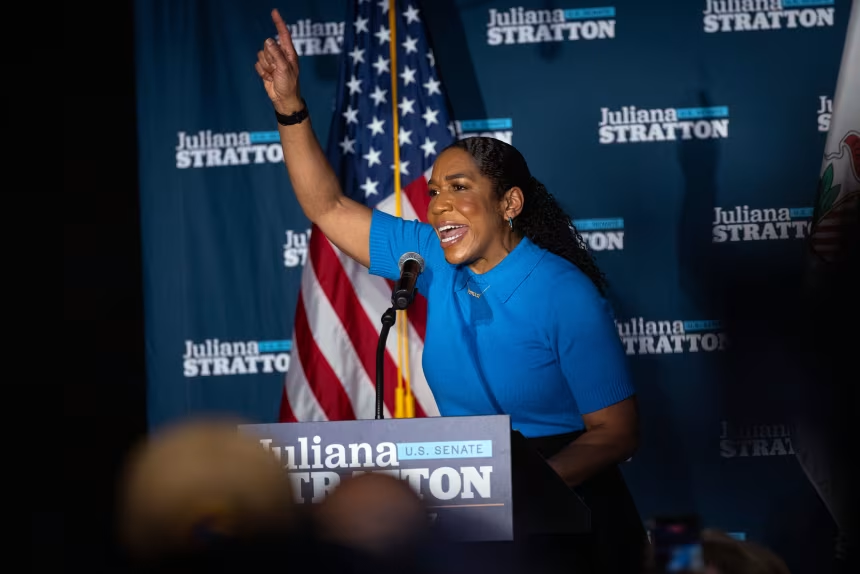
Juliana Stratton wins Illinois Democratic primary for Senate. She could become the sixth Black woman senator in US history
Juliana Stratton has won the Democratic primary for the U.S. Senate seat in Illinois, positioning…