
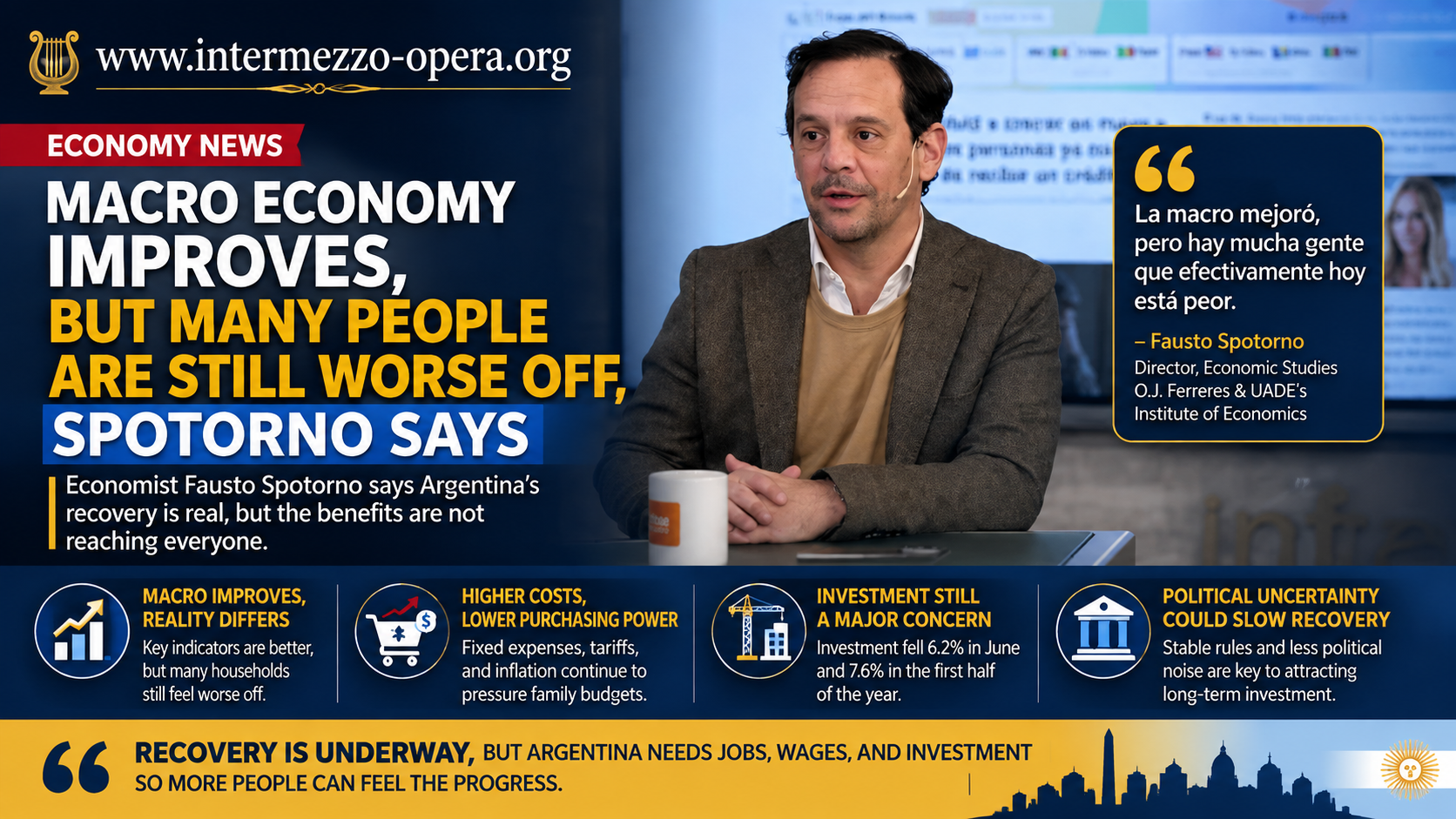
Argentina Economic Recovery Improves, but Many Still Struggle
 0
0
 0
0
Read Time:2 Minute, 46 Second
Economist Fausto Spotorno says Argentina’s macro economy has improved, but many households still face financial pressure and weaker purchasing power.
Argentina Economic Recovery Shows Uneven Progress
Argentina has improved several key macroeconomic conditions. However, economist Fausto Spotorno says many people still feel worse off financially.
Spotorno, director of economic studies at O.J. Ferreres and UADE’s Institute of Economics, discussed the gap between national indicators and household finances in an interview published on August 23.
According to Spotorno, Argentina previously faced conditions that made sustainable growth difficult. High inflation hurt savings, while weak investment affected productivity. The country also experienced more than a decade of economic stagnation.
However, improving those conditions does not immediately improve every household’s situation.
Better Numbers Do Not Mean Everyone Is Better Off
The Argentina economic recovery remains highly uneven across industries and regions.
Economic activity increased 1.5% during the period discussed by Spotorno, according to the EMAE activity indicator cited in the interview. Meanwhile, consumer confidence weakened from its average level during the first half of 2025.
Spotorno pointed to another important factor. Export-oriented businesses have performed differently from companies that depend heavily on domestic demand.
As a result, national economic growth can occur while some families and businesses continue to struggle.
Household Expenses Remain a Major Challenge
Middle-class households also face higher fixed expenses. For example, families must allocate more income to utilities, health services, education and other regular costs.
Therefore, they have less money available for mass consumption.
Real wages and credit initially helped offset some of this pressure. Nevertheless, financial volatility later affected credit conditions and interest rates. Inflation also accelerated during the first months of 2026, according to Spotorno.
At the same time, higher tariffs added pressure to household budgets.
Investment Becomes a Key Concern
Spotorno also highlighted investment as one of his main concerns.
Investment fell 6.2% year over year in June in physical-volume terms, according to figures he cited. Moreover, investment declined 7.6% during the first half of the year.
Investment announcements paint a more positive picture. Announced projects during the previous 12 months exceeded $150 billion, compared with about $46 billion in the preceding period.
However, Spotorno noted that those announcements have not yet translated fully into actual investment.
Political Uncertainty Could Affect Recovery
Political uncertainty presents another challenge for the Argentina economic recovery.
Long-term projects need predictable conditions. For this reason, political noise can influence investment decisions, particularly when companies can invest in other countries with lower inflation and fewer capital restrictions.
Spotorno has also argued that Argentina should focus on further liberalizing its foreign-exchange market rather than simply pursuing devaluation.
In addition, he considers fiscal and monetary responsibility essential foundations for economic stability.
The Economy Is Recovering, but the Benefits Remain Uneven
Spotorno believes Argentina remains in a recovery process. Yet the transformation has created very different outcomes across companies, workers and economic sectors.
Formal employment remains under pressure in some areas. Meanwhile, independent employment and informal wages have shown different trends as businesses adjust to the changing economy.
Ultimately, Spotorno’s assessment highlights the central challenge facing Argentina. Better macroeconomic conditions can create a stronger foundation for future growth, but households need improvements in wages, employment and investment before that progress becomes widely visible in everyday life.


Happy
0 %

Sad
0 %

Excited
0 %

Sleepy
0 %

Angry
0 %

Surprise
0 %
Related Post
European stocks move higher as attention turns to the Fed
European stocks moved higher in recent trading sessions as investor attention shifted toward the monetary…