
14-Year-Old Student Turns Cassava Peels Into Biodegradable Trays That Could Replace Plastic
 0
0
 0
0
Read Time:6 Minute, 2 Second
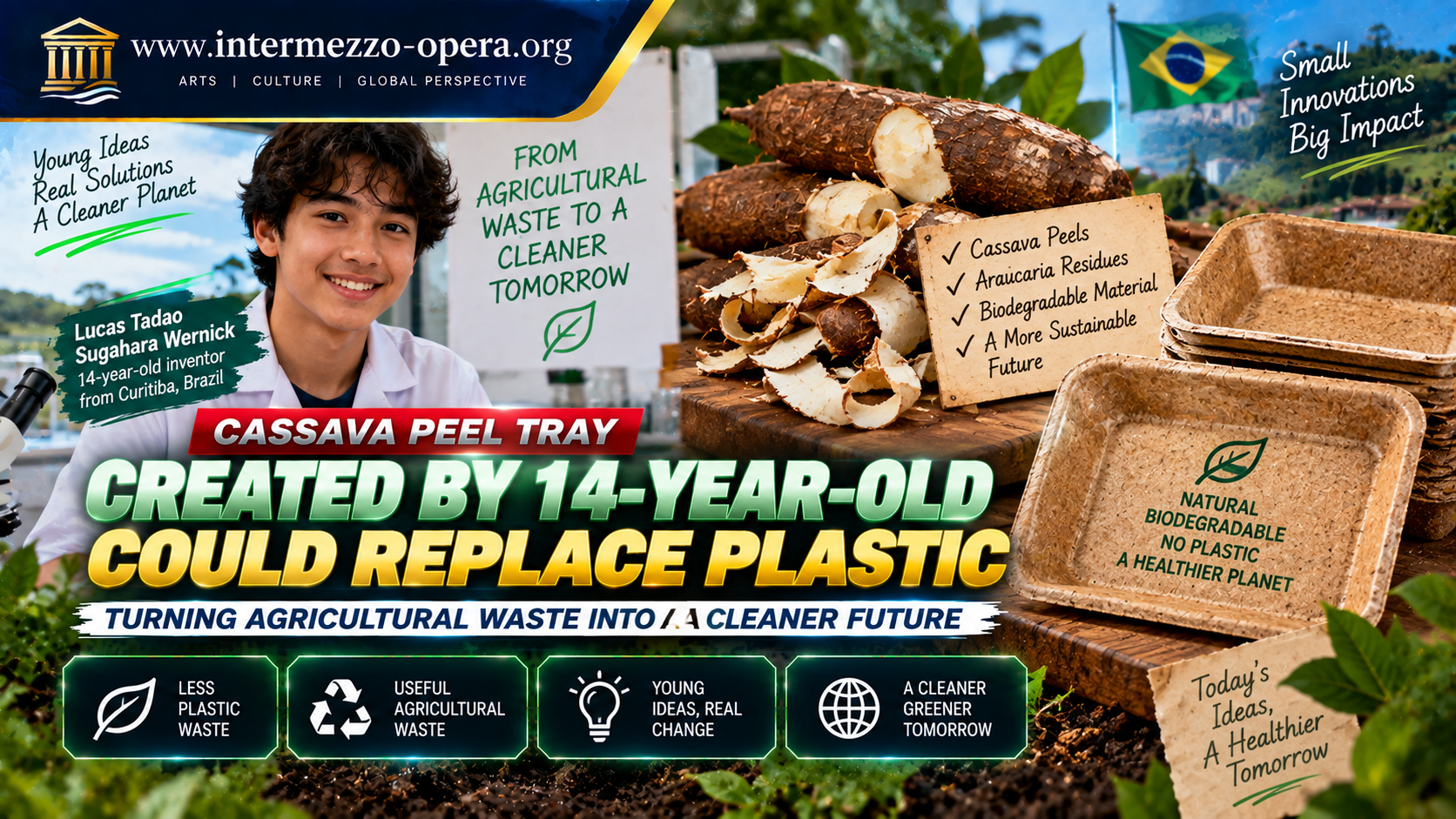
A cassava peel tray created by a 14-year-old Brazilian student is attracting attention for turning agricultural waste into a potential alternative to conventional food packaging. The experimental material combines discarded cassava peels with dry residues from araucaria trees and, according to tests conducted as part of the project, can biodegrade in soil in about 30 days.
The invention was developed by Lucas Tadao Sugahara Wernick, a student from Curitiba, Brazil. What began as a classroom science activity eventually became a finalist project at FEBRACE, the Brazilian Science and Engineering Fair.
The idea is simple but ambitious: take two types of plant waste that would normally be discarded and transform them into biodegradable trays that could eventually reduce dependence on expanded polystyrene and other single-use packaging.
Cassava Peel Tray Turns Waste Into Packaging
The cassava peel tray begins with an ingredient Brazil produces in enormous quantities: cassava.
According to the report from LARED21, Brazil harvested around 19.1 million tonnes of cassava roots in 2024. Processing that volume naturally produces a substantial amount of peel and other organic residue.
Lucas saw those discarded peels as a potential raw material rather than waste.
Cassava provides starch and fiber, two characteristics that can help create a moldable material. The project then combines those components with dry araucaria residues, which provide additional structural support.
The result is a material that can be formed into trays resembling packaging commonly used for food.
A School Project Became a National Science Finalist
The invention did not begin as a commercial startup.
Lucas started experimenting with the idea during science initiation classes at Colégio Bom Jesus Centro in Curitiba.
The first version of the research was presented in 2024. Continued experimentation eventually helped the project reach the finals of FEBRACE, one of Brazil’s prominent science and engineering fairs for young students.
That progression is one reason the story has attracted attention.
A relatively simple school experiment evolved into a prototype addressing two significant environmental problems at once: agricultural waste and disposable packaging.
How the Cassava Peel Tray Is Made
Producing the prototype involves several stages.
First, cassava peels are cleaned, dried and crushed. Dry araucaria material is also cut, ground and sieved.
The prepared materials are then combined with water and a binding agent. The mixture is heated before being placed into molds and allowed to dry.
However, finding the correct formula required experimentation.
Early prototypes used PVA glue. Those samples were resistant but became too brittle.
Lucas later experimented with starch extracted from cassava. That solved some problems but introduced another: the resulting pieces could deteriorate when exposed to water.
The latest versions therefore incorporate natural waterproofing substances to improve resistance.
30-Day Biodegradation Result Attracts Attention
The most striking claim surrounding the cassava peel tray is its biodegradation time.
According to results presented by the student project, the prototype can decompose in soil in approximately 30 days.
That figure creates an obvious contrast with conventional plastic packaging, which can remain in the environment for far longer.
The prototype was also subjected to tests involving pressure, compression, torsion, water absorption, breakage, flexibility and waterproofing.
Results presented at FEBRACE suggested encouraging performance in breakage and flexibility tests.
However, an important qualification remains.
LARED21 notes that the reported measurements come from the project’s own experiments and have not yet received independent validation.
Therefore, the 30-day result should be treated as a promising experimental finding rather than an established performance standard for a commercial product.
Why Cassava Could Become a Useful Material
Cassava is particularly interesting for sustainable-material research because of its starch content.
Starch-based materials can be processed into biodegradable products, while agricultural residues provide an opportunity to reduce waste.
In Lucas’s prototype, the cassava peel contributes starch and fiber.
Instead of cultivating an entirely new crop specifically for packaging, the concept seeks to use material generated as a by-product of existing agricultural activity.
That distinction could become important if the technology eventually scales.
Turning waste into a useful product can potentially reduce disposal problems while creating additional value from an existing agricultural supply chain.
Araucaria Waste Adds Structure
Cassava is only one half of the idea.
The prototype also uses dry material from araucaria trees.
These naturally fallen fine branches and leaves are usually treated as plant waste. In the experimental tray, however, they provide structural reinforcement.
Combining the two materials demonstrates an important principle of circular design.
One waste stream provides starch and fiber, while another contributes physical structure. Together, they form a product that could potentially replace a material manufactured from fossil-fuel-derived resources.
Could It Really Replace Polystyrene?
That remains the biggest question.
Expanded polystyrene is widely used because it is inexpensive, lightweight and practical. Any biodegradable alternative must compete with those characteristics while meeting strict requirements for safety and durability.
Food packaging presents additional challenges.
A cassava peel tray intended for supermarket use would need to withstand moisture, transportation, temperature changes and physical pressure.
It would also need to satisfy food-contact and sanitary regulations.
The current prototype has not reached that stage.
LARED21 emphasizes that there is not yet a finished formula ready for industrial production.
The project should therefore be understood as an experimental proof of concept rather than a product ready to replace supermarket trays immediately.
From Classroom Innovation to Environmental Solution
The story also demonstrates how student science projects can address practical environmental problems.
Lucas did not begin with an exotic laboratory material.
He started with waste.
Cassava peels and fallen araucaria residues are ordinary materials with little apparent value. By studying their physical properties, he found a way to combine them into something potentially useful.
That approach reflects a growing interest in the circular economy, where waste from one process becomes the raw material for another.
Instead of following the traditional model of producing, using and discarding materials, circular systems attempt to keep resources useful for longer.
Cassava Peel Tray Still Needs More Testing
Despite the attention surrounding the invention, significant development is still necessary.
Researchers would need to independently verify biodegradation performance and determine whether the material remains stable under realistic food-storage conditions.
Production cost is another critical issue.
A material can perform well in a laboratory yet remain commercially impractical if manufacturing requires too much energy, labor or expensive processing.
Industrial production would also require consistent access to raw materials and standardized manufacturing methods.
These questions do not diminish the project’s achievement. Instead, they represent the normal transition between a promising prototype and a commercially viable material.
Young Inventor Shows the Potential Hidden in Waste
The cassava peel tray ultimately offers a simple lesson: materials commonly considered useless may still contain significant value.
By combining cassava peels and araucaria waste, a 14-year-old student created an experimental biodegradable tray that could point toward a different approach to disposable packaging.
The approximately 30-day biodegradation result is particularly eye-catching, although it still requires independent verification before broader conclusions can be made.
Whether Lucas’s exact formula eventually reaches supermarket shelves remains uncertain.
But the project has already demonstrated something important. Innovation does not always begin with expensive technology. Sometimes it begins with looking at ordinary waste and asking whether it could become something completely different.


Happy
0 %

Sad
0 %

Excited
0 %

Sleepy
0 %

Angry
0 %

Surprise
0 %
Related Post

Abandoned Baby Monkey Punch Finds Comfort in Plush Toy, Captures Hearts Worldwide
Chiba, Japan – A baby Japanese macaque named Punch has captured worldwide attention after finding…