
Colombia Faces a Fiscal Crossroads as Finance Ministry Unveils “The Only Way Forward”
 0
0
 0
0
Read Time:7 Minute, 7 Second
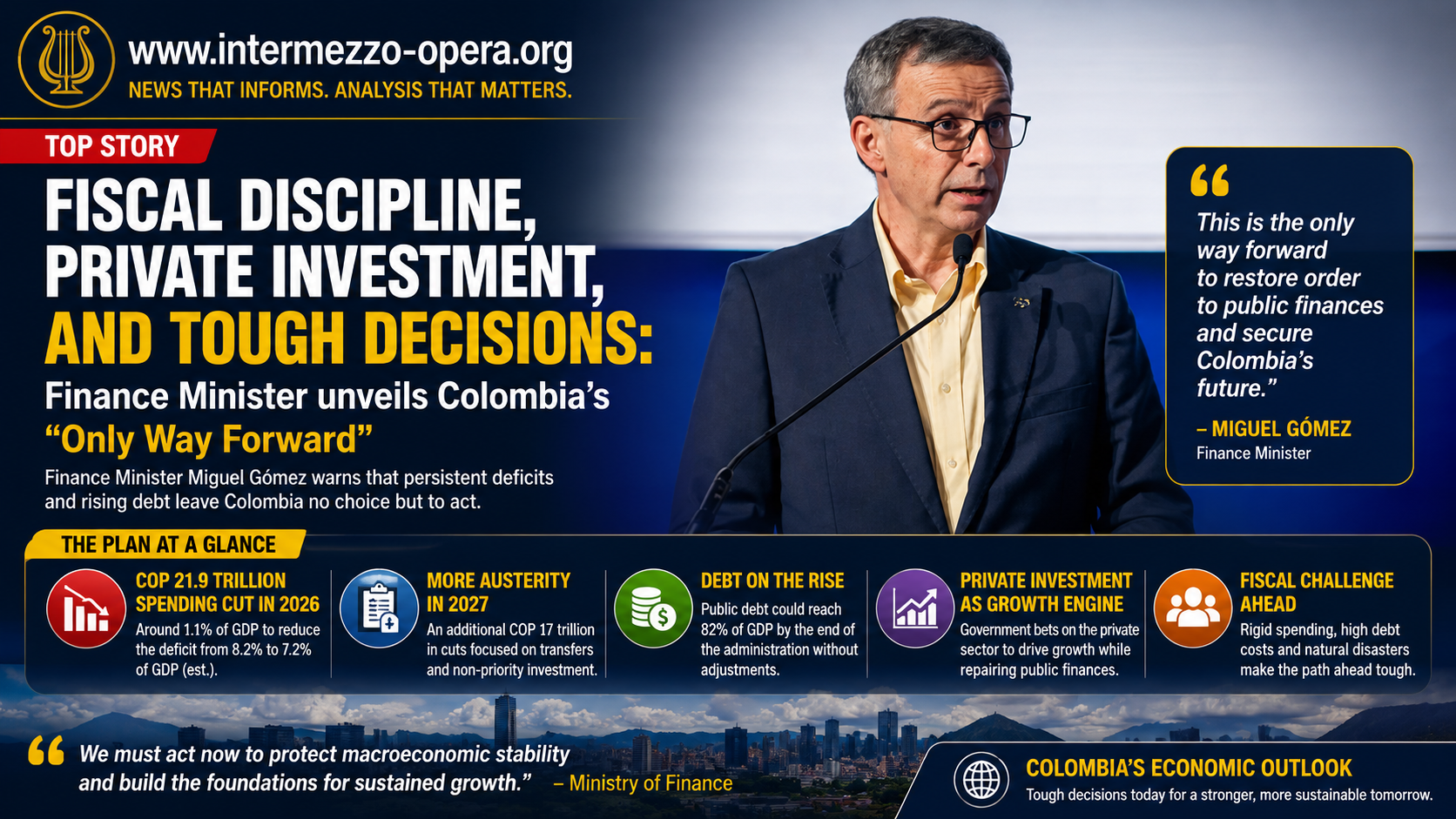
BOGOTÁ — Colombia’s Ministry of Finance has laid out a stark assessment of the country’s public finances, warning that persistent deficits, growing debt obligations and rigid government spending have left little room for gradual solutions. Finance Minister Miguel Gómez has described the proposed adjustment as “El camino obligado,” or “The Only Way Forward.”
The strategy begins with significant reductions in public expenditure. At the same time, the government wants private investment to play a larger role in supporting economic growth.
According to Gómez, restoring order to public finances has become essential for Colombia’s medium-term economic stability.
Colombia’s Fiscal Outlook Raises Alarm
The Finance Ministry’s diagnosis focuses heavily on the primary balance of the Central National Government.
This indicator measures government revenue against expenditure before interest payments on debt.
According to Gómez, Colombia’s primary balance has become chronically negative. Therefore, the government continues to spend more than it collects even before accounting for debt interest.
The ministry considers this trend difficult to sustain.
Without corrective measures, Gómez warned that public debt could climb to approximately 82% of GDP by the end of the current administration.
That projection represents a no-adjustment scenario rather than an inevitable outcome.
For this reason, the government is presenting fiscal consolidation as an urgent priority.
COP 21.9 Trillion Spending Cut Announced
The first major step involves a COP 21.9 trillion reduction in government spending for 2026.
The amount represents approximately 1.1% of GDP. The government expects the measure to reduce the deterioration in this year’s fiscal accounts.
Without adjustments, the new economic team estimates that the Central National Government deficit could reach about 8.2% of GDP in 2026.
With the announced spending measures, the government aims to bring that figure closer to 7.2% of GDP.
However, this would still represent a large fiscal deficit.
Therefore, the 2026 spending reduction is being presented as the beginning of a broader adjustment rather than a complete solution.
More Austerity Planned for 2027
Fiscal consolidation is also expected to continue next year.
The government strategy includes approximately COP 17 trillion in additional austerity measures for 2027.
These measures are expected to focus mainly on lower transfers and reductions in investment considered non-priority.
The government is also preparing a fiscal law focused primarily on controlling expenditure.
Gómez has indicated that the administration does not want to rely primarily on additional taxation to solve the imbalance.
Instead, expenditure reform will play a central role.
That approach makes the composition of government spending particularly important.
2027 Budget Exposes the Size of the Challenge
The proposed 2027 national budget totals COP 634.9 trillion, highlighting the scale of Colombia’s fiscal commitments.
Despite the government’s austerity message, the proposed budget is roughly COP 59.3 trillion larger than the previous initiative and COP 88 trillion above the 2026 budget.
This apparent contradiction has already generated political debate.
However, a significant part of the increase reflects debt-service requirements and obligations that the new government says were insufficiently funded.
Without corrective action, the Finance Ministry estimates that the Central National Government deficit could reach 9.4% of GDP in 2027, equivalent to around COP 200.4 trillion.
That estimate is substantially higher than the 4.5% previously projected in the Medium-Term Fiscal Framework.
Debt Has Become a Central Concern
Colombia’s debt burden adds another layer of pressure.
Data reported earlier this year showed gross Central National Government debt reaching approximately COP 1,169 trillion in May 2026, equivalent to about 60.6% of projected GDP.
Interest payments are also absorbing substantial public resources.
As debt costs rise, the government has less flexibility to finance investment and other priorities without generating additional revenue or reducing expenditure.
Moreover, refinancing needs create another challenge.
Colombia relies heavily on domestic government bonds, known as TES, to finance its obligations.
Gómez said that when he arrived at the ministry, 97% of the planned TES issuance had already been used within seven months.
That situation illustrates the limited financial room available to the new economic team.
Government Spending Is Difficult to Reduce Quickly
Cutting expenditure is easier to announce than to implement.
A substantial share of Colombia’s public spending is tied to commitments that cannot be eliminated immediately.
These include pensions, government payrolls, regional transfers and debt-service obligations.
Consequently, large reductions can place greater pressure on investment spending and other more flexible areas of the national budget.
This structural rigidity helps explain why the Finance Ministry describes the adjustment as difficult but necessary.
It also means the government will have to decide carefully which programmes can absorb spending reductions without creating larger economic or social problems.
Private Investment Expected to Drive Growth
Another important element of “El camino obligado” is the government’s approach to economic growth.
Gómez has told the financial sector that the state will focus on repairing public finances while businesses and banks must help generate investment and economic expansion.
This represents a significant policy signal.
The government does not expect additional public spending to become the main engine of economic growth while fiscal consolidation is underway.
Instead, officials want greater private-sector participation.
The strategy is expected to be reinforced through the National Development Plan, including incentives for private investment and proposals to reorganize parts of the state.
Investment Remains a Macroeconomic Weakness
Colombia also faces challenges beyond the government budget.
Investment has remained relatively weak, limiting the economy’s capacity to expand over the longer term.
Gómez recently described investment at around 17% of GDP, while warning about the difficult combination of fiscal pressure and limited room for faster growth.
Increasing productive investment will therefore be essential.
If fiscal consolidation reduces public demand while private investment remains weak, economic growth could face additional pressure.
On the other hand, stronger business investment could help compensate for lower government expenditure.
That balance will be one of the central tests of the government’s strategy.
Fiscal Adjustment Comes After a Major Earthquake
The economic challenge has become more complicated following the major earthquake that struck Colombia in August.
The disaster created additional reconstruction needs precisely when the government was attempting to control expenditure.
Banks provided approximately COP 1.1 trillion in financial relief for people affected by the earthquake, according to Gómez’s remarks at the banking convention.
The government has consequently called on financial institutions and businesses to participate actively in reconstruction.
This adds another difficult equation.
Colombia must repair infrastructure and support affected communities while simultaneously attempting to reduce its fiscal deficit.
The Primary Deficit Is at the Heart of the Problem
Although debt receives significant attention, the government’s diagnosis emphasizes a deeper issue.
Colombia needs to improve the relationship between recurring revenue and recurring expenditure.
A persistent primary deficit means borrowing is required not only to service existing debt but also to cover the gap between ordinary government income and spending.
Over time, that dynamic can increase debt further.
For the Finance Ministry, reversing this trend is therefore essential.
The immediate spending cuts are intended to begin that process.
However, a durable improvement will require changes extending beyond a single annual budget.
Political Debate Over the Adjustment Has Begun
The government’s fiscal plans are already generating debate in Congress.
Some lawmakers have expressed concern that the 2027 budget still contains too much expenditure relative to available revenue.
Others question whether austerity could reduce social investment or redirect too much public money toward debt obligations.
These competing concerns will become increasingly important as lawmakers examine the budget.
Reducing the deficit requires restraint.
However, excessive cuts could also weaken investment, public services or economic activity.
The challenge for the Finance Ministry will be finding a balance between fiscal credibility and economic stability.
“The Only Way Forward” Sets Colombia’s Economic Direction
The phrase “El camino obligado” summarizes the government’s argument: Colombia no longer has enough fiscal space to postpone difficult decisions.
The plan combines immediate expenditure reductions, additional austerity in 2027, greater reliance on private investment and longer-term reform of government spending.
Its success will depend on several factors.
The government must control the deficit without severely weakening growth. Meanwhile, private investment must recover enough to support economic activity.
Debt dynamics will also remain critical.
For now, the Finance Ministry’s assessment shows an economy facing a demanding fiscal transition.
The COP 21.9 trillion spending cut marks the first concrete step. Yet the larger challenge will be transforming that emergency adjustment into a sustainable fiscal path for Colombia.


Happy
0 %

Sad
0 %

Excited
0 %

Sleepy
0 %

Angry
0 %

Surprise
0 %
Related Post
Spain Moves to Curb Temporary Public Jobs as Government Identifies 200,000 Long-Term Interim Workers
MADRID – The Spanish government is preparing new measures to curb temporary public employment, as…