Uruguay’s Political Dialogue Tested as National Party Delays Meeting With President Orsi
 0
0
 0
0
Read Time:6 Minute, 15 Second
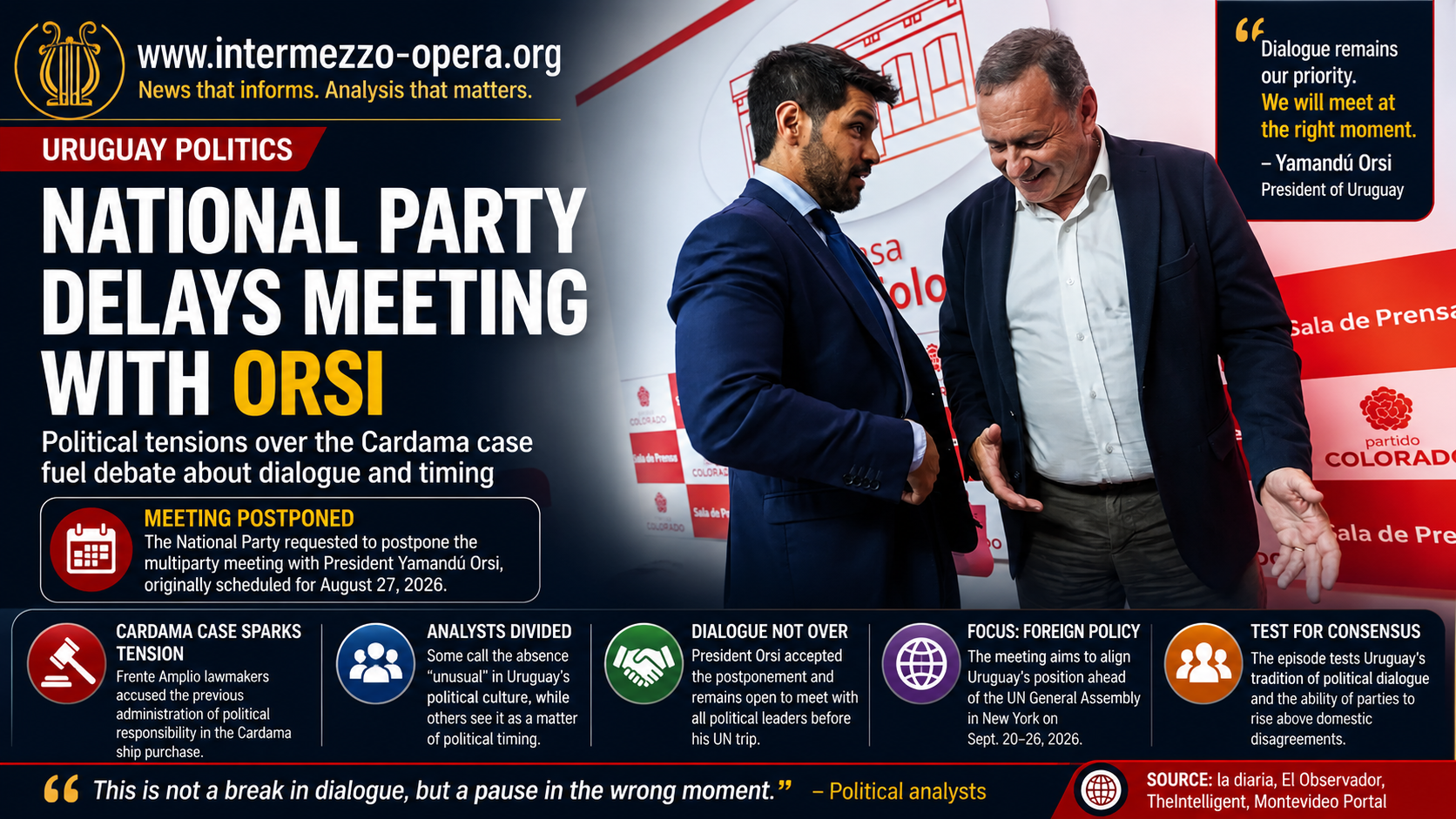
MONTEVIDEO — Uruguay’s tradition of dialogue between government and opposition has come under scrutiny after the Partido Nacional requested the postponement of a multiparty meeting called by President Yamandú Orsi. The decision followed growing political tensions over the Cardama case and criticism directed at former president Luis Lacalle Pou.
The meeting was intended to bring political leaders together before Orsi travels to New York for the United Nations General Assembly in September. However, the National Party argued that the political climate was not appropriate for the talks.
Political analysts have offered different interpretations of the decision. While some consider the absence unusual in Uruguay’s political culture, others see it mainly as a question of timing.
National Party Postpones Meeting With Orsi
The controversy began after the Frente Amplio presented its conclusions regarding the parliamentary investigation into the purchase of offshore patrol vessels from Spanish shipyard Cardama.
Government-party lawmakers pointed to political responsibility within the previous administration, particularly that of former president Luis Lacalle Pou. They also said new information with possible criminal implications should be sent to prosecutors.
Those statements angered National Party leaders.
Álvaro Delgado, president of the National Party’s board, subsequently contacted Orsi and requested that the planned meeting be postponed.
The meeting had originally been scheduled for Thursday, August 27.
Orsi accepted the request and postponed the gathering without immediately setting another date.
Cardama Case Raises Political Tensions
The Cardama controversy has become an important source of tension between Uruguay’s governing coalition and the opposition.
The dispute centers on the previous administration’s purchase of offshore patrol vessels from Spanish shipyard Cardama.
Following its parliamentary investigation, the Frente Amplio argued that the affair exposed political responsibility in the former government.
The National Party strongly objected to criticism directed at Lacalle Pou.
Consequently, party leaders concluded that conditions were not suitable for a high-level political meeting immediately after those accusations.
Political Scientists Differ Over the Decision
The National Party’s move has also triggered a broader debate about Uruguay’s political traditions.
Political scientists Eduardo Bottinelli, Daniel Chasquetti, Adolfo Garcé, Antonio Cardarello and Federico Irazábal, among others consulted in the debate reported by la diaria, examined the implications of the decision.
Their assessments did not point in exactly the same direction.
For some analysts, declining to participate in a presidential meeting of this kind is highly unusual.
Others stressed that political context matters.
In that interpretation, the National Party has not abandoned institutional dialogue. Instead, it decided that immediately following the Cardama confrontation was not the right moment for the meeting.
Therefore, describing the episode simply as a refusal to talk could exaggerate what happened.
Timing Becomes Central to the Debate
The distinction between rejecting dialogue and postponing dialogue is important.
The National Party requested a delay after the Frente Amplio publicly criticized figures from the previous government.
Meanwhile, Orsi indicated that he still wants the meeting to take place.
On August 27, the president said he hoped to organize the gathering the following week with as many political representatives as possible.
He also indicated that individual meetings remained another possibility.
This supports the argument that the dispute concerns timing as much as political substance.
Orsi Keeps the Door Open
President Orsi did not publicly treat the postponement as a breakdown in relations.
Asked whether the decision had bothered him, he rejected that suggestion and maintained his intention to continue the dialogue.
The president wants to hear different political perspectives before representing Uruguay at the United Nations.
His trip to New York for the 81st session of the UN General Assembly is officially scheduled for September 20–26, 2026.
Foreign policy was therefore the central reason behind the planned meeting.
The initiative itself had originally been proposed by Colorado Party Secretary-General Andrés Ojeda and was welcomed by Orsi.
Uruguay’s Foreign Policy Was Supposed to Unite the Parties
The planned gathering had a broader objective than resolving domestic political disagreements.
Party leaders were expected to exchange views about Uruguay’s international position before Orsi addressed the United Nations.
Supporters of the initiative argued that demonstrating political consensus could strengthen Uruguay’s image abroad.
However, the Cardama dispute quickly became intertwined with that agenda.
As a result, a meeting intended to demonstrate political stability instead highlighted tensions between the government and its main opposition party.
Frente Amplio Questions National Party’s Position
The decision also drew criticism from the governing Frente Amplio.
Senator Daniel Caggiani described it as unusual for the National Party to avoid an opportunity for dialogue.
He argued that discussions about Uruguay’s international position were particularly important because of current global instability.
Caggiani also rejected the reasoning used by the National Party.
From his perspective, political disagreements should not prevent leaders from discussing issues of national importance.
That represents the government coalition’s side of the dispute.
The National Party, meanwhile, maintains that criticism surrounding the Cardama affair created an unsuitable environment for the meeting.
Political Strategy Also Under Scrutiny
The episode has another important dimension: the role of former president Luis Lacalle Pou.
Political scientist Antonio Cardarello told la diaria that Lacalle Pou appears to be positioning himself publicly above everyday party disputes while continuing to exercise considerable influence within the National Party.
That dynamic matters because Lacalle Pou remains an influential figure in the opposition.
Therefore, criticism of his administration can quickly affect relations between the current government and National Party leaders.
The Cardama controversy illustrates that political connection.
A parliamentary investigation into a government contract has developed into a broader confrontation involving accountability, opposition strategy and relations with the Orsi administration.
Colorado Party Faces Its Own Strategic Choice
The situation has also placed attention on the Partido Colorado.
Political scientist Verónica Pérez and other analysts cited in the broader debate have examined how opposition parties position themselves relative to the National Party.
According to political scientist Federico Zeballos, the Colorado Party faced an opportunity to differentiate itself rather than appearing subordinate to the National Party’s political strategy.
This matters because Uruguay’s opposition is not politically uniform.
The parties can cooperate against the Frente Amplio while maintaining separate identities and strategic interests.
Therefore, the dispute is also testing relationships inside the opposition.
Postponement Does Not Mean Dialogue Is Over
Despite the political confrontation, there are signs that negotiations can continue.
Reports indicated that the meeting could be reorganized for the following week and held as a single gathering involving political leaders and President Orsi.
Orsi has also repeatedly signaled his willingness to meet opposition representatives.
For that reason, the current dispute should be understood as a setback to political dialogue rather than its definitive collapse.
The next meeting could show whether the parties can separate disagreements over the Cardama investigation from discussions about Uruguay’s foreign policy.
A Test for Uruguay’s Consensus-Driven Politics
Uruguay has long placed significant value on institutional dialogue between political parties.
That does not eliminate strong disagreements.
However, presidents and opposition leaders frequently maintain communication on issues considered important to the country.
The latest controversy tests that tradition.
For one interpretation, the National Party’s decision represents an unusual political gesture that weakens an opportunity for national consensus.
For another, it is simply a tactical pause during a particularly tense moment.
Either way, the disagreement surrounding the National Party meeting with Orsi has transformed what was supposed to be a foreign-policy consultation into a wider debate about political dialogue, opposition strategy and the limits of consensus in Uruguay.


Happy
0 %

Sad
0 %

Excited
0 %

Sleepy
0 %

Angry
0 %

Surprise
0 %
Related Post
Colombia Elects New CNE: Nine Magistrates Take Office After Last-Minute Political Deals
Bogotá – Colombia’s Congress has elected the nine magistrates who will form the new National…