
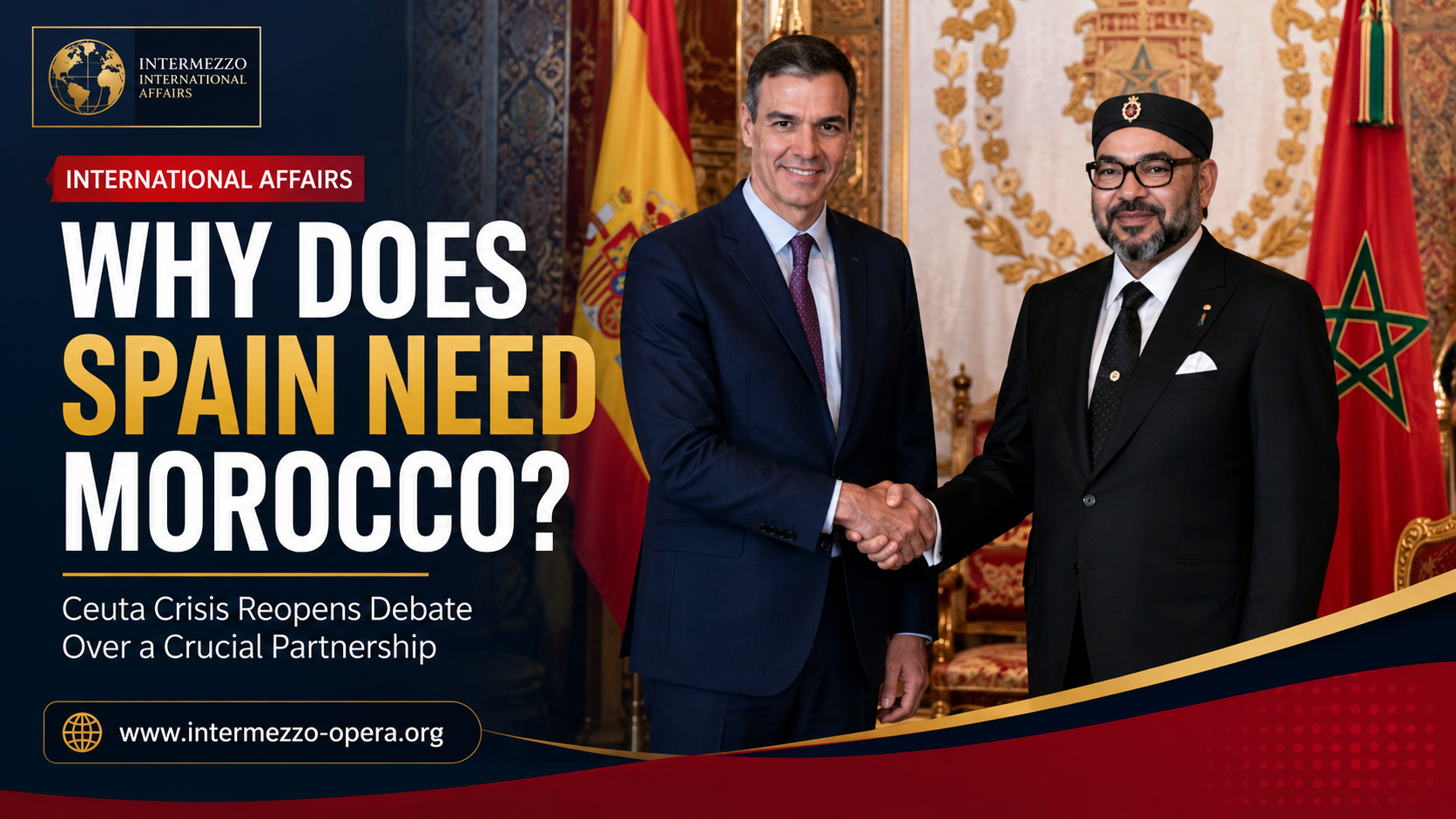
Why Does Spain Need Morocco? Ceuta Crisis Reopens Debate Over a Crucial Partnership
 0
0
 0
0
Read Time:6 Minute, 18 Second
Spain-Morocco relations are once again under intense scrutiny following the extraordinary migration crisis in Ceuta, raising a difficult question in Spanish politics: just how important is Morocco to Spain?
The debate intensified after tens of thousands of people crossed from Morocco into the Spanish autonomous city of Ceuta at the end of July 2026. The unprecedented influx overwhelmed local authorities and placed migration cooperation between Madrid and Rabat under renewed pressure.
Yet reducing the relationship to migration alone would overlook a much broader reality.
Morocco is one of Spain’s closest southern neighbours and an important partner in border management, trade, labour mobility and regional security. Spain’s own Foreign Ministry describes the Maghreb as strategically important because of geographical proximity and extensive economic, cultural and human ties.
Ceuta Crisis Puts Spain-Morocco Relations Under Pressure
The latest controversy stems from the extraordinary events in Ceuta.
A massive number of migrants, many of them young Moroccans, attempted to enter the Spanish territory in a short period. Spanish authorities were forced to respond to an emergency that placed enormous pressure on the relatively small autonomous city.
Morocco later argued that Spain should have anticipated the consequences of a Spanish court ruling that restricted immediate returns in certain circumstances.
A senior Moroccan official rejected accusations that Rabat deliberately relaxed border controls. Instead, Morocco blamed trafficking networks for exploiting perceptions created by the court decision.
Meanwhile, questions emerged in Spain and elsewhere in Europe about the reliability of Morocco as a migration partner.
That debate has revived a familiar question: can Spain protect its interests without maintaining close cooperation with Rabat?
Geography Makes Morocco Impossible for Spain to Ignore
The first answer is geography.
Spain and Morocco are separated by the Strait of Gibraltar. Moreover, the Spanish autonomous cities of Ceuta and Melilla are located on the North African coast and share land borders with Morocco.
Therefore, developments in Morocco can quickly have consequences for Spain.
Migration is perhaps the clearest example. However, the same geographical reality affects maritime security, organised crime, transportation and commercial activity.
Spain’s Foreign Ministry considers the Maghreb a priority region for Spanish foreign policy. It specifically identifies migration and regional security as challenges requiring cooperation with Morocco and other North African countries.
Migration Cooperation Remains Crucial
Migration is one of the most sensitive elements of Spain-Morocco relations.
Morocco is both a country of origin and an important transit route for migrants seeking to reach European territory.
Consequently, cooperation between Spanish and Moroccan security authorities has become an important component of border management.
According to Moroccan authorities, around 24,000 security personnel are deployed along the country’s northern coast. Morocco also says its forces prevented more than 150,000 attempted irregular crossings during the previous two years.
Those figures help explain why developments in Moroccan border enforcement matter directly to Spain.
When cooperation works effectively, migration pressure can be reduced. When that cooperation is disrupted, Ceuta and other routes can experience significantly greater pressure.
The Relationship Goes Beyond Irregular Migration
However, Spain does not cooperate with Morocco exclusively to prevent irregular migration.
Legal and circular migration has become another important part of bilateral relations.
More than 25,000 workers from 17 countries participated in Spain’s circular migration programmes during 2025, according to Spain’s Ministry of Inclusion, Social Security and Migration. Morocco plays a particularly important role in this system.
Spain, France and Morocco also agreed to launch WAFIRA II for 2026–2028.
The programme is designed to support approximately 3,000 Moroccan workers, primarily women, participating in seasonal employment in Spain and France while providing support for their eventual return and economic reintegration.
Therefore, the migration relationship has two very different dimensions: preventing irregular crossings while creating regulated pathways for workers.
Moroccan Workers Are Important to Spain
The economic connection is also visible inside Spain itself.
According to Spain’s Ministry of Inclusion, Morocco represents the largest nationality group among foreign workers registered with Spanish Social Security, with more than 365,000 contributors reported during a high-level bilateral meeting in late 2025.
Moroccan workers are present across several parts of the Spanish economy.
Agriculture is particularly important because seasonal labour programmes help employers meet workforce demand during major harvest periods.
Therefore, discussions about Morocco cannot be separated entirely from Spain’s domestic labour market.
Millions Cross Between Europe and Morocco
Another illustration of the relationship is the annual Operación Paso del Estrecho, known on the Moroccan side as Operation Marhaba.
Spain and Morocco coordinate the operation to manage the enormous summer movement of travellers between Europe and North Africa.
For 2026, Spanish and Moroccan officials prepared for another potentially record-breaking season, expecting more than 3.5 million travellers to pass through the system.
Authorities from both countries coordinate traffic, ports, security, emergency services and communication.
This is an important reminder that the relationship involves millions of ordinary travellers in addition to governments and security agencies.
But Cooperation Creates Political Vulnerabilities
Close cooperation also produces vulnerabilities.
The Ceuta crisis demonstrated how quickly migration can become a political problem.
When thousands of people suddenly reach Spanish territory, questions naturally arise over whether existing border agreements are effective and whether Spain has become excessively dependent on Moroccan cooperation.
The European Commission has also warned against using migration as political leverage. Meanwhile, Moroccan authorities have rejected allegations that they deliberately facilitated the latest crossings.
These competing claims are important.
Without conclusive evidence, it would be inaccurate to state as fact that Morocco intentionally created the latest migration crisis.
However, the episode clearly exposed the strategic risks created when border management depends heavily on cooperation between neighbouring governments.
Spain Also Needs Strategic Autonomy
For Madrid, therefore, the issue is not simply whether Spain “needs” Morocco.
A more useful question is how Spain can cooperate with Morocco while retaining enough independence to respond when their interests diverge.
Spain can strengthen surveillance around Ceuta and Melilla, improve coordination with European institutions and expand cooperation with other countries of origin and transit.
At the same time, completely disengaging from Morocco would be extremely difficult.
Geography cannot be changed.
Neither can the extensive economic, social and human connections that have developed across the Strait of Gibraltar.
Morocco Needs Spain Too
The relationship should also not be viewed as one-sided.
Morocco has significant reasons to maintain stable relations with Spain.
Spain provides access to European markets and is an important economic and political partner. Legal migration programmes also create employment opportunities for Moroccan citizens.
Meanwhile, cooperation with Spain can strengthen Morocco’s relationship with the wider European Union.
Therefore, Madrid possesses leverage of its own.
The relationship is better understood as mutual dependence with periodically conflicting interests, rather than Spain simply relying on Morocco.
Ceuta Has Changed the Political Conversation
Nevertheless, the 2026 Ceuta crisis has changed the tone of the debate.
Questions surrounding migration management, border security and responsibility are likely to remain politically sensitive.
Spain now faces the challenge of determining how much cooperation is necessary without allowing that cooperation to become a strategic weakness.
Morocco, meanwhile, has an interest in demonstrating that it remains a predictable partner in migration management and regional security.
The answer to “Why does Spain need Morocco?” is therefore complicated.
Spain needs cooperation with Morocco because the two countries share geography, migration routes, economic interests and security challenges. But Morocco also benefits significantly from its relationship with Spain.
The challenge after Ceuta is not to eliminate that partnership. It is to make Spain-Morocco relations resilient enough to survive the inevitable disagreements between two neighbours whose interests overlap but do not always coincide.


Happy
0 %

Sad
0 %

Excited
0 %

Sleepy
0 %

Angry
0 %

Surprise
0 %
Related Post
Uruguay Says No Concrete Deal With US on Deportees, Lubetkin Prioritizes Detained Uruguayans
Uruguay-US deportation talks have not developed into a concrete negotiation, Foreign Minister Mario Lubetkin said,…